
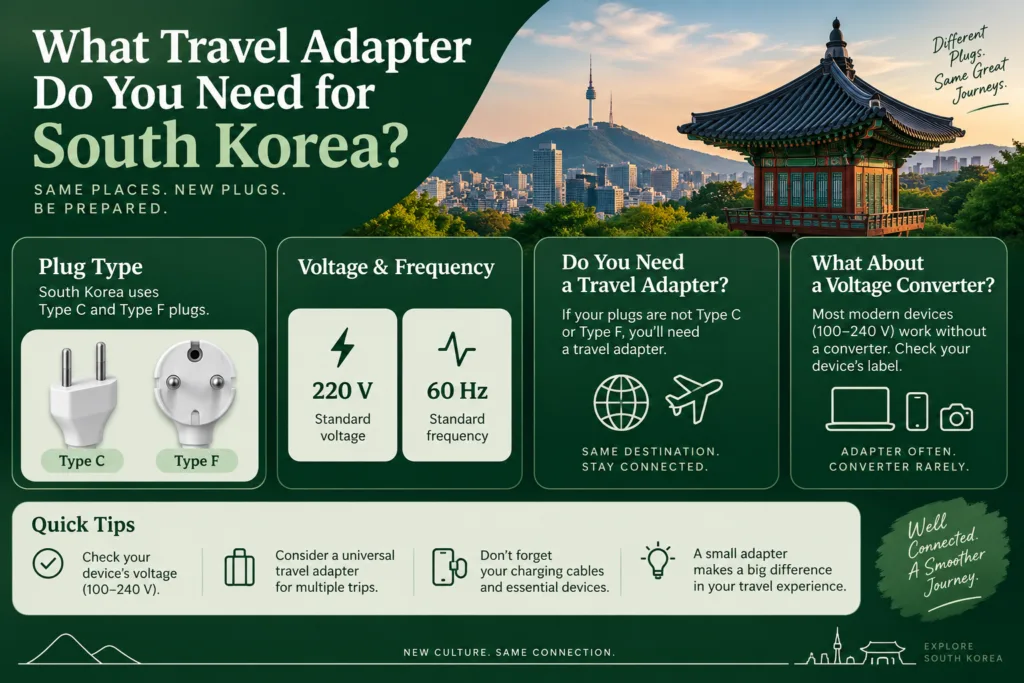
South Korea uses 220V electricity at 60Hz and European-style outlets with two round openings, commonly classified as Type C and Type F. Travelers bringing Type A/B plugs from the United States, Canada, or Japan; Type G plugs from the UK, Ireland, Singapore, or Malaysia; or Type I plugs from Australia and New Zealand will normally need a travel adapter. Travelers whose devices already use compatible Type C or Type F plugs may not need a plug-shape adapter.
The plug is only half of the decision. A charger marked Input: 100–240V ~ 50/60Hz can usually use South Korean mains power without a voltage converter, while a 100V-, 110V-, or 120V-only device needs a separate voltage check before it is connected to a 220V outlet.
Choose the Adapter by the Plug You Are Bringing
| Traveling from | Typical plug | Adapter for South Korea? | Electrical check |
|---|---|---|---|
| United States / Canada | Type A / B | Yes | South Korea is 220V, so check that the device accepts 220V or a range such as 100–240V. |
| Japan | Type A / B | Yes | Japan’s 100V equipment should not be assumed to work directly on 220V. |
| United Kingdom / Ireland | Type G | Yes | Many 220–240V devices are suitable for the voltage, but check frequency support. |
| Australia / New Zealand | Type I | Yes | Check the label for 220–240V and 60Hz or 50/60Hz support. |
| Singapore / Malaysia / Hong Kong | Usually Type G | Yes | The plug differs even when the device is designed for a similar voltage range. |
| Much of mainland Europe | Type C / E / F | Often not | Physical compatibility is often straightforward, but South Korea uses 60Hz rather than the 50Hz used across much of Europe. |
| Turkey | Type C / F | Usually not | Plug shape and voltage are generally close matches; check 60Hz compatibility where the device is frequency-sensitive. |
If your country uses several plug designs, check the actual plug on the charger or appliance rather than choosing only by country name.
What South Korean Power Outlets Look Like
South Korean outlets use the familiar European two-round-pin layout. Type C is the slimmer, ungrounded two-pin format. Type F, often called Schuko, also uses two round pins but adds grounding contacts at the sides. Type F-style sockets are commonly recessed into the wall and can accept compatible two-pin Type C plugs.
For a non-European plug, look for an adapter designed for South Korean or European Type C/F outlets. If the device originally uses a grounded plug, choose an adapter that preserves grounding rather than reducing the connection to an ungrounded two-pin plug.
South Korea’s 220V / 60Hz Combination Changes the Device Check
The unusual detail for travelers is not the 220V supply by itself. It is the combination of 220V and 60Hz. The outlet resembles those used across much of continental Europe, but much of Europe operates at 50Hz. South Korea uses 60Hz.
This creates different decisions depending on where the device came from. A US device may already be designed for 60Hz but still have the wrong voltage. A European device may be comfortable with the voltage range and plug shape but still need a frequency check.
Input: 100–240V ~ 50/60Hz
This is the easiest travel setup. The power supply covers South Korea’s voltage and frequency. If the plug itself does not fit, you normally need only the appropriate plug adapter.
Input: 220–240V ~ 50/60Hz
The listed voltage and frequency include South Korean mains power. The remaining question is whether the plug fits the local outlet and whether any required grounding is maintained.
Input: 220–240V ~ 50Hz
The voltage range may fit, but the label does not state 60Hz operation. Check the device manual or manufacturer guidance before using equipment that depends directly on mains frequency.
100V, 110V or 120V only
Do not connect it to a South Korean 220V outlet using only a plug adapter. The device may require a properly rated voltage converter or transformer, or a different 220V-compatible device.
The relevant rating is usually printed beside INPUT on the charger, AC adapter, power brick, appliance body, or charging base. A USB-C connector does not by itself prove international voltage compatibility; the wall charger still needs the correct input rating.
From the US or Canada: Adapter Yes, Converter Depends on the Device
Type A and Type B plugs used in the United States and Canada do not normally fit South Korea’s round-pin outlets, so a plug adapter is needed.
Voltage deserves more attention. North American mains power is around 120V, while South Korea supplies 220V. If a phone, tablet, laptop, camera, or USB charger says 100–240V, 50/60Hz, it normally does not need a voltage converter. The adapter changes only the plug connection.
A 120V-only appliance is a different case. Making its plug fit the wall does not make it suitable for 220V. Do not connect a single-voltage 120V appliance directly unless its manufacturer instructions allow the setup being used.
From Japan: The Plug and Voltage Both Need Attention
Japanese Type A plugs may look familiar to North American travelers, but they do not normally fit South Korea’s round-pin sockets. An adapter is therefore needed.
The larger issue is voltage. Japan uses 100V equipment, while South Korea uses 220V. A Japanese charger marked 100–240V can usually handle the Korean supply, but a device marked only for 100V should not be treated the same way. Check the label before plugging it in.
From Europe: Your Plug May Fit, but 60Hz Is the Detail to Check
Travelers bringing compatible Type C or Type F plugs from much of continental Europe may be able to plug directly into South Korean outlets without a travel adapter. Many modern European chargers also cover a 220–240V input range.
The part that should not be assumed is frequency. South Korea uses 60Hz, while much of Europe uses 50Hz. Chargers explicitly marked 50/60Hz are designed for both. Equipment marked only 50Hz deserves a closer look, especially if it uses a mains-powered motor, pump, timer, clock mechanism, or another component whose operation can depend on frequency.
The same point applies to travelers from Turkey: the familiar round-pin plug and similar voltage make the physical connection easy, but a 50Hz-only appliance should still be checked for 60Hz operation.
Hair Dryers and Other High-Power Appliances Need a Separate Decision
Hair dryers, curling irons, straighteners, steamers, travel irons, and similar heat appliances should not be treated like phone chargers. Their power draw is much higher, and single-voltage versions are common.
A dual-voltage appliance may show a range such as 110–240V or may have a manual 120V/240V selector. If there is a selector, it needs to be set according to the manufacturer’s instructions before the appliance is connected.
If the appliance is rated only for 100–120V, a small plug adapter is not enough. A voltage converter would need to support the appliance’s electrical load and operating requirements. For a high-watt device, using a locally suitable 220V appliance or a genuinely dual-voltage travel model is often simpler than trying to adapt a single-voltage one.
Grounding Matters When Choosing Between a Simple Two-Pin Adapter and Type F
A compact two-pin adapter can be suitable for devices that do not use protective grounding, such as many small double-insulated chargers. It should not automatically replace a grounded connection.
If your original plug has an earth or ground connection, use an adapter designed to carry that grounding into a compatible Type F socket. A travel adapter that physically accepts a grounded home plug but provides only two ungrounded pins on the wall side does not preserve the original grounding arrangement.
This is also a reason to look beyond labels such as “Europe adapter.” Check the actual wall-side plug, grounding support, electrical rating, and whether the adapter is designed to sit correctly in a recessed Type F-style socket.
Make Sure the Adapter Fits a Recessed Korean Socket
Type F-style wall outlets are recessed rather than completely flat. Most adapters sold for Type F or Schuko sockets are shaped for this, but an unusually bulky or poorly designed adapter may sit awkwardly, especially when a heavy charger is attached.
- Choose an adapter explicitly compatible with Type C/F or Type F-style outlets.
- Use a grounded adapter when the connected device requires grounding.
- Do not use an adapter that feels loose or cannot remain properly seated.
- Stop using an adapter or charger that becomes abnormally hot, damaged, or unstable in the socket.
You Can Buy an Adapter After Arriving in South Korea
If you arrive without the correct adapter, travel adapters are commonly available at airports, retail shops, major duty-free stores, and convenience stores. Hotel front desks may also have adapters available to borrow or purchase.
That availability is useful as a backup, but it does not solve a voltage mismatch. Before using a newly purchased adapter, check the INPUT rating on every device that will be connected to South Korea’s 220V / 60Hz supply.