
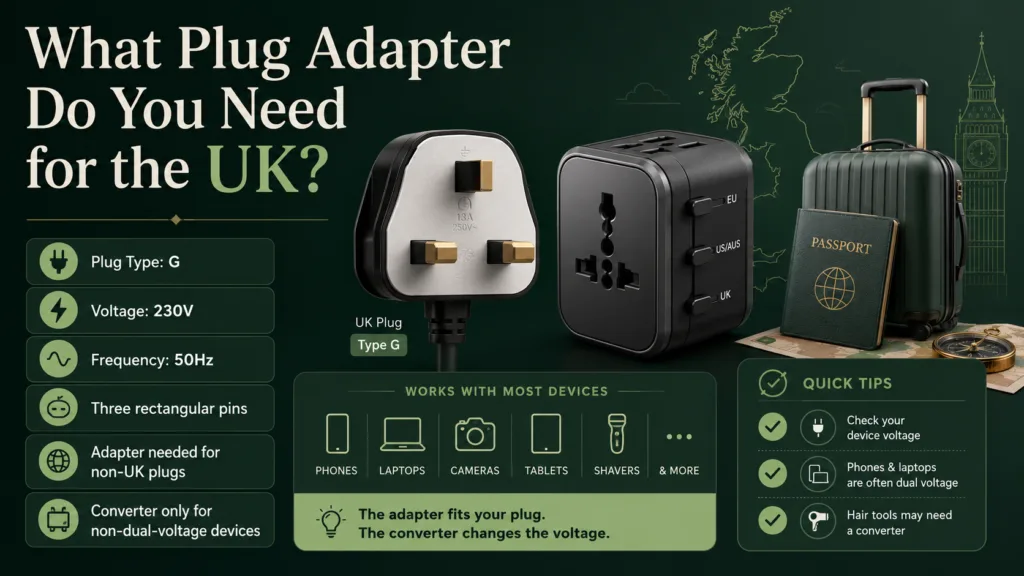
Traveling to the UK? You will usually need a Type G plug adapter if your device plug is not already Type G. The UK commonly uses 230V power at 50Hz, so many phone and laptop chargers work with only a plug adapter, but single-voltage appliances may need a voltage converter.
What UK Outlets Look Like
Destination Adapter Checker for the UK
Use this quick checker to decide what to pack for a trip to the United Kingdom. It is designed for common travel devices, not for industrial equipment or unusual appliances.
United Kingdom
Type G, with three rectangular slots
Usually needed unless your plug is already Type G.
UK power is commonly 230V / 50Hz. Check your device label before plugging in.
A plug adapter does not convert voltage. It only changes the plug shape so your device can fit the UK socket.
Quick Answer: UK Plug Adapter and Voltage
| Question | Practical answer |
|---|---|
| What plug adapter do you need for the UK? | A Type G travel adapter is usually needed if your plug is not already Type G. |
| What outlets are used in the UK? | The UK commonly uses Type G power outlets with three rectangular slots. |
| What voltage is used in the UK? | UK mains power is commonly 230V. |
| What frequency is used in the UK? | The UK commonly uses 50Hz. |
| Do phone chargers work in the UK? | Usually yes, if the charger label says Input: 100–240V. You still need the correct plug adapter. |
| Do you need a voltage converter? | Only if your device is not compatible with UK voltage. High-power appliances need extra caution. |
What Plug Adapter Do You Need for the UK?
For the United Kingdom, the plug adapter most travelers need is a Type G adapter. Type G has three rectangular pins and is used for UK-style sockets.
If you are traveling from the United States, Canada, Mexico, Japan, most of Europe, Australia, New Zealand, or many other countries, your plug will usually not fit directly into a UK wall outlet. In that case, you need a travel adapter that accepts your home plug and fits into a UK Type G socket.
A plug adapter solves only the physical fit problem. It lets the plug go into the socket. It does not make a 120V appliance safe for 230V power.
Always check the device label before using high-power appliances abroad. Hair dryers, curling irons, straighteners, kettles, irons, and other heat-producing devices can be risky if they are not built for the destination voltage.
UK Adapter Safety
Type G shape alone is not enough when choosing a travel adapter. Travel adaptors sold in the UK with a UK plug or socket section should meet BS 8546, and the UK plug section must have the correct dimensions and safety features.
UK product-safety actions in 2026 repeatedly identified problems with plug pin dimensions, safety shutters, and fuses. Check that the adapter fits firmly without forcing it, has intact shutters, provides an earth connection when your device requires one, and has a proper fuse where required. Buy from a reputable retailer and avoid an adapter that feels loose, becomes unusually hot, or shows damage.
What Power Outlets Are Used in the UK?
The UK commonly uses Type G power outlets. These sockets are designed for plugs with three rectangular pins. Many UK sockets also have a switch next to the outlet, so you may need to turn the socket on after plugging in your device.
In hotels, airports, and newer buildings, you may also see USB charging ports or international-style outlets. Do not depend on them being available. For packing, assume you need a Type G travel adapter.
Countries and areas where a UK-style adapter may also be useful
Type G is associated with the UK and is also used in several other destinations. Outlet types can vary by place, building, or older installation, so check your exact destination when traveling beyond the UK.
- United Kingdom
- Ireland
- Malta
- Singapore
- Malaysia
- Hong Kong
- United Arab Emirates
Other outlet types may also appear in some places, especially in hotels or older buildings.
Adapter Advice from Common Home Countries
You will usually need a Type A/B to Type G plug adapter. Your phone or laptop charger may work on UK voltage if the label says Input: 100–240V.
You will usually need a Type C/E/F to Type G plug adapter. Many small chargers are compatible with 230V, but the plug shape is different.
You will usually need a Type I to Type G plug adapter. Voltage is often less of a problem for many devices, but the plug shape is not the same.
You will usually need a Type A/B to Type G plug adapter. Voltage is the main thing to check carefully, especially for single-voltage appliances.
UK Voltage and Frequency: What to Check
The UK commonly uses 230V electricity at 50Hz. This matters because some countries use lower voltage, such as around 100V or 120V, while many others use around 220V to 240V.
Frequency is also part of the power system. The UK uses 50Hz, while some countries use 60Hz. Most modern phone chargers, laptop chargers, camera chargers, and USB power supplies handle both 50Hz and 60Hz. Some motor-based or timing-sensitive devices may be more sensitive, so check the device label or manual when needed.
How to read the device label
Look for the word Input on the charger, power brick, or device body. A travel-friendly label commonly looks like this:
Input: 100–240V, 50/60Hz
If your device shows that range, it is usually designed to work in the UK with the correct Type G plug adapter. If the label says only 110V, 120V, or another single-voltage rating that does not include 230V, a plug adapter alone is not enough.
Plug Adapter vs Voltage Converter
A travel adapter and a voltage converter do different jobs. Mixing them up is one of the most common travel power mistakes.
| Item | What it does | What it does not do |
|---|---|---|
| Plug adapter | Changes the plug shape so it fits a UK Type G outlet. | Does not convert voltage. |
| Voltage converter | Changes voltage for devices that are not compatible with destination voltage. | Does not guarantee every appliance is safe; wattage and device type still matter. |
| Dual-voltage charger | Accepts a wide input range such as 100–240V. | Still needs a plug adapter if the plug shape does not fit. |
For many travelers, a dual-voltage charger plus a Type G plug adapter is enough. For single-voltage heat appliances, the answer is more cautious.
Device Guidance for the UK
Phone chargers
Most modern phone chargers are designed for international travel. Check the tiny print on the charger. If it says Input: 100–240V, it will usually work in the UK with a Type G plug adapter.
Laptop chargers
Laptop power bricks commonly support 100–240V and 50/60Hz. Check the charger brick, not just the laptop. If the label supports the UK voltage range, you usually only need the correct plug adapter.
Camera chargers and USB chargers
Camera battery chargers, USB-C chargers, and small electronics chargers are often dual voltage, but not always. The device label is the deciding point.
Electric shavers and toothbrushes
Some electric shavers and toothbrush chargers support global voltage, while others are made for one region. Bathroom shaver sockets can vary, so do not assume every hotel bathroom outlet works like a normal wall socket.
CPAP machines
Many CPAP machines use external power supplies that may support 100–240V, but this is not something to guess. Check the CPAP power brick and any manufacturer travel notes. If the power supply supports UK voltage, you will usually need a Type G adapter for the plug shape.
Hair dryers, curling irons, and straighteners
These are high-power appliances. They draw much more power than a phone charger and can overheat, trip protection, or fail if used with the wrong voltage. If the label does not clearly support 230V, do not use the device with only a plug adapter.
| Device | Adapter needed? | Converter needed? | What to check |
|---|---|---|---|
| Phone charger | Usually yes, Type G | Usually no if dual voltage | Look for Input: 100–240V |
| Laptop charger | Usually yes, Type G | Usually no if dual voltage | Check the charger brick |
| Camera charger | Usually yes, Type G | Usually no if dual voltage | Check input voltage and frequency |
| Electric shaver | Usually yes, Type G | Depends on rating | Check device or charging base label |
| CPAP machine | Usually yes, Type G | Depends on power supply | Check power brick and travel instructions |
| Hair dryer | Usually yes, Type G | May be needed if single-voltage | Check voltage and wattage carefully |
| Curling iron or straightener | Usually yes, Type G | May be needed if single-voltage | Look for 100–240V or dual-voltage marking |
What to Pack for UK Power Outlets
- Type G plug adapter for your chargers and small electronics.
- A charger that clearly says Input: 100–240V if you plan to use it internationally.
- A compact USB charger if you charge several devices, after checking its voltage label.
- The original charger for important devices such as laptops, cameras, medical devices, and CPAP machines.
- A safer plan for high-power appliances, such as using a dual-voltage travel model or local appliance instead of guessing.
Do not pack only a plug adapter for a single-voltage appliance. If the device is not rated for 230V, the UK socket shape is only one part of the problem.
Common UK Travel Power Mistakes
Assuming the adapter changes voltage
This is the main mistake. A plug adapter does not convert voltage. It only helps your plug fit the wall outlet.
Checking the device, but not the charger
For laptops, cameras, and some medical devices, the power brick or charger label is often more important than the device body. Check the part that plugs into the wall.
Using high-power appliances without checking the label
Hair dryers, curling irons, straighteners, kettles, and irons need more care. A small travel adapter may fit the plug, but that does not mean the appliance is safe on UK voltage.
Depending on hotel USB ports
Some hotels have USB ports, but availability and charging speed vary. Bring your own compatible charger and Type G adapter.