
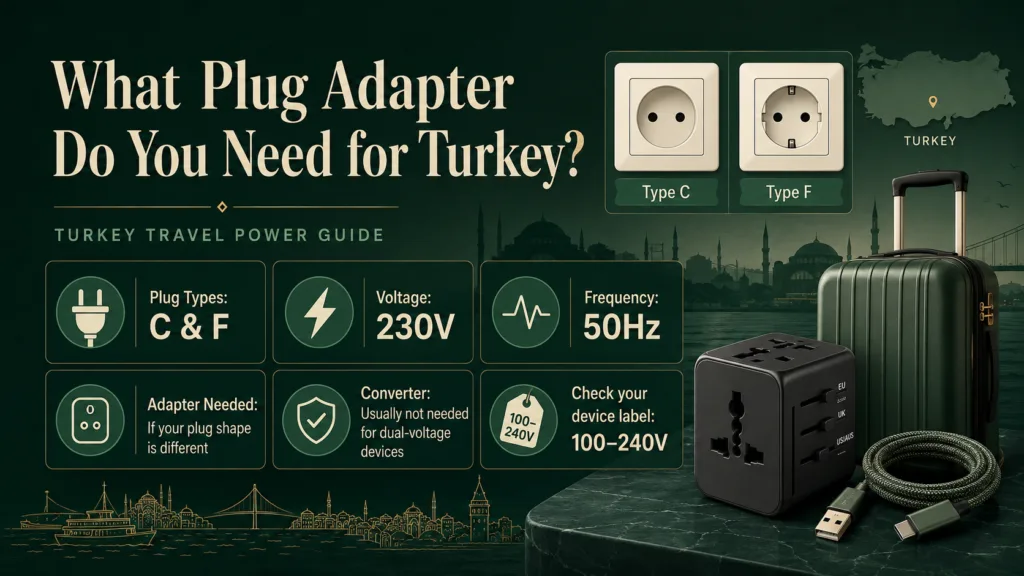
What the Outlets in Turkey Look Like
For Turkey, most travelers need a plug adapter that fits Type C or Type F outlets. Turkey commonly uses round-pin European-style sockets, with a standard supply of 230V and 50Hz. Your exact need depends on where you are traveling from and what device you plan to plug in.
Destination Adapter Checker for Turkey
Use this simple checker to decide what to pack before traveling to Turkey.
Turkey
Type C and Type F are commonly used.
You will usually need a Turkey plug adapter if your plug is not Type C, Type E, or Type F compatible.
A plug adapter does not convert voltage. It only changes the plug shape so your device can fit the wall outlet. For voltage safety, check your device label before plugging it in.
Quick Answer
| Item | Turkey Travel Power Details |
|---|---|
| Common plug types | Type C and Type F |
| Common outlet shape | Two round holes; Type F also has side grounding clips |
| Voltage | 230V |
| Frequency | 50Hz |
| Plug adapter needed? | Usually yes if your home plug is Type A, Type B, Type G, Type I, Type L, or another non-European shape |
| Voltage converter needed? | Only if your device is not rated for 220–240V or Input: 100–240V |
| Best device advice | Phones and laptops are usually low-risk with the right charger label; heat appliances need more caution |
What Plug Adapter Do You Need for Turkey?
For Turkey, pack a travel adapter that supports Type C and Type F outlets. Type C has two round pins. Type F also uses two round pins, but it includes side grounding clips. Many European-style adapters work in Turkey, but the safest choice is an adapter clearly listed for Type C or Type F sockets.
If you are traveling from the United States, Canada, Mexico, Japan, the United Kingdom, Ireland, Australia, New Zealand, Singapore, or many other countries with different plug shapes, your plug will usually not fit directly into Turkish wall outlets.
If you are traveling from much of mainland Europe, your plugs may already fit, especially if you use Type C, Type E, or Type F plugs. Even then, check the shape of grounded plugs before assuming they will work everywhere.
What Power Outlets Are Used in Turkey?
Turkey commonly uses European-style round-pin outlets. In hotels, apartments, airports, and homes, the most common socket you are likely to see is Type F, with Type C compatibility often present for low-power two-pin plugs.
Type C is the simple two-round-pin plug often used for small chargers and low-power devices. It is usually ungrounded.
Type F is a grounded round-pin socket with side clips. It is common in Turkey and many nearby European countries.
Outlet types can vary by building, especially in older properties or unusual locations. A compact travel adapter that covers both Type C and Type F is the practical choice.
Do You Need a Voltage Converter in Turkey?
Turkey uses 230V. Whether you need a voltage converter depends on your device, not only your country.
If your device label says Input: 100–240V, it is usually designed to work across common international voltage ranges. In that case, you normally only need the correct plug adapter for Turkey.
If your device label says only 120V, 110V, or a narrow range that does not include 220–240V, do not plug it directly into a Turkish outlet. A plug adapter would only make the plug fit; it would not make the voltage safe.
Always check the device label before using high-power appliances abroad. Hair dryers, curling irons, straighteners, clothes irons, kettles, and other heat devices can draw a lot of power and may not be suitable for a small travel converter.
How to Read Your Device Label
Before packing, look for the small text on your charger, power brick, or appliance. It is usually printed near the plug, on the power supply, or on the device body.
If the Label Says Input: 100–240V
This means the device is usually dual voltage or multi-voltage. Phones, tablets, laptop chargers, camera chargers, and many USB-C chargers often fall into this group. For these devices, a plug adapter is usually enough for Turkey.
If the Label Says 120V Only
This means the device is made for lower-voltage systems and may not be safe to use directly in Turkey. You may need a proper voltage converter, or it may be better to leave the device at home and use a travel-ready alternative.
If the Label Mentions 50Hz or 60Hz
Turkey uses 50Hz. Many chargers marked 50/60Hz work in both systems. Some motor-based or timing-based appliances may behave differently if they are designed only for 60Hz, so check the full label and manual when the device matters for health, work, or daily use.
Adapter Advice from Common Home Countries
| Traveling From | Common Home Plug | Adapter for Turkey? | Voltage Note |
|---|---|---|---|
| United States or Canada | Type A / Type B | Usually needed | Check for Input: 100–240V, especially because Turkey uses 230V |
| United Kingdom or Ireland | Type G | Usually needed | Voltage is usually similar, but plug shape is different |
| Australia or New Zealand | Type I | Usually needed | Voltage is usually similar, but plug shape is different |
| Mainland Europe | Type C / E / F | Often not needed | Still check grounded plug shape and device label |
| India | Type C / D / M | May be needed | Type C may fit, but larger round-pin plugs may not |
Phone Charger Guidance for Turkey
Most modern phone chargers are designed for international travel. Check the charger body for Input: 100–240V. If you see that range, your phone charger should usually work in Turkey with the correct plug adapter.
USB chargers still need a wall plug that fits. If your charger has a US, UK, Australian, or other non-European plug, pack a Turkey travel adapter.
Laptop Charger Guidance for Turkey
Laptop power bricks commonly support 100–240V and 50/60Hz. That means many laptops can be used in Turkey with a plug adapter only.
Do not assume this without checking. Some older or specialized power supplies may have narrower input ratings. The safe step is simple: read the input label before plugging in.
Hair Dryer, Curling Iron, and Heat Appliance Warning
Hair dryers, curling irons, straighteners, kettles, steamers, and clothes irons need more care than phone or laptop chargers. These are high-power appliances, and a small plug adapter is not enough to make a 120V-only appliance safe on 230V power.
If the appliance is dual voltage, make sure it is set correctly before use. Some travel hair tools have a manual voltage switch. If it is set to the wrong voltage, it may overheat or fail.
If the appliance is not rated for 220–240V, the safer choice is to use a locally suitable appliance rather than relying on a basic adapter.
What to Pack for Turkey
- A Type C or Type F compatible travel plug adapter
- USB charger or USB-C charger rated Input: 100–240V
- Laptop charger with a checked voltage label
- Power bank for travel days
- Extra charging cable for your phone
- Manufacturer power supply for medical or sleep devices such as CPAP machines
- A dual-voltage hair tool if you need one
Avoid packing only a voltage converter without checking plug shape. Also avoid packing only a plug adapter without checking voltage. You need to match both.
Common Mistakes to Avoid
A plug adapter does not convert voltage. It only changes the shape of the connection.
Many modern chargers are, but the label is the part that matters.
Heat appliances can be risky on 230V power unless they are designed for it.
Some grounded plugs need a Type F compatible adapter, not only a small two-pin adapter.
FAQ
What adapter do I need for Turkey?
You usually need a travel adapter that fits Type C or Type F outlets. If your home plug already uses compatible European round pins, you may not need one.
Can I use a US plug in Turkey?
No, a US Type A or Type B plug will usually not fit Turkish outlets directly. You will need a plug adapter, and you should check whether your device supports 230V.
Do I need a voltage converter for my phone in Turkey?
Usually not, if your phone charger says Input: 100–240V. You may still need a plug adapter so the charger fits the outlet.
Do UK plugs work in Turkey?
UK Type G plugs do not fit Turkish Type C or Type F outlets directly. Travelers from the UK usually need a plug adapter for Turkey.
Can I use my hair dryer in Turkey?
Only if it is rated for 220–240V or clearly dual voltage. If it is 120V only, do not use it directly with a simple plug adapter.
Is Turkey 50Hz or 60Hz?
Turkey uses 50Hz. Many chargers marked 50/60Hz are fine, but some motor-based appliances may need extra checking.