
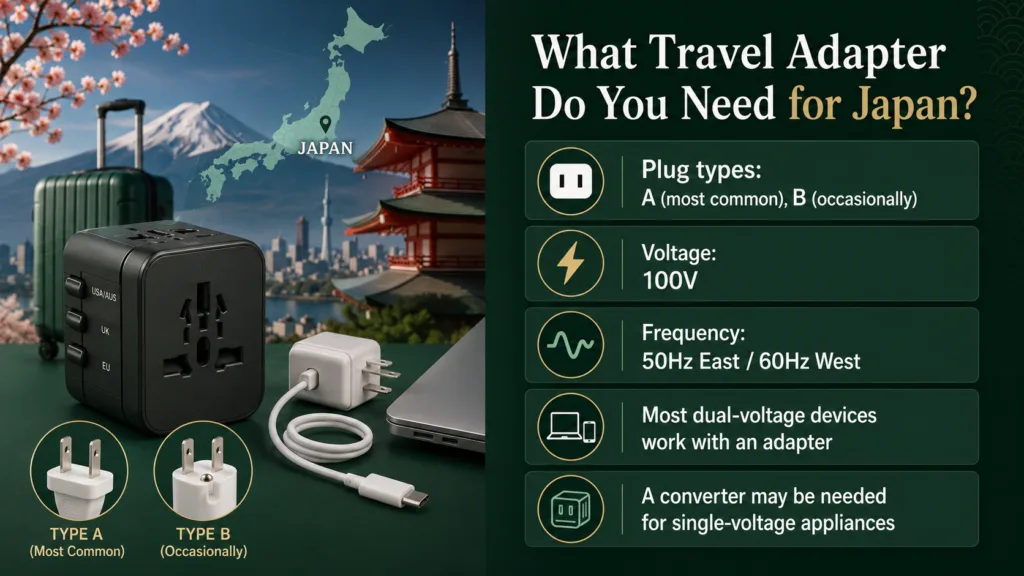
Plug Compatibility Visual
Traveling to Japan? Japan commonly uses Type A and Type B power outlets, with a standard supply of 100V. If your plug is not Type A or Type B, you will usually need a travel adapter. If your device is not rated for 100V, you may also need to think about voltage compatibility.
Destination Adapter Checker for Japan
Use this simple checker to match your home plug situation with Japan’s outlets. It gives practical packing advice, not a formal electrical approval.
Japan
Type A and Type B
Usually 100V
50Hz in eastern Japan, 60Hz in western Japan
A plug adapter does not convert voltage. It only helps your plug fit the wall outlet. For voltage, check the device label before you plug in.
Quick Answer
For Japan, most travelers should check two things: plug fit and voltage compatibility. Japan uses Type A and Type B outlets, and the voltage is commonly 100V. The frequency depends on the region: 50Hz in eastern Japan and 60Hz in western Japan.
| Item | Japan travel power answer |
|---|---|
| Destination | Japan |
| Common plug types | Type A and Type B |
| Voltage | Usually 100V |
| Frequency | 50Hz in eastern Japan, 60Hz in western Japan |
| Plug adapter needed? | Usually yes if your home plug is not Type A or Type B |
| Voltage converter needed? | Depends on the device label |
| Best device advice | For chargers, look for Input: 100–240V. For heat appliances, check very carefully. |
What Plug Adapter Do You Need for Japan?
You need a travel adapter for Japan if your plug does not fit Type A or Type B outlets. Type A has two flat parallel pins. Type B has two flat parallel pins plus a round grounding pin.
If you are coming from the United States or Canada, many two-prong Type A plugs can physically fit Japanese Type A outlets. Grounded three-prong Type B plugs may not fit every outlet, especially in older buildings or places with two-slot sockets. A small grounded or ungrounded adapter may still be useful.
If you are coming from the United Kingdom, Ireland, much of Europe, Australia, New Zealand, India, South Africa, or many other regions, your plug shape will usually not fit directly. In that case, pack a Japan-compatible travel adapter that accepts your home plug and outputs to Type A or Type B.
Do not use plug shape alone as a safety check. A plug may fit, but the device still needs to be suitable for Japan’s 100V supply.
What Power Outlets Are Used in Japan?
Japan commonly uses Type A and Type B outlets. In many everyday places, you may see two-slot Type A outlets. Grounded Type B outlets can also appear, especially for appliances or in newer buildings, but they are not something to rely on for every hotel room, café, train station, or rental apartment.
Two flat parallel slots. This is the outlet shape many travelers notice first in Japan.
Two flat parallel slots plus a round grounding hole. Useful for grounded plugs, but not always available everywhere.
Outlet availability can vary by hotel, airport, train, apartment, and building age. If your device uses a grounded plug, bring an adapter plan that does not assume every socket will have a grounding hole.
Voltage and Frequency in Japan
Japan commonly uses 100V. This is lower than the 120V used in places such as the United States and Canada, and much lower than the 220–240V used in many European, Asian, African, and Middle Eastern countries.
Japan also has two frequency regions. Eastern Japan, including Tokyo and nearby areas, commonly uses 50Hz. Western Japan, including Osaka, Kyoto, Nagoya, and Hiroshima, commonly uses 60Hz. Most phone and laptop chargers handle both 50Hz and 60Hz without trouble when the label says so. Some clocks, motors, medical devices, and older appliances may be more sensitive.
The safest habit is simple: read the device label. You are looking for wording such as Input: 100–240V, 50/60Hz. That means the charger or power supply is usually designed to work across Japan and many other countries, as long as you also have the correct plug adapter.
Adapter Advice from Common Home Countries
| Home plug region | Will it fit in Japan? | Adapter advice |
|---|---|---|
| United States / Canada | Often for two-prong Type A plugs; not always for grounded Type B plugs | Bring a small adapter if your charger has a three-prong plug or a polarized plug that may not fit older outlets. |
| United Kingdom / Ireland | No | Use a Type G to Japan Type A/B travel adapter. |
| Most of Europe | No | Use a Type C/E/F to Japan Type A/B travel adapter. |
| Australia / New Zealand | No | Use a Type I to Japan Type A/B travel adapter. |
| Other countries | Depends on your plug | Match your plug shape to Japan Type A/B before packing. |
Do You Need a Voltage Converter for Japan?
You may need a voltage converter for Japan if your device is single voltage and not rated for 100V. This matters most for appliances that heat, spin, pump, or draw a lot of power.
A plug adapter changes the shape of the plug. A plug adapter does not convert voltage. If a 230V-only appliance is plugged into Japan’s 100V supply, it may work weakly, slowly, or not at all. If a device has strict voltage needs, the wrong setup can damage the device or create a safety risk.
Look for the input label on the charger, plug, handle, power brick, or device body. If it says Input: 100–240V, the device is usually dual voltage or wide-range voltage. If it says only 220–240V, 230V, 120V, or another narrow range that does not include 100V, do not assume it will work normally in Japan.
AdapterMatch rule: match your trip in this order: destination outlet shape, device voltage label, device power level, then what to pack.
Device Guidance for Japan
Phone Chargers
Most modern phone chargers are designed for travel and often show Input: 100–240V. If yours does, you usually only need the correct plug adapter for Japan. USB chargers, USB-C chargers, and multi-port chargers should still be checked on the label.
Laptop Chargers
Laptop chargers are commonly wide-range voltage. Check the power brick, not only the laptop. If the brick says Input: 100–240V, 50/60Hz, it should usually work in Japan with the right plug adapter.
Camera Chargers and Small Electronics
Camera chargers, battery chargers, e-reader chargers, and headphone chargers are often low-risk when they support 100–240V. Bring the right adapter and avoid overloading one wall outlet with too many devices.
Hair Dryers, Curling Irons, Kettles, and Travel Irons
High-power appliances need extra caution. These devices use heating elements and can draw much more power than a phone charger. If your hair dryer or curling iron is not clearly rated for 100V, it may not work properly in Japan. A basic plug adapter is not enough to solve voltage mismatch.
Electric Shavers
Electric shavers vary. Some are dual voltage, some are made for one region only, and some charge through a separate adapter. Check the label before packing. If it supports 100–240V, a Japan plug adapter is usually the main thing you need.
CPAP Machines and Medical Devices
For a CPAP machine or other medical device, check the power supply label and the manufacturer instructions before travel. Many CPAP power supplies are wide-range, but you should not guess. Pack the correct adapter, consider backup power needs, and keep the device in your carry-on if airline rules allow it.
| Device | Adapter needed? | Converter needed? | What to check |
|---|---|---|---|
| Phone charger | Usually yes unless the plug already fits Type A/B | Usually no if label says Input: 100–240V | Charger label |
| Laptop charger | Usually yes unless the plug already fits Type A/B | Usually no if power brick says Input: 100–240V | Power brick input rating |
| Hair dryer | Usually yes for non-Type A/B plugs | May be needed, but many high-power devices are not good travel candidates | Voltage, wattage, and heat settings |
| Curling iron | Usually yes for non-Type A/B plugs | May be needed if not rated for 100V | Voltage range on handle or plug |
| Electric shaver | Depends on plug | Depends on label | Input voltage and charging method |
| CPAP machine | Usually yes for non-Type A/B plugs | Depends on power supply label | Medical device power adapter and instructions |
What to Pack for Japan
- A Japan-compatible plug adapter for Type A/B outlets.
- A small extra adapter if you have a grounded three-prong plug and may find two-prong outlets.
- Chargers that clearly say Input: 100–240V.
- A USB charger or USB-C charger that supports the devices you use daily.
- A power bank for long travel days, following airline battery rules.
- Device labels or photos of labels for anything you are unsure about.
- A safer plan for hair dryers and heat appliances, such as using hotel-provided options when available.
For most travelers, the safest packing choice is a compact Japan plug adapter plus chargers that already support international voltage. For high-power appliances, check the label early so you are not trying to solve a voltage problem after arrival.
Common Japan Travel Power Mistakes
Two-prong plugs often fit, but grounded or polarized plugs may not fit every outlet.
Japan’s 100V supply is not the same as 120V or 230V. Check the label before use.
Hair dryers, curling irons, kettles, and travel irons are not like phone chargers. They need more caution.
Most chargers handle both, but some motors, clocks, and appliances may care about frequency.
FAQ
Do I need a travel adapter for Japan?
You usually need a travel adapter for Japan if your plug is not Type A or Type B. Travelers from the UK, Europe, Australia, and many other regions normally need one.
Do US plugs work in Japan?
Many two-prong US Type A plugs can fit Japanese Type A outlets. Three-prong grounded plugs may not fit every outlet, so a small adapter can still be useful.
Does Japan use 110V or 220V?
Japan commonly uses 100V. This is different from 120V in North America and 220–240V in many other countries.
Will my phone charger work in Japan?
Usually yes if the charger label says Input: 100–240V. You may still need a plug adapter so the charger fits the wall outlet.
Can I use my hair dryer in Japan?
Only if it is rated for Japan’s 100V supply. Hair dryers and curling irons are high-power appliances, so do not rely on a plug adapter alone.
Is Japan 50Hz or 60Hz?
Both are used. Eastern Japan commonly uses 50Hz, while western Japan commonly uses 60Hz. Most modern chargers handle both if the label says 50/60Hz.