
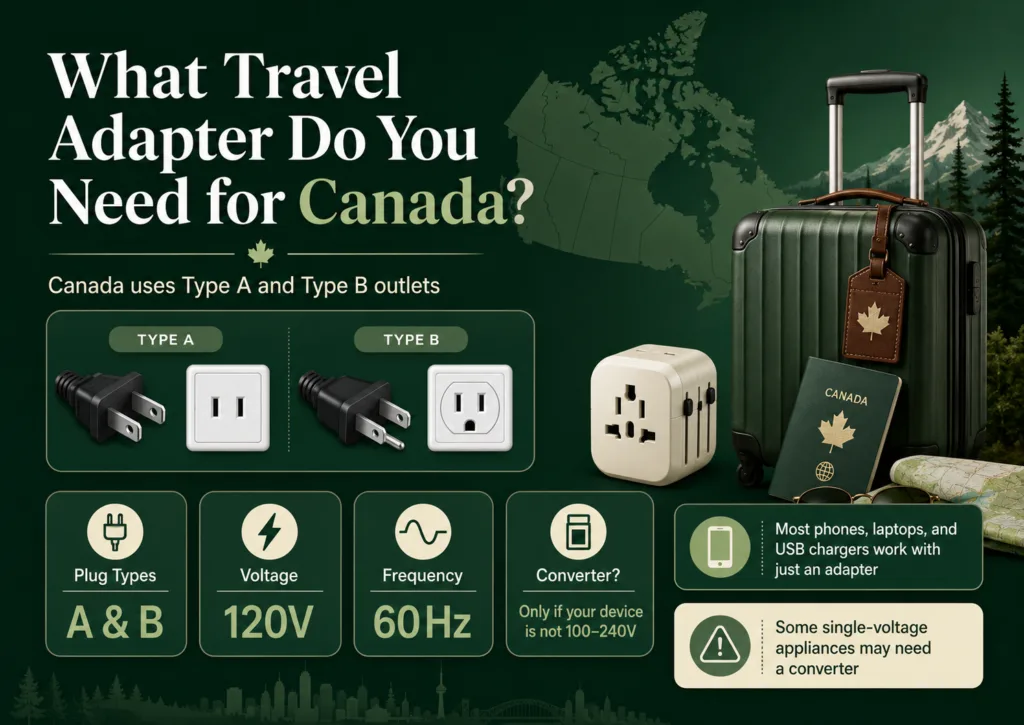
For Canada, you usually need a travel adapter if your plug is not Type A or Type B. Canada commonly uses Type A and Type B outlets, with 120V electricity and 60Hz frequency. If your device label says Input: 100–240V, a plug adapter is usually enough.
Plug Compatibility Visual
Canada Adapter Checker
Use this quick decision box before packing. It gives a practical result for common travel devices, but you should still check the label on each charger or appliance.
Canada
Type A and Type B
120V, 60Hz
A plug adapter does not convert voltage.
Most travelers need to check two things: whether their plug fits Canada’s Type A/B outlets, and whether the device can safely use 120V power.
Quick Answer
| Item | Canada Travel Power Information |
|---|---|
| Destination | Canada |
| Plug types | Type A and Type B |
| Voltage | 120V |
| Frequency | 60Hz |
| Adapter needed? | Usually yes if your home plug is not Type A or Type B |
| Converter needed? | Only if your device is not rated for 120V |
| Best device advice | Check the label for Input: 100–240V before use |
What Plug Adapter Do You Need for Canada?
For Canada, choose a travel adapter that lets your plug connect to Type A or Type B power outlets. Type A has two flat parallel slots. Type B has two flat parallel slots plus a round grounding hole.
If you are traveling from the United States, Mexico, Japan, or another country that commonly uses Type A/B plugs, your plug may already fit many Canadian outlets. If you are traveling from the United Kingdom, Ireland, most of Europe, Australia, New Zealand, India, South Africa, or many other regions, you will usually need a plug adapter.
A plug adapter only changes the physical shape of the plug. It does not change 230V to 120V, or 120V to 230V. That is why the device label matters as much as the outlet shape.
What Power Outlets Are Used in Canada?
Canada commonly uses Type A and Type B outlets. Type B is grounded and is common in homes, hotels, airports, offices, and newer buildings. Type A may still appear, especially for simple two-prong connections.
Two flat parallel pins. This plug type is usually ungrounded.
Two flat parallel pins plus one round grounding pin. This is common for grounded devices.
If your device has a grounded plug, use an adapter that supports the grounding pin when possible. Avoid forcing a grounded plug into an ungrounded adapter, especially for higher-power or metal-bodied appliances.
Voltage and Frequency in Canada
Canada uses 120V electricity with a 60Hz frequency. This is different from many countries that use 220–240V and 50Hz.
If you are coming from a 220–240V country, many small electronics will still work because their chargers are designed for international travel. The label is the deciding point. Look for wording such as:
Input: 100–240V, 50/60Hz
If your charger says this, it is usually designed to work in Canada. You may still need a plug adapter if the plug shape does not fit.
If a device says only 220–240V, it is not designed for Canada’s 120V supply unless used with the correct voltage converter or transformer. Some devices may simply run weakly; others may not work properly.
Adapter Advice from Common Home Countries
| Traveling From | Common Home Plug | Adapter for Canada? | Voltage Note |
|---|---|---|---|
| United States | Type A / B | Usually no | Voltage is usually compatible |
| United Kingdom | Type G | Yes | Check for Input: 100–240V |
| European countries | Type C / E / F | Yes | Many chargers work; heat devices need caution |
| Australia / New Zealand | Type I | Yes | Check voltage before using appliances |
| India | Type C / D / M | Usually yes | Check each device label |
Do You Need a Voltage Converter for Canada?
You may need a voltage converter for Canada if your device is single-voltage and not rated for 120V. This is most important for appliances with heating elements, motors, or high power draw.
For many travelers, the main devices are phones, laptops, tablets, camera chargers, and USB chargers. These are often dual voltage. Still, do not guess. Check the charger or power brick for Input: 100–240V.
Always check the device label before using high-power appliances abroad. Hair dryers, curling irons, straighteners, kettles, and clothes irons can draw much more power than small chargers.
If your appliance is marked only for 220–240V, it may not perform correctly in Canada without a suitable converter. If it is marked only for 110–120V, it is generally made for Canadian-style voltage, but you still need to confirm the plug shape.
Phone Charger Guidance for Canada
Most modern phone chargers are designed for international voltage ranges. If the charger label says Input: 100–240V, 50/60Hz, it can usually handle Canada’s 120V / 60Hz supply.
Your remaining issue is plug shape. If your charger has a UK, European, Australian, or other non-Type-A/B plug, pack a travel adapter for Canada. A USB wall charger bought for Canada can also work, but check ratings and avoid low-quality chargers.
Laptop Charger Guidance for Canada
Laptop power bricks are often dual voltage, especially for major travel-friendly models. Look on the charger brick, not only on the laptop body. The label should show something like Input: 100–240V.
If the label includes 100–240V and 50/60Hz, the laptop charger is usually fine on Canadian electricity. You will need only the correct plug adapter if the plug does not fit Type A or Type B outlets.
Hair Dryers, Curling Irons, and Heat Appliances
Heat appliances need more care than phone and laptop chargers. A hair dryer or curling iron from a 230V country may not work properly on Canada’s 120V supply unless it is dual voltage or designed for travel use.
Check the label or switch on the device. Some travel hair tools have a voltage selector, such as 110/120V and 220/240V. If your device has a selector, set it correctly before plugging it in. If you are unsure, do not use it.
- Check whether the appliance says 120V, 110–120V, 100–240V, or 220–240V.
- Check the wattage before using any converter.
- Do not use a basic plug adapter as if it were a voltage converter.
- For hotel stays, using locally provided hair dryers is often simpler.
CPAP Machines and Medical Devices
Many CPAP machines and medical power supplies are dual voltage, but you should treat them more carefully than ordinary chargers. Check the power supply label for Input: 100–240V and 50/60Hz support.
Pack the correct plug adapter, and consider carrying the original power supply. If the device is medically necessary, confirm the power requirements before travel and avoid relying on an unknown converter at the last minute.
What to Pack for Canada
- A travel adapter for Type A/B outlets if your home plug is different.
- Your original phone, laptop, camera, and medical device chargers.
- A short USB charging cable and a spare cable for daily use.
- A grounded adapter if your device uses a grounded plug.
- A voltage converter only if your device label shows it is needed.
- A device label check before packing hair tools or other high-power appliances.
Common Mistakes to Avoid
A plug adapter does not convert voltage. It only helps the plug fit the outlet.
The safest answer is printed on the charger or appliance label. Look for voltage and frequency input.
If your device has a grounded plug, use an adapter that handles grounding when possible.
High-power appliances need extra caution because they draw more power and may not be dual voltage.
FAQ
What plug type does Canada use?
Canada commonly uses Type A and Type B outlets. Type A has two flat parallel slots, while Type B adds a round grounding hole.
Do I need a travel adapter for Canada?
You usually need a travel adapter if your plug is not Type A or Type B. Travelers from the US often do not need one, while travelers from the UK, Europe, Australia, and many other regions usually do.
Does Canada use 110V or 220V?
Canada commonly uses 120V electricity. People often say 110V or 120V in casual travel advice, but the practical travel check is whether your device supports Canada’s 120V supply.
Will my phone charger work in Canada?
Most modern phone chargers work if the label says Input: 100–240V. If the plug does not fit Type A or Type B outlets, you will still need a plug adapter.
Do I need a voltage converter for Canada?
You need a voltage converter only if your device is not rated for 120V. Phones and laptops are often dual voltage, but hair dryers, curling irons, kettles, and irons need closer checking.
Can I use a European hair dryer in Canada?
Only if it is rated for 120V or has a correct dual-voltage setting. A basic plug adapter is not enough for a 220–240V-only hair dryer because a plug adapter does not convert voltage.