
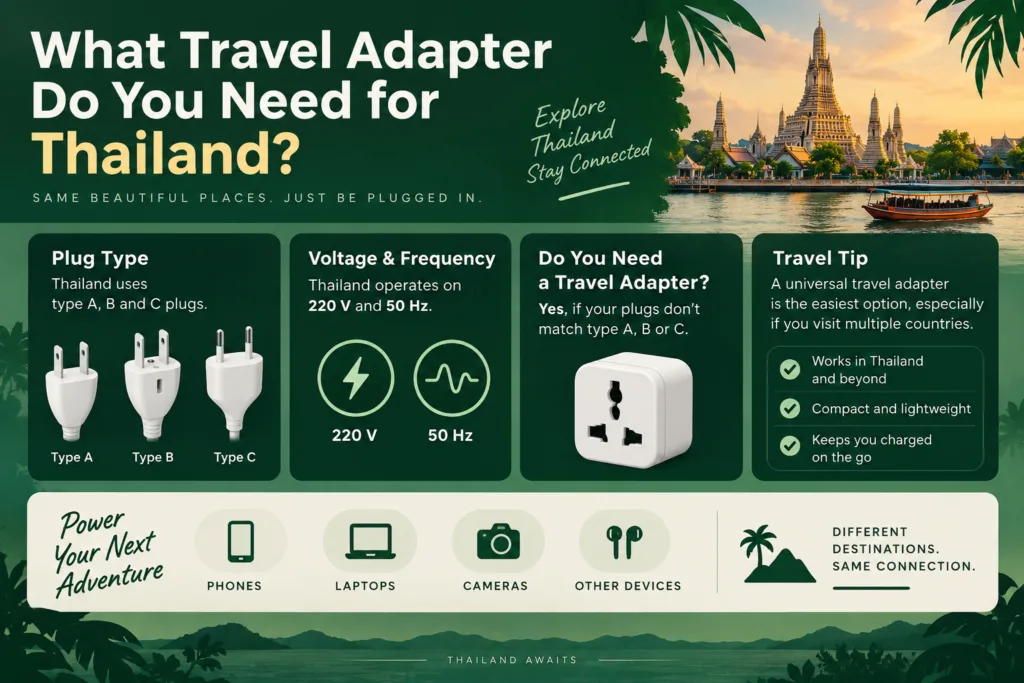
Thailand uses a mixed outlet system rather than one socket shape everywhere. Travelers may encounter Type A, Type B, Type C, and Type O outlets, while the electricity supply is 230V at 50Hz. That means some foreign plugs may fit directly, some need an adapter, and a plug that fits can still be unsafe if the device was made only for lower-voltage power.
The practical decision is based on two separate checks: whether your plug fits a Thai outlet, and whether the device itself can accept 230V.
230V, 50Hz
Check the input rating on chargers and appliances brought from countries that use 100V or 120V power.
Type A, B, C and O
Socket designs can vary between hotels, homes and other buildings, so a plug that works in one location may not fit every outlet you encounter.
Which Plugs Can You Use in Thailand?
Thailand is unusual for travelers because its outlet landscape includes both flat-pin and round-pin formats. This creates more direct plug compatibility than destinations that use only one socket standard, but it also makes blanket advice such as “you do not need an adapter for Thailand” unreliable.
| Your plug type | What to expect in Thailand | Practical decision |
|---|---|---|
| Type A | Two flat parallel pins can fit some Thai outlets. | An adapter may not always be required, but carrying one gives you more outlet options. |
| Type B | Some compatible outlets accept the two flat pins and grounding pin, but socket design varies. | Do not assume every outlet will accept the plug or preserve grounding correctly. |
| Type C | The two-round-pin Europlug is commonly compatible with suitable Thai sockets. | Many Type C chargers can be used without a plug adapter. |
| Type E or F | Round power pins may be physically compatible in some situations, but grounded connections need closer checking. | Use an appropriate grounded adapter when protective earth is required. |
| Type G | The three rectangular UK-style pins do not normally match Thai outlets. | Pack a Thailand-compatible travel adapter. |
| Type I | The angled Australian/New Zealand plug does not normally match Thai outlets. | Pack a travel adapter. |
| Type D or M | The larger round-pin formats should not be assumed to fit Thai sockets. | A suitable adapter is normally the safer choice. |
Why Thailand Outlets Can Look Different From One Building to Another
Thailand has used more than one plug format, and travelers can encounter sockets designed to accept different pin shapes. Some wall outlets have openings that accommodate flat two-pin plugs, round two-pin plugs, or more than one supported configuration.
Thailand also has its own round-pin system, commonly identified as Type O. A Type O plug has two round power pins and a round grounding pin. Thailand’s TIS 166-2549 standard covers household and similar plugs and socket-outlets rated up to 250V.
This mixed environment explains why two hotel rooms, apartments or cafés in Thailand may have outlets that do not look identical. It also explains why a traveler with a US Type A charger or European Type C charger may be able to plug in directly at one location but still benefit from carrying an adapter for the rest of the trip.
Do not use physical fit as proof of electrical compatibility. A US or Japanese flat-pin plug may fit a Thai outlet even though Thailand supplies much higher voltage than the device’s home electricity system.
The 230V Check Matters Most for US and Japanese Devices
Thailand supplies 230V electricity. This is close to the normal supply used across the UK, much of Europe, Australia, New Zealand and many other countries, but it is very different from the approximately 120V systems used in the United States and Canada and the 100V system used in Japan.
This creates an important Thailand-specific situation: a flat-pin charger may fit the outlet even when the appliance is not designed for the voltage coming from it.
If the label says Input: 100–240V, 50/60Hz
The power supply is normally designed to accept Thailand’s 230V, 50Hz electricity. This rating is common on modern phone chargers, laptop power supplies, camera chargers and many USB-C wall chargers.
In this case, you normally need to solve only the plug-shape problem. If the charger’s plug already fits the particular Thai outlet, no voltage converter is needed.
If the label says 110V or 120V only
Do not connect the device directly to Thailand’s 230V supply simply because its plug fits. A basic travel adapter changes the physical connection; it does not reduce 230V electricity to 120V.
A suitable voltage converter may be required, although using a converter becomes less practical with high-power appliances. The converter must be designed for the appliance’s voltage and power demand.
If the label says 220–240V
The voltage is normally suitable for Thailand. Check the plug shape and, where relevant, grounding.
For US and Japanese travelers: a two-flat-pin plug going into a Thailand outlet is not a safety test. Read the voltage rating before switching the device on.
Adapter Decisions for Common Trips to Thailand
United States or Canada to Thailand
US and Canadian Type A plugs can fit some Thai outlets, while Type B compatibility varies with the socket. Carrying an adapter is still useful because you cannot depend on every outlet accepting your plug.
The bigger issue is voltage. Thailand uses 230V while US and Canadian household devices are commonly designed around 120V. Chargers marked 100–240V normally handle this difference without a voltage converter. A 120V-only appliance does not.
Japan to Thailand
Japan deserves the same caution for a different reason. Japanese Type A plugs can appear physically compatible with some Thailand outlets, but Japan uses a much lower supply voltage.
Many modern Japanese electronic chargers support 100–240V and can operate in Thailand after the label is checked. A device marked only for 100V should not be connected directly to Thai power.
United Kingdom, Ireland, Singapore or Malaysia to Thailand
Type G plugs normally need a travel adapter for Thailand. Voltage is less likely to be the problem because these countries use electricity in a similar voltage range.
For an ordinary charger or appliance designed for approximately 220–240V, the adapter usually solves the main travel-power problem. The device label remains the final check.
Australia or New Zealand to Thailand
Type I plugs normally require an adapter. Thailand’s voltage is broadly compatible with most Australian and New Zealand appliances, so a converter is usually unnecessary when the device is designed for standard local mains power.
Mainland Europe to Thailand
Travelers carrying a simple Type C Europlug are among the most likely to have direct physical compatibility with Thailand sockets. Small two-pin phone and USB chargers may therefore work without an adapter.
Grounded Type E and Type F equipment needs a more careful decision. The fact that two round power pins can enter a socket does not mean the protective earth connection is present.
India to Thailand
A two-pin Type C charger may already fit a compatible Thai outlet. Larger Type D or Type M plugs should not be expected to fit, so an adapter is useful for those devices.
Voltage is normally less problematic than it is for travelers from the US or Japan, but the actual rating printed on the appliance should still be checked.
Grounded Appliances Need More Than a Plug That Fits
Two-pin phone chargers and other double-insulated travel electronics often do not use a protective earth connection. Three-pin appliances are different.
If an appliance depends on grounding, the complete connection needs to preserve it:
- the appliance has a grounding connection;
- the travel adapter supports grounding;
- the destination socket provides the appropriate earth connection.
An adapter that merely allows the live and neutral pins to fit is not automatically an appropriate choice for grounded equipment.
This matters for some three-wire laptop power supplies, metal-bodied appliances and specialized electrical equipment. If earth continuity is required, use an adapter specifically designed to preserve grounding with the available outlet rather than forcing a grounded plug into a two-pin configuration.
Phone and Laptop Chargers Are Usually the Simple Cases
For most travelers, phones and laptops do not require a voltage converter in Thailand because many modern power supplies accept a broad international input range.
INPUT: 100–240V ~ 50/60Hz
This type of charger is normally suitable for Thailand’s 230V, 50Hz supply. You still need a compatible outlet connection.
Check the wall charger or power brick rather than the USB cable. A USB-C, Lightning or other charging cable does not tell you what mains voltage the charger accepts.
For a laptop, check the input specification on the power brick or USB-C charger. If it shows 100–240V and 50/60Hz, a separate voltage converter is normally unnecessary.
Hair Dryers and Other High-Power Appliances Need a Different Decision
Hair dryers, straighteners, curling irons, travel kettles, clothes steamers and similar appliances can draw far more power than a phone charger. They should not be treated as ordinary travel electronics.
A US 120V-only hair dryer, for example, should not be connected to Thailand’s 230V electricity with only a plug adapter. The same applies to a Japanese appliance designed solely for 100V.
If a hair tool is marked 120/240V or has a manual voltage selector, make sure the appliance is actually configured for the higher voltage before use. If a converter is required, its wattage rating must be suitable for the appliance. Small electronic travel converters are not automatically appropriate for high-wattage heating equipment.
For these appliances, a device designed for 220–240V operation or a properly rated dual-voltage travel model is often simpler than trying to convert the supply.
Will a Universal Travel Adapter Work in Thailand?
A universal travel adapter can be useful in Thailand if its destination plug is designed for the Thai outlet formats you expect to use. It can also reduce the need to carry separate adapters when a trip includes several countries.
Check three things before relying on one:
- whether its plug configuration is suitable for Thailand;
- whether it preserves grounding if your appliance requires it;
- whether its current and power ratings are suitable for the device being connected.
Do not assume the AC outlet on a universal adapter converts voltage. Many universal adapters provide plug conversion and USB charging while passing the local mains voltage through their AC socket. In Thailand, that can still mean approximately 230V reaches the connected appliance.
What You Actually Need to Pack
| Your situation | What normally makes sense |
|---|---|
| Type C charger marked 100–240V | It may work directly in many suitable Thailand outlets. An adapter is useful as a backup for outlet variation. |
| US Type A charger marked 100–240V | It may fit some outlets directly, but carry an adapter for broader compatibility. No converter is normally needed. |
| US 120V-only appliance | Do not rely on a plug adapter. The voltage problem must be solved separately. |
| Japanese 100V-only appliance | Do not connect directly to Thailand’s 230V supply. |
| UK Type G charger rated for 220–240V or 100–240V | Pack a Thailand-compatible plug adapter. A voltage converter is normally unnecessary. |
| Australian Type I charger rated for 220–240V or 100–240V | Pack a plug adapter. The voltage is normally compatible. |
| Grounded three-pin appliance | Use an adapter and outlet combination that preserves protective earth. |
| High-power single-voltage heat appliance | Check voltage and wattage before travel; a basic plug adapter is not enough. |
A Simple Thailand Power Check Before You Plug In
- Look at your plug. Type C and some Type A/B plugs may already fit compatible Thai outlets. Type G, Type I and several larger plug formats normally need an adapter.
- Read the device input label. For Thailand, the rating must include 230V or a range such as 100–240V.
- Check frequency when the device depends on it. Thailand uses 50Hz. Chargers marked 50/60Hz are normally designed for either frequency.
- Check grounding for three-pin equipment. Physical fit alone does not prove that protective earth is maintained.
- Treat high-power appliances separately. Check voltage, wattage and any manufacturer instructions before using hair tools, heaters or other high-load equipment.
For most modern travel electronics, Thailand is straightforward once the label is checked. A charger marked 100–240V, 50/60Hz normally does not need a voltage converter. The remaining question is whether its plug fits the particular Type A, B, C or O outlet available to you.