
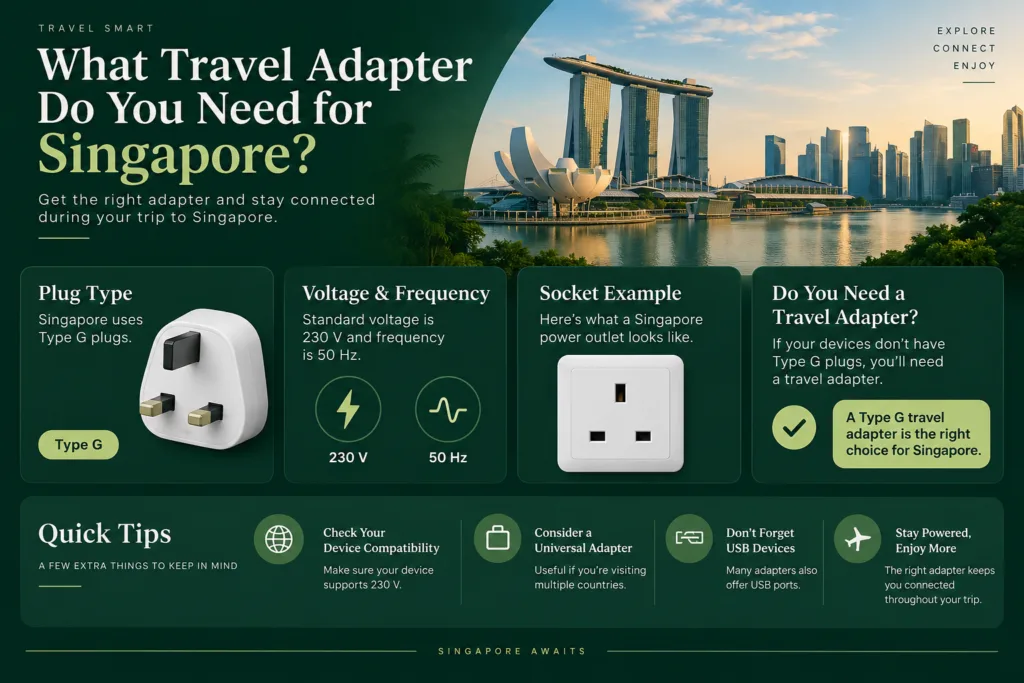
Singapore uses Type G power outlets and a standard electricity supply of 230V AC at 50Hz. If the plug on your charger or appliance is not Type G, you will normally need a Type G travel adapter. Travelers arriving with UK-style Type G plugs may not need an adapter at all.
The plug shape is only the first check. Travelers bringing 100V or 120V appliances should also read the voltage rating on the device before connecting it to Singapore’s 230V supply. A travel adapter can make the plug fit, but it does not change the voltage.
Who Needs a Type G Adapter for Singapore?
Type G has three rectangular pins arranged in a triangular pattern. It is the same general plug system used in the United Kingdom and several other countries, so some travelers can connect their normal plugs directly.
| Traveling from | Common plug | Type G adapter? | Voltage check |
|---|---|---|---|
| United States / Canada | Type A / B | Yes, usually | Important because many appliances are designed for 120V |
| United Kingdom / Ireland | Type G | Usually no | Supply voltage is generally compatible, but check the device label |
| Malaysia / Hong Kong / Brunei | Type G commonly used | Usually no for Type G plugs | Check the individual device rating |
| Mainland Europe | Type C / E / F | Yes | Voltage is commonly similar; plug shape is the main issue for many devices |
| Australia / New Zealand | Type I | Yes | Voltage is commonly similar; check the device label |
| Japan | Type A / B | Yes | Important because Japan uses a much lower supply voltage |
These are common plug arrangements rather than a guarantee for every appliance. Imported equipment, replaceable power cords and travel chargers can use a different plug from the one normally associated with the country where you live.
Read the Input Label Before You Plug In
Singapore’s nominal supply is 230V at 50Hz. The easiest way to decide whether your device can use that electricity is to read the INPUT line on the charger, power brick or appliance.
This is the common travel-friendly rating found on many phone, tablet, camera and laptop chargers. The device normally does not need a voltage converter in Singapore. You may still need a Type G adapter for the plug.
The stated voltage and frequency include Singapore’s supply. If the plug is different from Type G, the remaining issue is normally the physical connection.
Do not treat a Type G adapter as permission to use the appliance on 230V. A 120V-only appliance is not made to receive Singapore’s normal supply directly.
Do not guess from the device brand or connector type. Check the charger body, appliance label or manufacturer instructions before use.
For USB devices, check the wall charger rather than the USB cable. A USB-C, Lightning or other charging cable does not tell you what mains voltage the charger accepts.
US and Canadian Travelers Have Two Separate Checks
A normal US or Canadian Type A or Type B plug does not match a Singapore Type G socket, so a Type G travel adapter is usually required. The voltage difference also deserves attention: Singapore supplies 230V, while many North American household appliances are designed around 120V.
For a phone or laptop charger labeled 100–240V, 50/60Hz, that voltage difference is normally handled by the charger itself. In that case, the Type G adapter only needs to solve the plug-shape difference.
A 120V-only appliance should not be connected to Singapore’s 230V supply with a basic plug adapter. This matters particularly for appliances with heating elements or motors.
If a single-voltage appliance genuinely needs to be used, voltage conversion has to be considered separately. The converter must be suitable for the appliance’s voltage, wattage and operating characteristics. A small converter intended for low-power electronics should not be assumed suitable for a high-watt hair dryer, iron or kettle.
European Plugs Need More Than a Physical “Almost Fit”
Travelers from continental Europe will normally need a proper adapter from their plug type to Singapore Type G. Do not force a round two-pin plug into a three-pin Singapore socket or use an object to defeat the socket shutters.
There is an extra concern with Schuko plugs, commonly associated with Type F systems. Singapore’s Consumer Product Safety Office warns that Schuko plugs are not suitable for direct use in local mains sockets. Their round pins can stress the socket contacts, and the side earthing strips used by Schuko do not connect to the earth contact in a Singapore Type G outlet.
Use an adapter that is designed to accept your European plug and connect correctly to Type G. If the appliance relies on protective earth, the adapter must preserve that grounding path rather than simply making the pins fit.
Small two-pin plugs used on double-insulated, low-power equipment can also require an adapter. A loose or improvised connection is not an acceptable substitute for a correctly fitted Type G connection.
Phones and Laptops Usually Need the Plug Changed, Not the Voltage
Many modern phone chargers, laptop power supplies, camera chargers and multi-port USB chargers accept 100–240V and 50/60Hz. When your own charger carries that rating, Singapore’s 230V/50Hz supply is within its stated input range.
| Device setup | What the label says | Usual Singapore result |
|---|---|---|
| US phone charger | 100–240V, 50/60Hz | Type G adapter normally needed; converter normally not needed |
| European laptop charger | 100–240V, 50/60Hz | Proper Type G adapter normally needed; converter normally not needed |
| UK laptop charger with Type G plug | 100–240V, 50/60Hz | Normally no plug adapter and no converter |
| 120V hair dryer | 120V only | Type G adapter alone is not suitable |
| Dual-voltage hair tool | 120/240V or another range covering 230V | Check the voltage setting and plug connection before use |
A removable laptop power cord can provide another option. If the power brick accepts 100–240V and the manufacturer supports a compatible Type G mains lead for that power supply, using the correct Type G cord can remove the need for a separate plug adapter.
Hair Dryers and Other Heat Appliances Need a Different Decision
Hair dryers, curling irons, straighteners, garment steamers, travel irons and kettles should not be treated like phone chargers. Their higher power draw makes incorrect voltage use more hazardous.
A hair tool labeled only 120V is not made for direct use on Singapore’s 230V supply. Some travel appliances are dual voltage and have a manual 120/240V selector. If yours does, the selector must be placed in the correct position before the appliance is connected.
- 100–240V automatic input: normally compatible with Singapore voltage if the appliance’s other ratings permit it.
- 220–240V: normally within Singapore’s voltage range.
- 120/240V selector: confirm the selector setting before connecting the appliance.
- 120V only: do not use it with a Type G plug adapter alone.
If a converter is being considered for a heat appliance, check its continuous power rating and the appliance wattage rather than choosing one only because it changes 230V to 120V. Manufacturer instructions should take priority where the appliance has special operating limits.
Do Not Depend on a Hotel Universal Socket
Some Singapore hotels and other visitor-oriented properties may provide universal sockets or USB charging ports. They can be convenient, but they should not be the basis of your packing decision.
Universal sockets accept several plug shapes, which can also make incorrect connections possible. Singapore’s Consumer Product Safety Office notes risks including incomplete plug insertion, accessible live contacts in some designs and the possibility of connecting a 100–120V appliance to the country’s 230V supply.
A socket accepting your plug does not prove that your appliance is voltage-compatible. A 120V hair dryer can still be a 120V appliance even when its plug physically enters a universal hotel socket.
If your own plug is not Type G, carrying a suitable Type G adapter gives you a predictable connection instead of relying on the room having a particular universal socket or USB outlet.
What Type G Adapter Makes Sense for Singapore?
For a Singapore-only trip, a compact adapter that converts your home plug to a Type G connection is usually enough when all the devices you plan to use already support 230V.
If several phones, watches, tablets or other USB devices need charging, one appropriately rated Type G connection feeding a multi-port charger can be simpler than carrying a separate adapter for every USB charger. The multi-port charger itself still needs to support Singapore’s input voltage.
Grounded appliances need more care. If the appliance plug includes a protective earth connection, choose an adapter designed to maintain grounding. Do not reduce a grounded plug to an ungrounded connection simply because the device appears to power on.
Adapters should also be used within their electrical rating. Stop using an adapter that becomes damaged, loose in the socket, discolored or unusually hot.
If You Buy a Power Accessory in Singapore
Singapore regulates a range of household electrical products and accessories through its Consumer Product Safety Office. Controlled Goods covered by the local safety rules are required to meet the applicable requirements and carry a valid SAFETY Mark before sale.
For a traveler buying a plug or power accessory locally, the practical checks remain simple: make sure it provides the Type G connection you actually need, is rated for the equipment being connected and preserves grounding when the appliance requires it. A universal shape on its own does not establish electrical compatibility.
Singapore and Nearby Type G Destinations
A Type G setup can also be useful on a trip that combines Singapore with countries such as Malaysia or Brunei, where the same plug system is commonly used. Hong Kong also commonly uses Type G.
Do not extend that assumption to an entire Southeast Asia itinerary. Plug systems can change from one destination to the next, so a Singapore adapter should be treated as a Type G adapter rather than as a universal “Asia” solution.