
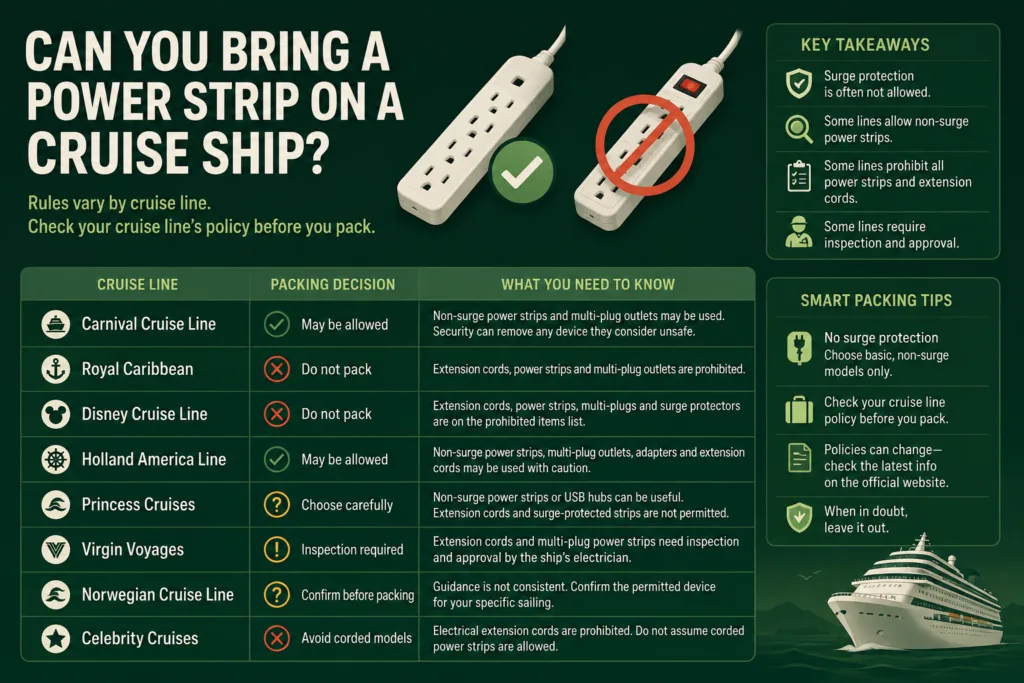
You can bring a power strip on some cruise ships, but not on every cruise line. Some operators permit certain non-surge strips, while others prohibit power strips and multi-plug outlets as a category. A third group requires inspection or publishes guidance that does not support a simple yes-or-no answer.
The safest rule: leave any surge-protected strip at home. Before packing a non-surge model, check whether your cruise line permits devices that add extra AC outlets. A product advertised as “cruise approved” is not automatically accepted by ship security.
The rule changes with the cruise line
“No surge protection” is only one part of the decision. Some companies allow a basic non-surge strip, some prohibit every power strip, and some reserve the right to inspect the device. The policy for the company operating the ship matters more than the wording on the product box.
| Cruise line | Packing decision | What the published rule says |
|---|---|---|
| Carnival Cruise Line | May be allowed | Power strips, multi-plug outlets, adapters and extension cords may be used if they do not contain surge protection. A device considered unsafe can still be taken by security. [Carnival rule] |
| Royal Caribbean | Do not pack | Extension cords, power strips and multi-plug outlets are prohibited. The policy does not create an exception merely because a strip lacks surge protection. [Royal Caribbean rule] |
| Disney Cruise Line | Do not pack | Extension cords, power strips, multi-plugs and surge protectors appear on Disney’s prohibited-items list. [Disney rule] |
| Holland America Line | May be allowed | Power strips, multi-plug outlets, adapters and extension cords may be used with caution when they do not contain surge protection. [Holland America rule] |
| Princess Cruises | Choose carefully | Princess says a non-surge power strip or USB hub can be useful, while extension cords and surge-protected strips are generally not permitted. [Princess rule] |
| Virgin Voyages | Inspection required | Extension cords and multi-plug power strips are subject to inspection and approval by the ship’s electrician. Do not treat approval as guaranteed. [Virgin Voyages rule] |
| Norwegian Cruise Line | Confirm before packing | NCL’s published material is not consistent: one packing article recommends a small surge protector, while its medical-accessibility guidance says an extension cord should not include surge protection. Confirm the permitted device for the booked sailing rather than relying on a packing article alone. [NCL guidance] |
| Celebrity Cruises | Avoid corded models | Celebrity expressly prohibits electrical extension cords. Its public packing rule should not be read as approval for a corded power strip. [Celebrity rule] |
Check the policy again for the booked sailing. A cruise line may revise its prohibited-items list, and security staff can reject an item that appears damaged, unmarked or unsuitable even when the general category is normally accepted.
Power strip, outlet extender and USB charger are not the same device
Travel listings often use several names for products that perform different jobs. The distinction matters because a cruise line may allow charging equipment while prohibiting anything that creates extra AC outlets.
| Device | Adds AC outlets? | May contain surge protection? | Packing concern |
|---|---|---|---|
| Power strip | Yes | Yes | Some lines accept only non-surge models; others prohibit the whole category. |
| Surge-protected strip | Yes | Yes, by design | This is the least portable choice across cruise lines and is prohibited by many operators. |
| Wall outlet extender | Yes | Sometimes | A cord-free body can still be treated as a multi-plug outlet. |
| USB-only multiport charger | No | Not in the power-strip sense | Usually a lower-risk option because it does not multiply AC receptacles, but it remains subject to the line’s electrical-device rules. |
| Travel plug adapter | Usually no | Not normally | Changes plug shape only. A model with several AC sockets may be treated as a multi-plug device. |
A wall tap is not automatically safer than a strip. If it turns one cabin outlet into three AC outlets, security may classify it as a multi-plug outlet even though it has no cord.
Why “cruise approved” does not settle the question
There is no single permission label that binds every cruise company. “Cruise approved,” “travel safe” and similar wording may describe how a seller markets the product. The ship operator still decides whether the device is permitted.
A non-surge label also does not create universal acceptance. It may satisfy Carnival’s or Holland America’s published condition, but Royal Caribbean and Disney prohibit broader device categories. A device can therefore be acceptable on one voyage and taken by security on another.
Use the product description only to identify what the device is. Use the cruise line’s own prohibited-items or electrical-appliance page to decide whether to pack it.
Why surge-protected strips receive stricter treatment
A household surge protector is designed around the electrical system for which it was made. Shipboard distribution can be arranged differently. The U.S. Coast Guard has warned that commercially available surge protective devices made for shore use may create a fire risk aboard vessels when their internal protection does not interrupt the conductors in the way the ship’s system requires. The alert followed investigations of two stateroom fires on a U.S.-flagged container vessel. [Marine electrical safety]
This does not mean every ship uses one identical wiring arrangement or that every power strip will fail. It explains why operators use broad rules instead of asking passengers to make their own electrical compatibility judgment.
Do not remove, bypass or cover a surge-protection feature to make a strip appear compliant. If the product is not clearly identified as a basic non-surge device, choose another charging setup.
How to tell whether a strip has surge protection
Check the product body, underside label, packaging and manufacturer specification. Do not judge only by its shape or by the presence of a power switch.
- Look for the words surge protector, surge suppression, transient protection or protected.
- Look for a joule rating, such as a number followed by J. A joule rating commonly indicates surge-absorption capacity.
- Check whether the specification mentions an MOV, or metal-oxide varistor, which is commonly used in surge-protection circuits.
- Do not assume a reset button proves the device is surge protected. It may be an overload circuit breaker.
- Do not assume a grounded plug, USB ports or an on/off switch proves that the strip is acceptable.
- Reject the device if its rating label is missing, damaged or too vague to identify the protection features.
Overload protection and surge protection are different features. An overload breaker responds when connected equipment draws too much current. Surge protection is intended to react to short voltage spikes. A strip may have one, both or neither.
A packing decision for the device in your hand
Use the following order before placing any outlet-expanding device in your luggage.
1. Check for surge-protection wording
If the strip has a joule rating or is described as surge protected, leave it at home unless the cruise company has issued written approval for that exact use.
2. Count the AC receptacles it creates
If the product creates two or more AC outlets, treat it as a power strip or multi-plug device even if it plugs directly into the wall.
3. Check whether it has a cord
A corded product may fall under an extension-cord prohibition. This matters on lines whose public wording names extension cords but does not clearly approve every type of power strip.
4. Match it to the cruise line’s wording
Look for all relevant terms: power strip, power board, multi-plug outlet, outlet adapter, extension cord and surge protector. Checking only one term can produce the wrong result.
5. Keep a lower-risk charging plan
Even when a non-surge strip appears permitted, take enough ordinary USB cables and original device chargers to manage if security does not accept it.
If security finds the strip
Putting a prohibited device in carry-on luggage does not make it acceptable. Cruise lines screen both passengers and luggage, and an item can be referred for inspection regardless of where it was packed.
Royal Caribbean states that a bag containing a prohibited or possibly prohibited item may be sent to a screening location. If the item is taken, the passenger receives a receipt and can normally retrieve it from a designated area before leaving the ship at the end of the voyage. [Security screening]
That process should not be assumed for every operator or every item. Some objects may not be returned, and local law can affect handling. The practical risk is also wider than losing the strip: luggage delivery may be delayed while the bag is inspected.
Charge several devices without adding AC outlets
A single multiport USB charger is usually a cleaner solution than a strip when the cabin must support phones, watches, tablets, cameras and earbuds. Choose a unit that plugs into one AC receptacle and provides only USB-A or USB-C outputs. Avoid a model that also includes several household AC sockets unless the cruise line permits multi-plug devices.
- Use one charger with enough total output for the devices that need charging together.
- Check port allocation. A charger advertised at a high total wattage may divide that power when several ports are active.
- Keep the manufacturer’s electrical label readable.
- Do not cover the charger with clothing, bedding or luggage while it is operating.
- Replace cracked cables, loose plugs and chargers that become unusually hot.
- Unplug equipment that is no longer being used.
Using a European-style cabin outlet
Some cabins provide more than one outlet type. A simple plug adapter may let a dual-voltage phone or laptop charger use an otherwise unused European-style receptacle. Check the charger’s input label first. A plug adapter changes the physical connection; it does not convert voltage.
A typical modern phone charger marked with a broad input range can usually accept different supply voltages, but the printed input rating on the actual charger is the deciding information. Do not apply this assumption to heating appliances or any item prohibited by the cruise line.
Using a power bank
A power bank can cover a phone or small USB device when cabin outlets are occupied. It does not replace a suitable charger for every laptop or medical device. Passengers flying to the departure port must also follow the airline’s battery and baggage rules, which are separate from the cruise policy.
A practical charging plan for two passengers
A cabin with limited outlets does not require every device to charge at the same moment. Charging in groups reduces the number of adapters needed and keeps the desk area less crowded.
| Time | Devices | Connection |
|---|---|---|
| While getting ready for dinner | Camera and tablet | Multiport USB charger |
| During cabin time | Laptop | Original laptop charger |
| Overnight | Two phones and two watches | Multiport USB charger |
| During the day | One phone when needed | Power bank |
Short, clearly labelled cables are easier to manage in a small cabin. Packing one cable for each connector type is often more useful than carrying several outlet-expanding products.
Medical equipment follows a separate process
Do not assume the ordinary cabin rule covers a CPAP, BiPAP, oxygen concentrator, nebulizer or another powered medical device. The cruise line may allow a specific cord, provide one onboard, inspect the equipment or ask for advance notice.
Carnival permits guests using CPAP, BiPAP, concentrators and nebulizers to bring their equipment. Its medical-equipment page allows extension cords but prohibits surge protectors and says the equipment may be checked for electrical safety. [Carnival medical rule]
MSC uses a different procedure. Its accessibility information says passengers should not bring their own extension cords for CPAP or BiPAP use; an extension cord can be requested from the cruise line. [MSC medical rule]
A medical need does not create automatic permission for a personal power strip. Contact the cruise line’s accessibility or special-needs team before sailing and follow the instructions for the booked ship. Keep any battery backup charged where the device manufacturer recommends one.
Questions that affect what you pack
Are all non-surge power strips allowed on cruise ships?
No. A non-surge design can meet the rule on Carnival or Holland America, but Royal Caribbean and Disney prohibit power strips or multi-plug outlets more broadly. The cruise line must approve the device category, not merely the absence of surge protection.
Does a “cruise approved” label guarantee acceptance?
No. The phrase does not override the operator’s prohibited-items policy or the decision made during security inspection. Match the product’s actual features to the cruise line’s wording.
Can a cord-free outlet extender be packed instead?
Only when the cruise line permits multi-plug outlets. Removing the cord does not change the fact that the product adds AC receptacles. Royal Caribbean’s policy, for example, expressly includes multi-plug outlets.
Is a USB charger the same as a power strip?
A USB-only charger does not create extra household AC receptacles, so it is a different device category. A product that combines USB ports with several AC outlets can still be treated as a power strip or multi-plug adapter.
Can a prohibited strip be packed in checked luggage?
No. Checked luggage does not create an exception. It may delay delivery of the bag and lead to inspection or temporary confiscation.
What should be packed when the cruise line’s wording is unclear?
Use original device chargers or a USB-only multiport charger, then contact the cruise line about any device that adds AC outlets. Keep a copy of the written response with the product, while recognizing that onboard security retains the final safety decision.
Before the suitcase is closed
- Confirm the policy for the company operating the ship, not only the travel agency or seller listing.
- Check separately for power strips, power boards, multi-plug outlets, outlet adapters and extension cords.
- Leave any device with surge-protection wording or a joule rating at home unless written approval applies.
- Make sure the electrical label is readable and the device has no cracks, loose sockets or damaged cable.
- Prefer a USB-only charging setup when the policy does not clearly allow extra AC outlets.
- Arrange medical-device power needs with the accessibility team before sailing.
- Pack a fallback charging plan in case the device is not accepted at security.
The best cabin setup is not the one with the greatest number of outlets. It is the smallest charging arrangement that meets the ship’s rule, supports the devices being carried and can be used without damaged cords, overloaded adapters or hidden heat buildup.