
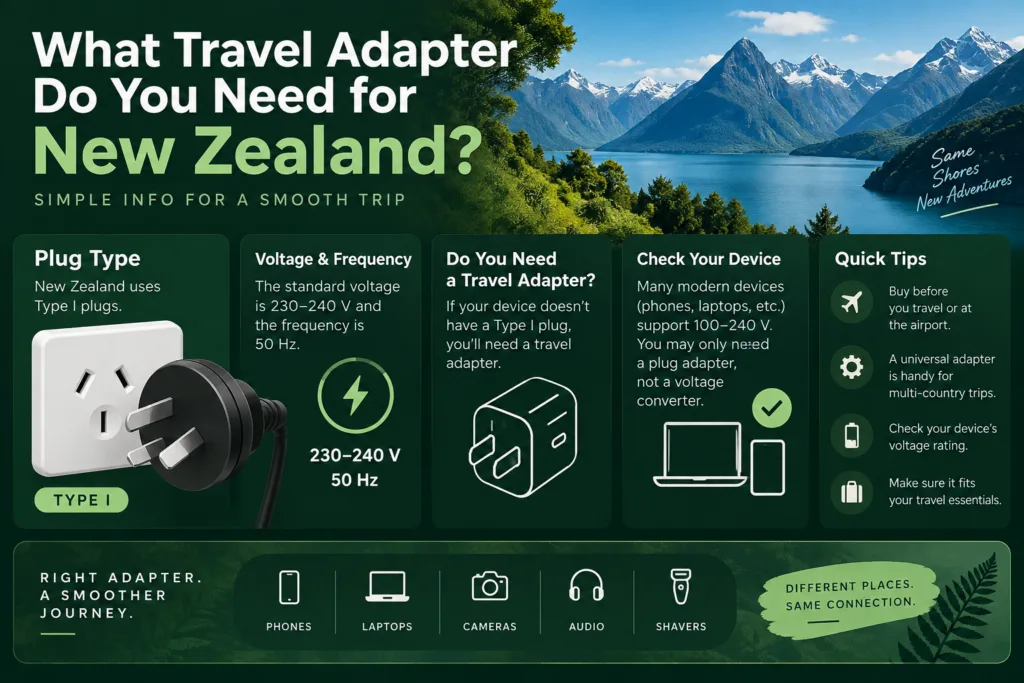
New Zealand uses Type I power outlets and a nominal 230 V, 50 Hz electricity supply. If the plug on your charger or appliance is not Type I, you will normally need a Type I travel adapter. Travelers from Australia usually do not need an adapter because the standard plug shape is the same.
The plug is only one part of the decision. A travel adapter changes how your plug fits the wall; it does not reduce New Zealand’s 230 V supply for a 110 V or 120 V appliance. Travelers from the United States, Canada, Japan and other lower-voltage countries should check the electrical input printed on each device or power supply before plugging it in.
New Zealand Uses the Type I Plug
The standard New Zealand outlet accepts a Type I plug. It is recognizable by two flat pins angled toward each other. Grounded versions add a third vertical earth pin.
Travel adapters are often sold as Australia/New Zealand adapters because Australia also uses Type I. An adapter labeled for Australia can therefore be suitable for New Zealand when it genuinely has the Type I plug configuration.
Do not rely only on words such as “international” or “universal” on the packaging. Check that the adapter actually provides Type I pins.
Your Home Plug Decides the Adapter; Your Device Decides the Voltage
| Traveling from | Typical home plug | What usually changes in New Zealand |
|---|---|---|
| United States / Canada | Type A or B | Type I adapter needed; 120 V-only devices require a separate voltage check |
| United Kingdom / Ireland | Type G | Type I adapter needed; normal mains voltage is usually compatible with suitably rated equipment |
| Continental Europe | Type C, E or F | Type I adapter needed; voltage is usually already in the same general range |
| Australia | Type I | Adapter usually not needed |
| Japan | Type A or B | Type I adapter needed; device voltage rating needs careful checking |
| Singapore / Malaysia | Usually Type G | Type I adapter needed; many devices are already suitable for 230 V supplies |
The country where you bought a device is useful context, but the actual plug and electrical label on the equipment are more reliable. Some countries use more than one plug type, and travelers may carry chargers bought abroad.
Look for the INPUT Rating Before You Plug In
Chargers and powered devices normally have an electrical label on the charging brick, power supply, base or appliance body. For New Zealand, the most useful line is the one beginning with INPUT.
This is a wide-range power supply. It normally accepts New Zealand’s 230 V, 50 Hz supply. If its plug does not fit Type I, a plug adapter is usually all that is required.
The stated range covers New Zealand’s nominal supply. You still need to solve any plug-shape difference.
A Type I adapter alone is not suitable. The adapter can make the plug fit without making the appliance compatible with 230 V electricity.
Do not assume compatibility from the plug shape. Check the original label, manual or manufacturer information before connecting the device.
A plug adapter does not convert 230 V into 120 V. If an appliance is rated only for 110–120 V, changing the plug shape does not make it safe for a New Zealand wall outlet.
Traveling From the US or Canada Requires Two Checks
Travelers from the United States or Canada will normally need a Type I adapter because Type A and Type B plugs do not fit standard New Zealand outlets. There is also a voltage difference: North American household equipment is commonly designed around 120 V, while New Zealand supplies 230 V.
Modern phone, tablet, camera and laptop chargers often avoid this problem because many power supplies accept 100–240 V, 50/60 Hz. The printed rating still needs to be checked rather than assumed.
The appliances that deserve more attention are devices that produce heat or use a relatively large amount of power. A North American hair dryer marked only 120 V, for example, should not be connected to a New Zealand outlet simply by adding a Type I adapter.
Hair dryers, straighteners and curling irons
Look specifically for terms such as dual voltage or an input range that includes 230 V. Some travel hair tools have a manual voltage selector; if so, it must be set according to the manufacturer’s instructions before use.
If a styling appliance is 120 V only, a voltage converter would need to be suitable for that exact appliance and its power demand. High-wattage heating appliances can exceed the capacity of small travel converters, so buying a plug adapter and an arbitrary converter is not a reliable combination.
UK and European Travelers Usually Have a Plug-Shape Problem
UK and Irish Type G plugs do not fit New Zealand Type I outlets, so a travel adapter is normally required. The electrical situation is simpler than for most North American travelers because UK and New Zealand mains supplies are both in the 230 V, 50 Hz range.
The same general pattern applies to many travelers from continental Europe. Type C, E and F plugs normally require a Type I adapter, while equipment designed for European 220–240 V supplies is commonly compatible with New Zealand voltage.
That does not remove the need to read the device label. It simply means that for many UK and European chargers, plug shape rather than voltage is the main difference.
Coming From Australia? You Usually Do Not Need an Adapter
Australia and New Zealand use the same Type I plug format and both operate on nominal 230 V, 50 Hz systems. An ordinary Australian phone charger, laptop power supply or similar device with an Australian Type I plug will therefore usually connect directly to a New Zealand outlet.
You may still need an adapter if the charger you are carrying was purchased in another country and has a different plug attached. Check the plug itself rather than assuming compatibility from where you currently live.
A 110 V Hotel Bathroom Socket Is Not the Same as a Normal New Zealand Outlet
Some New Zealand hotels and motels may provide a low-power 110 V bathroom socket intended for electric shavers. These outlets should not be treated as general-purpose North American sockets.
A shaver socket may have a low power limit and is not intended for equipment such as hair dryers, laptops, kettles or other normal room appliances. The ordinary wall outlets elsewhere in the room remain part of New Zealand’s 230 V electrical system.
Seeing “110 V” beside a bathroom shaver outlet does not mean the room has a general 110 V supply for US appliances.
What Common Travel Devices Usually Need
| Device | Typical situation | Check before use |
|---|---|---|
| Phone charger | Often adapter only | Look for 100–240 V on the charging brick |
| Laptop charger | Often adapter only | Read the input range on the power supply |
| Camera battery charger | Often adapter only | Confirm that 230 V and 50 Hz are covered |
| USB-C multi-port charger | Useful for several low-power devices | Check mains input rating and the USB output required by each device |
| Electric shaver | Model dependent | Check the shaver or charging base rating |
| Hair dryer | Needs extra care | Confirm 230 V compatibility and power requirements |
| Hair straightener / curling iron | Model dependent | Look for dual-voltage support or a range including 230 V |
| CPAP power supply | Model dependent | Use the manufacturer’s specified power supply and confirm its stated input range |
One Type I Adapter Can Be Enough for a Simple Charging Setup
If you are traveling with a phone, tablet, watch and other USB-powered devices, you do not necessarily need a separate wall adapter for every cable. A suitably rated multi-port charger with a Type I plug, or a compatible multi-port charger connected through one Type I travel adapter, can reduce the number of wall connections you need.
Check the charger’s mains input rating as well as its USB output. A charger supporting USB-C Power Delivery may provide different output levels depending on the port and the number of devices connected, so the destination plug adapter does not determine charging speed.
If your trip includes several countries with different outlet types, a universal travel adapter that explicitly includes Type I may be more practical. For a New Zealand-only trip, a dedicated Type I adapter is often simpler.
Grounded Equipment Needs an Adapter That Preserves Grounding
A two-pin Type I adapter may be adequate for a double-insulated charger that does not use an earth connection. Equipment supplied with a grounded three-pin plug is different.
If the original plug uses grounding, choose an adapter designed to maintain that earth connection. Do not remove or bypass a grounding pin merely to make a plug fit.
The Outlet May Have Its Own Switch
New Zealand wall sockets commonly include an individual power switch. If your adapter fits correctly and a known-working charger appears to receive no power, check whether the switch beside the outlet is turned on.
This does not affect adapter compatibility, but it can explain why a correctly connected charger initially appears not to work.
Before Connecting a Device in New Zealand
- Check whether the plug fits a Type I outlet.
- If it does not, use a travel adapter that explicitly supports Type I.
- Read the device or charger INPUT label and confirm that its voltage range includes 230 V.
- For 110–120 V-only equipment, do not rely on a plug adapter alone.
- Give extra attention to high-power heating appliances such as hair dryers.
- Preserve grounding when the original equipment uses a grounded plug.
- Treat 110 V hotel bathroom shaver sockets as dedicated low-power outlets rather than normal room sockets.
For most travelers carrying modern phones, laptops and camera chargers marked 100–240 V, 50/60 Hz, the New Zealand decision is straightforward: use a Type I adapter if your plug shape is different. Travelers bringing single-voltage 110–120 V appliances need to resolve the voltage issue before connecting them to New Zealand’s 230 V supply.