
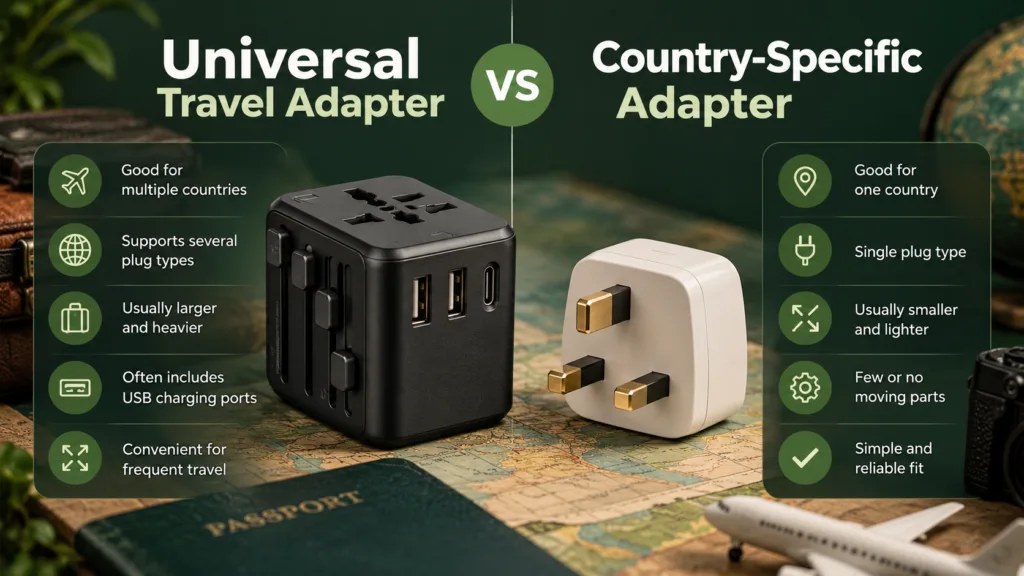
A universal travel adapter is usually the better choice for a trip that crosses several plug systems, while a country-specific adapter is often the better choice for one destination or repeated travel to the same place. The difference is mainly convenience versus simplicity: a universal adapter combines several plug configurations into one body, while a country-specific adapter is designed around one destination plug system.
Neither choice automatically solves a voltage mismatch. If your device cannot accept the voltage supplied at your destination, changing the plug shape alone will not make the device electrically compatible.
Universal and country-specific adapters solve the same problem differently
| Consideration | Universal travel adapter | Country-specific adapter |
|---|---|---|
| Best trip type | Multiple countries or several plug systems | One country or one known plug system |
| Plug coverage | Several configurations in one unit, depending on the design | Usually one destination plug configuration |
| Size | Usually larger and heavier | Usually smaller and lighter |
| Moving parts | Often uses sliders, retractable pins, locks or interchangeable mechanisms | Usually has few or no moving parts |
| Outlet fit | Can be bulky in recessed, loose or crowded outlets | Often sits closer to the wall and can provide a simpler mechanical fit |
| Grounding | Varies considerably by model and plug configuration | Can be easier to match to a grounded destination system when specifically designed for it |
| USB charging | Common on models with built-in USB-A or USB-C charging | Less common, though some models include USB ports |
| Packing for future trips | Convenient when destinations change frequently | You may need separate adapters for later trips |
When a universal travel adapter makes more sense
A universal adapter earns its space when your itinerary crosses several outlet systems. A traveler going from the United States to the United Kingdom, then to continental Europe and later to Australia would otherwise need multiple destination adapters. A compatible universal unit can combine those plug configurations into one device.
It is also useful when travel plans change often. If you do not yet know whether the next trip will be to France, Singapore, Japan or New Zealand, carrying one multi-country adapter can be simpler than maintaining a collection of individual pieces.
- Multi-country trips
- Long itineraries with stopovers in different regions
- Frequent international travel
- Travelers who want several USB charging ports in one unit
- Trips where minimizing the number of separate adapters matters more than minimizing adapter size
- Your destination uses a plug configuration the unit does not support
- You need dependable protective-earth continuity for grounded equipment
- The outlet is recessed or positioned where a large adapter may not fit well
- You regularly visit only one country
- You plan to connect a heavy power brick that may put strain on a bulky wall adapter
The word universal should not be interpreted as “works with every outlet in every country.” Coverage varies by product. Many multi-country adapters focus on common North American, European, British and Australian-style plug arrangements, but less common plug systems or particular socket designs may need another adapter.
Check the destination plug type against the adapter’s supported output configurations instead of relying on the word “universal” on the package.
Why a country-specific adapter can be the better tool
A dedicated adapter has a narrower job, and that can be useful. If you are traveling only from the United States to the United Kingdom, for example, you do not need mechanisms for European or Australian outlets. A straightforward US-to-UK adapter can be smaller, easier to pack and less awkward when connected to a wall socket.
The same applies to frequent travel between the same two countries. Someone who visits Germany several times a year may get more practical use from a compact adapter intended for compatible European sockets than from carrying a larger multi-region unit on every trip.
Country-specific models can also make the electrical path easier to understand. If you need a grounded connection, you can look specifically for an adapter designed to connect your home plug to the grounded system used at the destination rather than trying to determine whether one configuration of a multi-country adapter carries protective earth correctly.
Grounded plug compatibility deserves a separate check. An adapter may physically accept a three-pin plug without providing a protective-earth connection in every destination configuration. For equipment that requires grounding, verify that the adapter explicitly supports grounding for both the device plug and the destination outlet.
The voltage question is separate from the adapter question
A plug adapter changes how a plug connects to an outlet. It does not, by itself, change 230V electricity into 120V or 120V electricity into 230V.
This matters because two travelers using the same adapter may reach different decisions depending on the devices they carry.
Example: a modern phone charger
If the charger’s label says something such as Input: 100–240V, 50/60Hz, the charger is designed to operate across the voltage ranges commonly encountered during international travel. In that situation, the main problem is usually connecting the plug to the destination socket, so a suitable universal or country-specific adapter may be enough.
Example: a single-voltage appliance
If an appliance is marked only for 120V and the destination supplies around 230V, a travel adapter alone is not enough. The appliance would need to be evaluated for use with an appropriate voltage converter or transformer, or replaced with a version designed for the destination voltage.
The same caution applies in the opposite direction. A device intended only for a higher supply voltage may not operate correctly from a lower-voltage outlet even when the plug physically fits through an adapter.
Do not choose an adapter by plug shape alone. Check the voltage information on the device, charger or power supply before connecting it abroad. High-power heating and motor-driven appliances need particular care because converter suitability depends on more than plug compatibility.
Universal adapters have more mechanical compromises
Combining several plug systems into one housing requires more parts. Depending on the design, a universal adapter may contain retractable pins, shutters, sliders, locking mechanisms and multiple socket openings.
That does not automatically make a universal model unreliable, but it changes how the adapter behaves in real outlets. The larger body can protrude farther from the wall. A heavy laptop charger or another cable pulling downward can add leverage, especially in an older or loose socket.
Recessed outlets can create another problem. A plug mechanism may be electrically suitable for a country but still be difficult to seat fully if the adapter housing is too wide for the outlet recess.
A small destination-specific adapter normally has fewer of these mechanical constraints. For travelers who use one outlet standard repeatedly, that simplicity can matter more than having unused plug configurations available.
Built-in USB ports can change the decision
Universal adapters often include USB charging, which can reduce the number of separate chargers needed for phones, watches, earbuds and other low-power electronics. Some current designs also provide USB-C Power Delivery, though the available wattage differs between products and can be shared across ports.
That feature should be evaluated separately from AC outlet compatibility. The adapter’s USB charging electronics convert power for the USB ports, but that does not mean the AC socket portion acts as a voltage converter.
For a USB-C laptop, check the power required by the computer and the output available from the adapter’s USB-C port. A port that is adequate for a phone may charge a laptop slowly or may not provide enough power for normal use.
If you already carry a suitable multi-voltage USB-C charger with enough ports, built-in USB charging may add little value. A small country-specific plug adapter paired with your existing charger can be the cleaner setup.
Trip situations where the choice becomes clearer
| Travel situation | Usually the more practical choice | Reason |
|---|---|---|
| One week in a single country | Country-specific adapter | Small, simple and tailored to the outlet system you actually need |
| Three countries using different plug systems | Universal adapter | Avoids carrying several separate adapters |
| Frequent business trips to the same destination | Country-specific adapter | Repeated use favors a compact adapter with a straightforward fit |
| Backpacking through several regions | Universal adapter | More useful when the next outlet type changes repeatedly |
| Travel with grounded professional equipment | Depends on verified grounding support | Protective-earth continuity matters more than the universal or country-specific label |
| Phone, tablet and USB-C accessories only | Either | The better choice depends on whether your charger already accepts destination voltage and how many plug systems you will encounter |
| High-power hair appliance | Adapter choice is only part of the decision | Voltage rating, wattage and appliance design must be checked before use |
Check these details before buying either type
- Destination outlet support: confirm that the adapter actually has the plug configuration required where you are going.
- Device plug acceptance: confirm that your device or charger plug fits the input side of the adapter.
- Voltage compatibility: read the input rating on each charger or appliance that will connect directly to AC power.
- Grounding: if the equipment uses protective earth, verify that the adapter preserves it in the destination configuration.
- Maximum electrical rating: stay within the adapter manufacturer’s stated voltage, current and power limits.
- USB output: for adapters with USB ports, check the supported charging standards and available wattage rather than assuming every USB-C port can power a laptop.
- Physical fit: consider recessed sockets, crowded power strips and heavy chargers that may place extra strain on a wall-mounted adapter.
One adapter may not be enough for every trip
A universal adapter is most useful when flexibility matters. It reduces the number of separate pieces needed for an itinerary involving different outlet systems and can be especially convenient when USB charging is built in.
A country-specific adapter is often better when the destination is already known and unlikely to change. It can be smaller, mechanically simpler and easier to match to requirements such as grounding.
For many travelers, the most practical setup is not choosing one category forever. A universal adapter can cover mixed international itineraries, while a small destination-specific adapter can be kept for countries visited regularly.
The final check is always the device itself. Confirm its input voltage, determine whether grounding is required, then match the adapter to the destination outlet. Once those three pieces agree, the choice between universal and country-specific becomes much easier.