
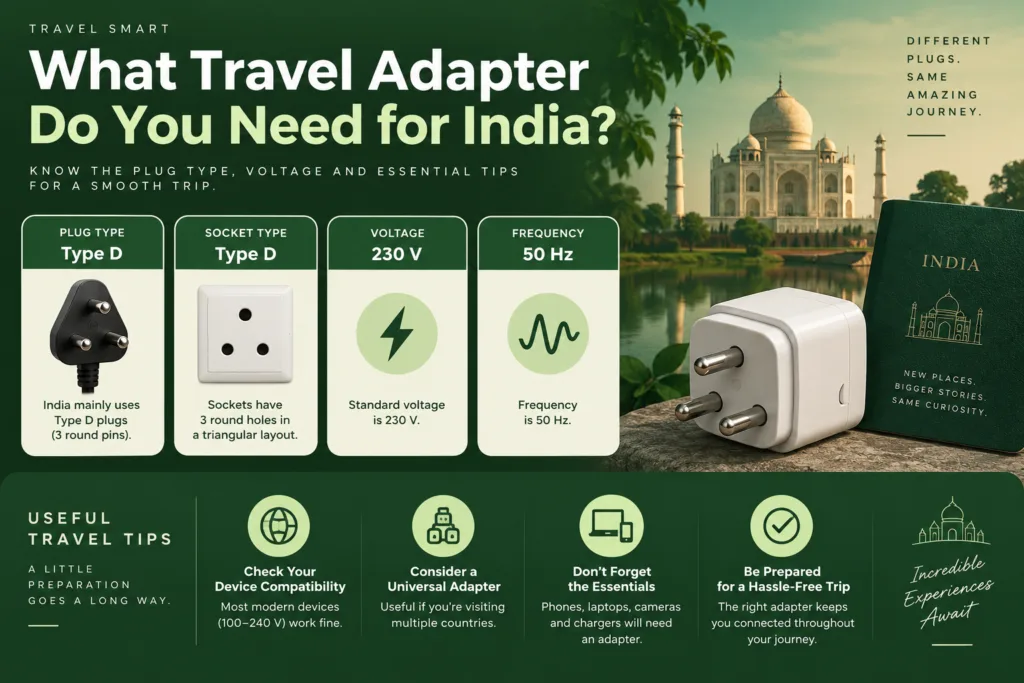
For India, the safest single-country choice is a travel adapter that properly supports Type D, the three-round-pin plug strongly associated with Indian household outlets. India supplies 230V electricity at 50Hz. Larger three-round-pin outlets commonly described as Type M are also used, while some two-pin and multi-standard sockets may accept Type C plugs.
If your charger is marked Input: 100–240V, 50/60Hz, you will normally need only the correct plug adapter. Travelers carrying a 110–120V-only appliance need to treat voltage as a separate issue because changing the plug shape does not make that appliance suitable for India’s 230V supply.
The adapter to pack for India
- Primary plug to support: Type D
- Larger outlet you may encounter: Type M-style 16A three-round-pin outlet
- Supply: 230V, 50Hz
- Phone or laptop charger marked 100–240V: normally needs an adapter, not a voltage converter
- 110–120V-only appliance: do not connect it to 230V with only a plug adapter
India’s Type D plug should be your starting point
Type D has three round pins arranged in a triangle. The upper earth pin is larger than the two current-carrying pins. For a traveler choosing one adapter specifically for India, proper Type D compatibility is more useful than relying on a two-pin European plug fitting whatever outlet happens to be available.
Type D support matters even when a hotel advertises universal sockets. Indian buildings can contain different socket designs depending on the installation, room, building age and equipment being powered. A multi-standard socket in one hotel does not mean the next accommodation will accept the same foreign plug.
A Type D adapter solves only the physical connection. The device still has to be suitable for 230V power.
Type D and Type M look similar but are not interchangeable
India also uses a larger three-round-pin arrangement associated with higher-current outlets. Travelers usually know this configuration as Type M. It resembles Type D, but its pins are larger and spaced farther apart.
A Type D adapter should not be forced into a larger Type M socket simply because both use three round openings. An adapter advertised as suitable for India should clearly state which Indian plug configurations it supports.
The larger socket is especially relevant when dealing with higher-current installations. It does not mean that a traveler charging a phone should seek out a Type M outlet; for ordinary travel electronics, Type D compatibility remains the more useful starting point.
India’s 6A and 16A outlets explain part of the plug difference
Indian plug and socket standards cover round-pin configurations at different current ratings, including 6A and 16A arrangements and combined socket designs. This helps explain why two outlets can both look recognizably Indian while having different pin sizes.
For travelers, the practical lesson is simple: physical fit and electrical capacity are separate checks. A small charger drawing modest power is a different case from a hair dryer, kettle or other high-wattage appliance.
Do not choose an adapter only because its pins appear to fit. Check its rated voltage and current as well, especially before connecting a heating appliance or another high-power device.
What you need depends heavily on where you are coming from
| Traveling from | Typical home plug | India plug decision | Voltage decision |
|---|---|---|---|
| United States or Canada | Type A / B | Pack a Type D-compatible adapter | Check carefully because many home appliances are made for about 120V |
| United Kingdom or Ireland | Type G | Pack a Type D-compatible adapter | Voltage is generally similar, so many devices do not need conversion |
| Continental Europe | Type C / E / F | Type D support is recommended rather than relying on two-pin compatibility | Voltage is generally similar |
| Australia or New Zealand | Type I | Pack a Type D-compatible adapter | Voltage and frequency are generally similar |
| Japan | Type A / B | Pack a Type D-compatible adapter | Check every device because Japan uses a much lower nominal voltage |
| Singapore or Malaysia | Type G | Pack a Type D-compatible adapter | Voltage is generally similar |
Coming from the United States or Canada
US and Canadian Type A and Type B plugs do not normally fit a Type D outlet, so an adapter is needed. The larger issue is the voltage change: India uses 230V, while standard household power in the United States and Canada is around 120V.
Phone chargers, laptop power supplies and many camera chargers often cover both systems. Look for wording such as:
Input: 100–240V ~ 50/60Hz
A charger with this input range is normally suitable for India’s 230V, 50Hz supply. You still need the correct plug connection.
A device labeled only 120V is a different case. Connecting it to Indian power through a simple plug adapter can expose it to roughly twice the voltage it was designed to receive.
Coming from the United Kingdom or Ireland
British and Irish Type G plugs have three rectangular pins and do not match India’s Type D socket shape. A physical adapter is therefore useful even though the electrical supply is much closer to what you use at home.
Many UK and Irish devices designed for 220–240V, 50Hz operation can use Indian electricity without voltage conversion. The label on the actual appliance or power supply remains the deciding information.
Coming from continental Europe
European travelers need a little more nuance. A two-round-pin Type C plug may fit some Indian two-pin or multi-standard sockets, but that possibility should not be treated as guaranteed compatibility throughout a trip.
Type E and Type F plugs also involve grounding arrangements that should not be ignored simply because the live and neutral pins are round. Carrying an adapter designed for Indian Type D outlets gives more predictable physical compatibility.
Voltage is usually less of a concern for equipment already designed for European 220–240V systems.
Coming from Australia or New Zealand
Type I plugs do not fit Type D outlets, so a plug adapter is needed. Australia, New Zealand and India operate within broadly similar household voltage ranges and use 50Hz power, which means voltage conversion is often unnecessary for ordinary equipment. Check the rating label before use rather than relying only on the country of purchase.
230V decides whether an adapter is enough
The printed input rating on your charger or appliance is more useful than the shape of its USB connector, its brand or the country where you bought it.
| Label | What it means in India |
|---|---|
| 100–240V, 50/60Hz | Normally compatible with India’s supply; use the correct plug adapter |
| 220–240V, 50Hz | Normally compatible with India’s supply |
| 220–240V, 50/60Hz | Normally compatible with India’s supply |
| 110–120V only | Do not use with only a plug adapter |
| Dual-voltage appliance with a manual selector | Set it to the correct voltage before connecting it |
| Unreadable or missing voltage label | Do not assume that it can accept 230V |
A travel adapter changes the mechanical connection between your plug and the wall socket. It does not step 230V down to 120V.
A voltage converter, when one is actually required, must also be suitable for the appliance’s power draw. This becomes particularly important with heating appliances because their wattage can be much higher than the wattage of a phone or laptop charger.
Phones and laptops are usually easier than heat appliances
Phone and USB chargers
Many modern phone wall chargers support 100–240V and 50/60Hz. If yours does, India’s supply is normally within the charger’s accepted range and the remaining problem is the plug shape.
Do not use USB-C as evidence that a charger is internationally compatible. USB-C describes the connection and charging system on the output side. The small print beside Input tells you what the charger can accept from the wall.
Laptop chargers
Laptop power bricks also commonly accept 100–240V, but the rating should be checked on the charger itself. A label showing 65W, 100W or 140W describes power capability; it does not replace the input-voltage rating.
If the laptop power cable uses grounding, use an adapter that preserves the intended earth connection rather than reducing it to an improvised two-pin connection.
Hair dryers, straighteners and other heating devices
These devices deserve more attention because they can draw far more power and are more likely to be sold in single-voltage versions.
US and Canadian travelers: a 120V-only hair dryer should not be connected to India’s 230V supply with only a plug adapter. Check for a dual-voltage setting or use an appliance designed for 220–240V.
A dual-voltage hair dryer may have a manual 120/240V selector. It must be put in the correct position before use. Hair straighteners and curling irons vary by model; some accept a wide voltage range and others do not.
For a high-power device, also confirm that any adapter or converter is rated for the appliance’s wattage and intended type of load. A tiny charger adapter that works well with a phone should not automatically be treated as suitable for a high-wattage heating appliance.
Do not depend on universal hotel sockets
Some Indian hotels, newer apartments and travel-oriented properties provide multi-standard outlets that accept several foreign plug shapes. USB-A or USB-C wall charging may also be available in some rooms.
These features are convenient when present, but they vary by property and even by room. A socket that accepts a US or European plug in Delhi does not establish what will be available later in Mumbai, Goa, Jaipur or another stop.
A universal-looking outlet also does not change India’s supply voltage. A 120V-only appliance remains a 120V-only appliance even if its plug happens to fit the socket without an adapter.
Traveling between Indian cities does not require a different national adapter
You do not need a Delhi adapter, a Mumbai adapter and a Goa adapter. The national electrical supply does not change plug system simply because you cross from one Indian city or state to another.
What can change is the installation in front of you. One room may have a standard three-round-pin socket, another may have a combined 6A/16A outlet, and another may provide a multi-standard hotel socket. Building age, renovation history and socket hardware can all affect what you physically see.
For a trip with several accommodations, carrying a well-rated adapter designed for Indian outlets is more dependable than planning around whatever universal socket may be provided.
How to choose between an India-specific and universal adapter
India-specific Type D adapter
- Suitable when India is your only destination
- Usually smaller than a multi-country unit
- Makes sense for phones, laptops and other compatible travel electronics
- Check whether the product also supports the larger Indian outlet configuration if you expect to need it
Universal travel adapter
- More useful for a multi-country trip
- May combine several plug systems in one unit
- Can reduce the number of separate adapters you carry
- India or Type D compatibility should be stated explicitly rather than assumed from the word “universal”
Whichever format you choose, check the adapter’s voltage and current rating. If it includes USB charging ports, those ports have their own output limits and should be evaluated separately from the AC socket rating.
A practical India power check before you plug in
- Look at your plug. If it is not made for India’s Type D arrangement, use a suitable adapter.
- Read the input label. Confirm that 230V is inside the device or charger’s accepted range.
- Check frequency when relevant. Chargers marked 50/60Hz are normally comfortable with India’s 50Hz supply; appliances containing frequency-sensitive motors or timing components may need closer checking.
- Check power ratings for heat appliances. Hair dryers, kettles, irons and similar devices can place much heavier loads on adapters and converters.
- Preserve grounding when the device requires it. Do not defeat an earth connection simply to make a plug fit.
- Do not force an unfamiliar outlet. If the pins do not align naturally or the connection feels loose, use the correct adapter or another socket.
Typical phone or laptop case: Type D-compatible adapter + charger marked 100–240V, 50/60Hz. A separate voltage converter is normally unnecessary.
Typical 120V-only appliance case: a plug adapter by itself is not enough for India’s 230V supply.