
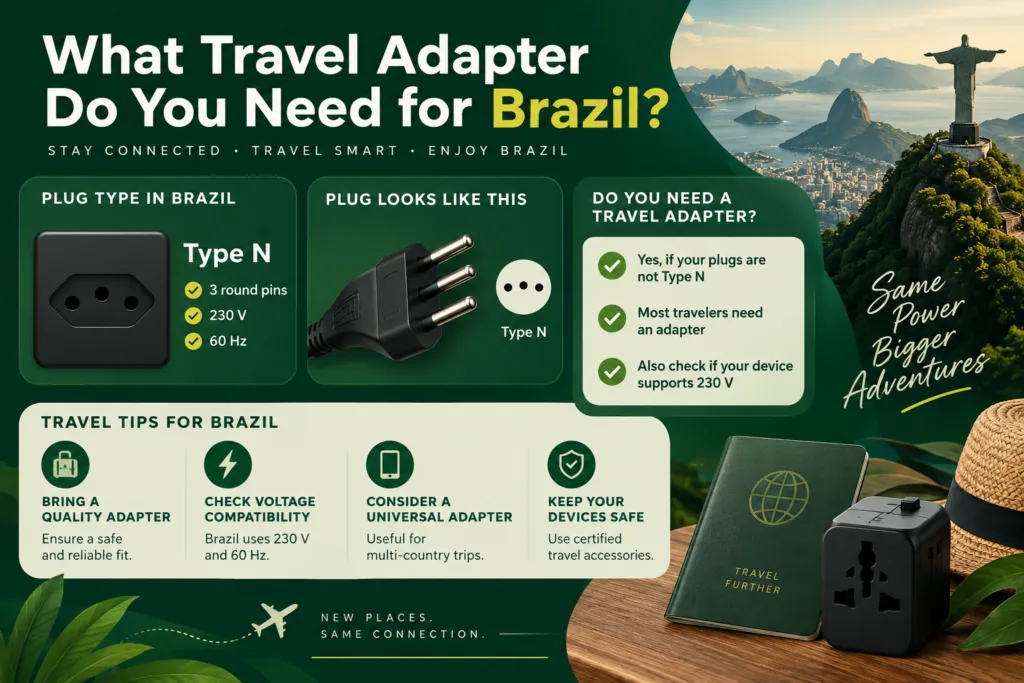
For Brazil, the safest general choice is a travel adapter that connects your plug to a Type N outlet. Travelers bringing US/Canadian Type A or B plugs, UK Type G plugs, or Australian/New Zealand Type I plugs will normally need an adapter. A small European Type C Europlug can fit Brazilian Type N sockets, so some two-pin European chargers need no plug adapter at all.
The part that needs more attention is voltage. Brazil uses both 127V and 220V electricity at 60Hz, and the Type N socket looks the same at either voltage. Before connecting anything that is not marked for a wide input range, check the voltage at your accommodation and the input rating printed on the device or charger.
Type N
Three-hole standardized socket. Small Type C Europlugs are physically compatible.
127V or 220V · 60Hz
The socket shape alone does not tell you which voltage is present.
Brazil’s Type N Outlet and the Type C Exception
Brazil’s standardized household plug and socket system follows ABNT NBR 14136. The wall socket has three round openings arranged in a triangular pattern. Local plugs may have two pins or three pins depending on the appliance and its grounding requirements.
This creates a useful exception for travelers from parts of Europe: the small two-pin Type C Europlug is compatible with the Brazilian Type N socket. A compact European phone charger with the familiar thin two-round-pin Europlug may therefore plug in directly.
Do not treat every European round-pin plug as Type C. Larger grounded Type E or Type F plugs, Schuko plugs, and other thicker round-pin designs should not be assumed to fit a Brazilian Type N outlet. If your plug is not the small two-pin Europlug, use a suitable Type N travel adapter rather than forcing the connection.
| Plug you are bringing | Common origin | Brazil result |
|---|---|---|
| Type A / B | United States, Canada, Japan and others | Travel adapter normally needed |
| Small Type C Europlug | Much of continental Europe | Usually fits Type N directly |
| Type E / F | Many European countries | Do not assume compatibility; use a Type N adapter when needed |
| Type G | United Kingdom, Ireland and others | Travel adapter needed |
| Type I | Australia, New Zealand and others | Travel adapter needed |
The Same Brazilian Socket Can Be 127V or 220V
Brazil cannot be reduced to a single national mains voltage. Both 127V and 220V supplies are used, and the local voltage can depend on the state, municipality or installation. Some accommodations may also provide outlets at more than one voltage.
This means the familiar travel shortcut of identifying voltage from the socket shape does not work in Brazil. A Type N socket in one destination may provide 127V while an identical-looking Type N socket elsewhere may provide 220V.
| Destination | Common nominal voltage | What to do before using a sensitive device |
|---|---|---|
| Rio de Janeiro | Commonly 127V | Confirm the actual outlet or accommodation supply |
| São Paulo | Commonly 127V | Local exceptions exist, so confirm before using single-voltage equipment |
| Brasília | 220V | Check 120V-only appliances before plugging in |
| Recife | 220V | Check the device input range |
| Fortaleza | 220V | Check the device input range |
| Manaus | 127V | Check devices designed only for 220–240V |
Use the city values as a planning aid rather than a guarantee for a particular wall socket. If voltage matters to your appliance, check with the hotel or property and look for voltage markings near the outlet.
Check the Input Label Before Deciding on a Converter
A Type N adapter only solves the physical plug connection. Whether you need voltage conversion depends on what your device is designed to accept.
This is the easiest case for Brazil. The power supply is designed to accept both of Brazil’s common voltage ranges and 60Hz frequency.
You would normally only need to solve the plug-shape issue.
Do not use the device on a 220V outlet with only a plug adapter.
Even where the local supply is 127V, follow the manufacturer’s stated input range rather than assuming that every 120V-only appliance is suitable.
The device may be suitable where 220V is supplied, but a 127V outlet is outside its stated range.
On lower voltage it may fail to operate correctly or perform poorly, depending on the appliance.
Some travel appliances have a 110/220V, 120/240V or similar selector.
Set the selector for the actual local supply before connecting the appliance.
Phones and Laptops Are Usually Simpler Than Heat Appliances
Modern phone chargers, USB-C wall chargers, camera chargers and laptop power supplies often carry a wide-range label such as Input: 100–240V ~ 50/60Hz. When your own charger has that rating, it can usually accept either 127V or 220V in Brazil without a voltage converter.
The cable connector does not prove this. A USB-C cable, Lightning cable or laptop charging cable says nothing about the AC input range of the wall charger. Read the small print on the charger or power brick itself.
Hair dryers, curling irons, straighteners, clothes steamers, travel kettles and similar heating appliances need more care. Many draw far more power than electronic chargers, and some are made for only one voltage range. A physical plug adapter cannot make a 120V-only hair dryer suitable for a 220V outlet.
For a high-wattage appliance, check three separate things: the device voltage rating, the adapter’s current or wattage rating, and the voltage of the outlet you will actually use. A plug fitting into the wall is not enough to establish electrical compatibility.
Why Brazil Has 10A and 20A Plug Sizes
The Brazilian standard distinguishes between lower-current and higher-current plugs. Inmetro describes 4.0 mm round pins for plugs rated up to 10A and 4.8 mm pins for plugs above 10A up to 20A.
The larger pins help prevent a higher-current 20A plug from being connected to a socket intended only for the lower-current configuration. Travelers are most likely to encounter the issue with high-power equipment rather than ordinary phone or laptop chargers.
| Brazilian plug rating | Pin diameter | Practical travel relevance |
|---|---|---|
| Up to 10A | 4.0 mm | Common low-to-moderate power equipment |
| Above 10A up to 20A | 4.8 mm | Higher-current equipment; do not bypass the larger-pin design with improvised adapters |
A universal travel adapter may have its own maximum current and wattage limits. Those limits still apply even when the adapter physically fits the Brazilian outlet.
What Travelers From Common Regions Should Bring
United States and Canada
Type A and Type B plugs do not normally fit Type N outlets, so pack a Type N adapter. Phone and laptop chargers marked 100–240V usually do not need voltage conversion.
Give extra attention to 120V-only appliances. A trip that includes both 127V and 220V areas makes it especially unsafe to assume that one voltage decision applies everywhere in Brazil.
United Kingdom and Ireland
Type G plugs require a Type N adapter. Many UK and Irish appliances are designed around 220–240V supplies, so plug shape is often easy to solve, but a 220–240V-only appliance still needs checking before use in a 127V area.
Continental Europe
If your charger uses the small ungrounded Type C Europlug, it will usually fit a Type N socket directly. Do not extend that rule to every European plug. Grounded Type E and Type F plugs should be checked separately and may require a Type N adapter.
European travelers also need to consider Brazil’s 127V areas. A device designed only for 220–240V should not be treated as universally compatible simply because its plug fits.
Australia and New Zealand
Type I plugs require an adapter for Brazilian Type N sockets. Many devices designed for Australian or New Zealand mains power are made for higher voltage, so check whether the appliance also accepts 127V if your itinerary includes a lower-voltage area.
A Three-Part Check Before You Plug In
- Match the plug. Your plug must fit a Type N socket directly or through a suitable travel adapter. Small Type C Europlugs are the main common exception.
- Match the voltage. Confirm whether the outlet is 127V or 220V, then compare it with the input range printed on your charger or appliance.
- Check the load for high-power devices. Hair dryers and other high-wattage appliances also need an adapter, converter or transformer rated for the actual electrical load. Do not choose one from plug shape alone.
For a typical phone or laptop charger marked 100–240V, 50/60Hz, the Brazil decision is usually simple: make sure the plug fits Type N and no voltage converter is normally required. For a single-voltage or high-power appliance, verify the local 127V or 220V supply before connecting it.