
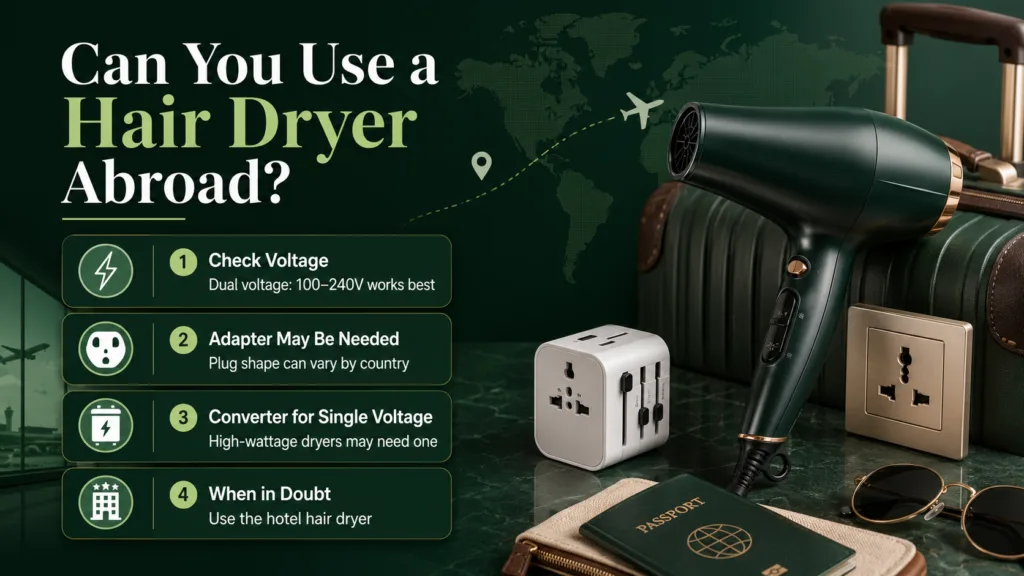
You can use a hair dryer abroad only if the plug shape, voltage, and device label match the country you are visiting. A simple plug adapter may let the plug fit, but a plug adapter does not convert voltage.
Hair Dryer Travel Power Visual
Hair Dryer Compatibility Checker
Use this simple checker before packing a hair dryer for another country. The safest answer depends on the label printed on the dryer, not only the plug shape.
A plug adapter does not convert voltage. It only helps the plug fit the destination outlet. A hair dryer is a high-power appliance, so voltage mismatch can damage the dryer, trip protection, or create a safety risk.
Quick Answer
A hair dryer is harder to travel with than a phone charger or laptop charger because it uses heat and draws more power. In most cases, the best option is to use a local hair dryer at the hotel, accommodation, gym, or buy a travel hair dryer rated for the country you are visiting.
| Hair dryer label | Can you use it abroad? | Adapter needed? | Converter needed? | Best advice |
|---|---|---|---|---|
| Input: 100–240V | Usually yes, if the plug fits or you have the correct adapter | Usually yes when plug shapes differ | Usually no | Check wattage and use only with a suitable outlet |
| 120V only | Usually not safe in many 220–240V countries | Plug adapter may be needed | May be needed, but not always practical for hair dryers | Use a local dryer or a travel model rated for the destination |
| 220–240V only | Usually not suitable in many 100–127V countries | Plug adapter may be needed | May be needed, but performance can be poor | Use a dryer made for the local voltage |
| No readable label | Do not guess | Unknown | Unknown | Do not use it abroad until the voltage rating is confirmed. |
Why Hair Dryers Are Different from Phone Chargers
Many phone chargers, laptop chargers, camera chargers, and USB power bricks are designed for travel. Their labels often say Input: 100–240V, which means they can usually accept common household voltage ranges used around the world.
A hair dryer is different. It is a heat appliance. It pulls far more power than a phone charger and can react badly to the wrong voltage. A small plug adapter will not make a 120V hair dryer safe in a 230V outlet.
If the dryer is not designed for the local voltage, the safest move is simple: do not plug it in.
How to Check the Hair Dryer Label
Before using a hair dryer abroad, look for a small printed label on the handle, body, cord tag, or plug. You are looking for the word Input, followed by voltage information.
If the label says Input: 100–240V
This means the dryer is usually designed to work across both lower-voltage and higher-voltage countries. You may still need a plug adapter if your plug does not physically fit the destination outlet.
Even then, check the wattage and use the dryer only where the outlet and accommodation rules allow it. Some bathrooms have shaver-only sockets that are not meant for hair dryers.
If the label says 120V only
A 120V-only hair dryer is commonly made for countries that use lower household voltage. If you take it to a country that commonly uses 220–240V, a plug adapter is not enough. The dryer may overheat, burn out, or fail quickly.
If the label says 220–240V only
A 220–240V-only hair dryer is commonly made for higher-voltage countries. If used in a lower-voltage country, it may run weakly, heat poorly, or not work as expected. A simple adapter does not solve that.
Plug Adapter vs Voltage Converter for Hair Dryers
A travel adapter and a voltage converter solve different problems.
| Item | What it does | What it does not do | Hair dryer caution |
|---|---|---|---|
| Plug adapter | Changes the plug shape so it can fit the outlet | Does not change voltage or frequency | Only useful when the dryer already supports the local voltage |
| Voltage converter | Changes voltage up or down | Does not change every travel power issue | Must be rated for the dryer’s wattage; many small converters are not enough |
| Dual-voltage travel dryer | Can usually work across common voltage ranges when set or rated correctly | May still need a plug adapter | Check the label and any voltage switch before use |
Because hair dryers use high wattage, voltage converters can be bulky, expensive, or unsuitable. Many travelers are better off packing a dual-voltage travel hair dryer or using one provided locally.
What “Input: 100–240V” Means
Input: 100–240V means the device is usually built to accept a wide voltage range. For many electronics, that is a good sign for international use.
For a hair dryer, still read the full label. Some models use a manual voltage switch. Others may list wattage limits or different heat settings by voltage. If there is a switch, set it correctly before plugging the dryer in.
If the label says something like 50/60Hz, that refers to power frequency. Many simple heating devices can tolerate both, but motors and timing parts may behave differently. For a hair dryer, voltage is usually the bigger issue, but 50Hz / 60Hz should still be checked when the label gives a clear rating.
Can You Use a 120V Hair Dryer in Europe?
In most cases, a 120V-only hair dryer should not be used in Europe with only a plug adapter. Many European countries commonly use around 230V household power. A 120V dryer connected to 230V can fail fast and may become unsafe.
A voltage converter may sound like a fix, but hair dryers often need high wattage. A small travel converter made for low-power electronics is not a good match. Check the dryer wattage and converter rating carefully, or avoid the setup.
Can You Use a 220–240V Hair Dryer in the USA?
A 220–240V-only hair dryer usually will not work well from a standard lower-voltage outlet in the United States. It may run slowly or produce weak heat. A plug adapter only changes the shape of the plug, so it does not raise the voltage.
If you are traveling to a lower-voltage country, bring a dryer rated for that voltage or use one available at your destination.
Device Risk: Hair Dryer vs Other Travel Devices
It helps to separate low-power chargers from high-power heat appliances. The adapter decision is not the same for every device in your bag.
| Device | Usually low-risk? | What to check | Travel advice |
|---|---|---|---|
| Phone charger | Often yes | Input: 100–240V | Usually needs only the correct plug adapter if dual voltage |
| Laptop charger | Often yes | Input label on the power brick | Most are travel-ready, but confirm the label |
| Camera charger | Often yes | Input voltage and plug type | Usually simple if rated 100–240V |
| Hair dryer | No | Voltage, wattage, frequency, and plug type | Use extra caution; many are single-voltage |
| Curling iron or hair straightener | No | Voltage rating and heat appliance warnings | Use only if rated for the destination voltage |
| Electric shaver | Sometimes | Input label and bathroom socket limits | Many are dual voltage, but shaver sockets can be limited |
| CPAP machine | Often travel-capable, but must be checked | Power supply label and medical device instructions | Confirm before travel and pack the correct adapter |
When a Plug Adapter Is Enough
A plug adapter may be enough for a hair dryer only when all of these are true:
- The hair dryer label supports the destination voltage.
- The plug adapter matches the destination outlet type.
- The outlet is suitable for a high-power appliance.
- The dryer wattage is allowed by the local socket and accommodation rules.
- Any manual voltage switch is set correctly before use.
If any of these points are unclear, do not use the dryer. Guessing is not worth it with heat appliances.
When a Voltage Converter May Be Needed
A voltage converter may be needed when your hair dryer is single-voltage and the destination country uses a different voltage range. For example, a 120V-only dryer taken to a 230V country is a mismatch.
However, a converter is not always the best solution for a hair dryer. Hair dryers can draw far more power than many travel converters can handle. If you choose a converter, it must be rated above the dryer’s wattage and made for high-power appliances. Many travelers skip this risk by using a local dryer instead.
Always check the device label before using high-power appliances abroad. A plug that fits the wall does not mean the device is safe to use.
What to Pack Instead
For most trips, the safest packing choice is simple: do not bring a single-voltage full-size hair dryer unless you know it matches the destination power supply.
- A plug adapter that matches the destination outlet type
- A dual-voltage travel hair dryer, if you need your own
- A photo of the dryer label, taken before packing
- A backup plan, such as hotel or local accommodation hair dryer availability
- A separate adapter for phone, laptop, and camera chargers
For longer stays, buying a local hair dryer can be easier than carrying converters and worrying about wattage limits.
Common Mistakes to Avoid
Using only a plug adapter with a single-voltage dryer
This is the most common problem. The plug may fit, but the voltage may still be wrong. A plug adapter does not convert voltage.
Assuming all bathroom outlets can power a hair dryer
Some bathroom outlets are designed for shavers or low-power devices only. Do not use a hair dryer in a socket marked for shavers only.
Ignoring the voltage switch
Some travel dryers have a manual voltage switch. If it is set to the wrong voltage, the dryer may fail even if it is sold as dual voltage.
Using a small converter for a high-wattage dryer
Many compact converters are not built for hair dryers. Check the wattage rating before use.
Simple Travel Decision
Your hair dryer says Input: 100–240V, the plug adapter matches the destination, and the outlet is suitable for a high-power device.
Usually workableYour dryer is 120V only, 220–240V only, has no readable label, or you are unsure about destination voltage.
Check firstFAQ
Can I use my hair dryer abroad with just a plug adapter?
Only if the hair dryer supports the destination voltage. A plug adapter changes plug shape only. It does not change voltage.
What happens if I plug a 120V hair dryer into a 230V outlet?
It may overheat, burn out, or become unsafe. Do not use a 120V-only hair dryer in a 230V country with only a plug adapter.
Is a dual-voltage hair dryer safe for travel?
Usually, yes, if the label supports the destination voltage and any manual voltage switch is set correctly. You may still need a plug adapter.
Do I need a voltage converter for a hair dryer?
You may need one if the dryer is single-voltage and the destination voltage is different. For hair dryers, the converter must be rated for high wattage, so using a local dryer is often easier.
Are phone chargers and hair dryers the same for travel power?
No. Phone chargers are often rated Input: 100–240V and use low power. Hair dryers use heat and high wattage, so they need extra caution.
Does 50Hz or 60Hz matter for a hair dryer?
Voltage is usually the main issue, but frequency can matter for some devices with motors. Check the full label for 50Hz / 60Hz support before use.