
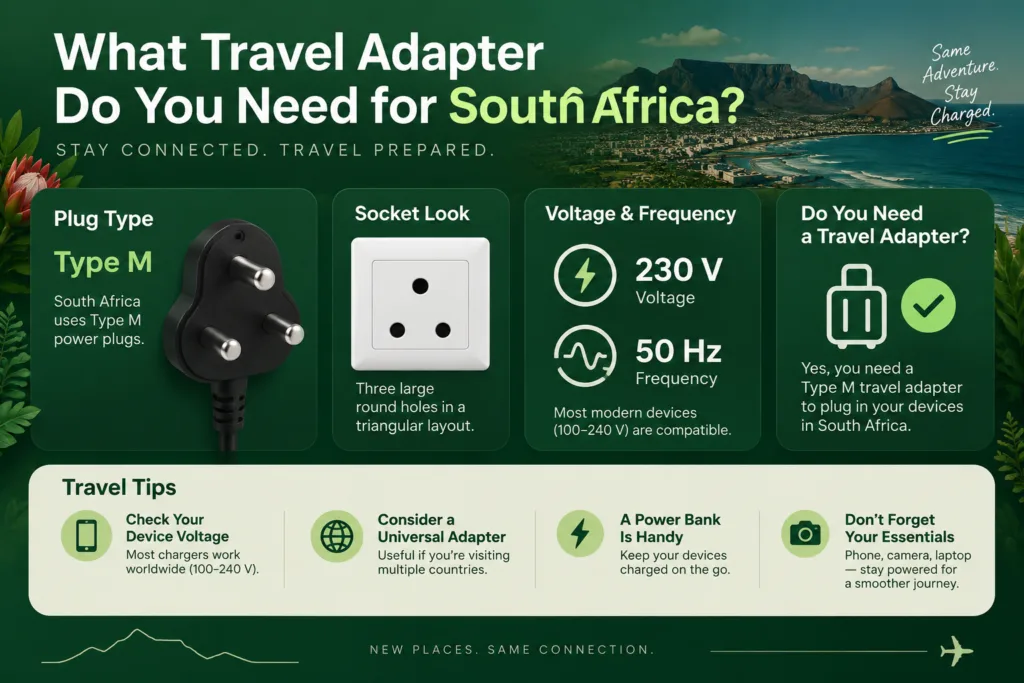
For South Africa, the safest travel-power setup is to prepare for Type M outlets and also understand Type N. South Africa uses a 230V, 50Hz supply. Type M, the large three-round-pin South African plug, remains common in existing buildings. Type N, the smaller SANS 164-2 three-pin system, is required at socket-outlet points in newer electrical installations under the national wiring code.
If you are arriving with a US, Canadian, UK, Australian, New Zealand, or most other non-South-African plugs, you will normally need an adapter. A traveler who wants coverage across older and newer accommodation should not assume that a Type M-only or Type N-only solution will cover every room.
South Africa Has Two Plug Systems You Need to Recognize
The unusual part of packing for South Africa is not the voltage. It is the coexistence of two socket systems.
Type M — SANS 164-1
Type M has three large round pins in a triangular arrangement. It is the familiar South African plug used across a large installed base of homes, hotels, offices, and other buildings.
Travel decision: do not leave for South Africa assuming a normal European two-pin adapter or a generic universal adapter will fit Type M. Check that the adapter specifically supports South Africa or Type M.
Type N — SANS 164-2
Type N is a much smaller three-round-pin system. South Africa’s wiring rules have required a SANS 164-2 socket at each socket-outlet point since 2018, while other socket configurations such as SANS 164-1 may also be installed at the same point.
Travel decision: Type N may appear in newer or renovated installations, but that does not mean Type M has disappeared.
What Adapter Should You Actually Pack?
For most visitors, the practical baseline is an adapter that explicitly lists South Africa / Type M. Type M is the outlet you are most likely to be unprepared for because its large round-pin layout is omitted from many compact travel adapters.
For broader coverage, make sure you also have a way to use a Type N socket. That can mean a travel-adapter set covering both Type M and Type N, or a separate Type M adapter plus a compatible solution for Type N. If your charger already has an ungrounded Type C Europlug, Type N is easier: the SANS 164-2 socket is designed to accept the two-pin Europlug.
Do not judge by the words “universal adapter” alone. Check the actual plug types on the adapter. A universal model can cover US, UK, European, and Australian patterns while still omitting the large Type M plug used in South Africa.
| Your usual plug | Type M outlet | Type N outlet | Practical packing choice |
|---|---|---|---|
| Type A / B — US, Canada | Does not fit | Does not fit directly | Carry South Africa Type M support and Type N-compatible support |
| Type G — UK, Ireland | Does not fit | Does not fit directly | Carry South Africa Type M support and Type N-compatible support |
| Type I — Australia, New Zealand | Does not fit | Does not fit directly | Carry South Africa Type M support and Type N-compatible support |
| Type C Europlug | Does not fit | Designed to be accepted | Type M adapter is still worth carrying because Type M remains common |
| Type E / F grounded European plug | Does not fit | Do not assume direct compatibility | Use adapters that preserve grounding when the device requires it |
| Type M | Fits the matching Type M socket | Does not fit | Add Type N coverage if you may encounter newer installations |
Why Type N Does Not Make Type M Obsolete for Travelers
South Africa is in a long socket transition rather than a clean overnight replacement. The South African Bureau of Standards states that, since 2018, the wiring code requires SANS 164-2 at every socket-outlet point. The same rule allows other configurations, including SANS 164-1, to be installed at that point as well.
That creates mixed real-world installations. A newer wall plate may include the smaller Type N socket alongside a Type M socket. An older property may still rely heavily on Type M. A renovated room may have a different mix from another room in the same property.
For travel planning, this means Type M should still be treated as an expected South African outlet, while Type N should be treated as part of the current system rather than an edge case.
The Type C Exception: Some European Chargers Have an Easier Time
A small two-pin Type C Europlug can be accepted by South Africa’s SANS 164-2 Type N socket. This is useful for many compact phone chargers, camera chargers, and other double-insulated devices that use the slim two-round-pin Europlug.
It does not solve the whole trip. Type C does not fit a Type M socket, and a grounded Type E or Type F plug should not be treated as if it were the same thing as an ungrounded Type C plug.
Grounding still matters. If the original plug or equipment requires a protective earth connection, use an adapter arrangement that maintains grounding. Do not remove the grounding path merely because a two-pin connection can be made to fit.
South Africa Is 230V, 50Hz: Check the Device Before You Plug In
South Africa’s nominal supply is 230V at 50Hz. The adapter only changes the physical connection. It does not make a 120V-only appliance suitable for 230V.
Label: Input 100–240V, 50/60Hz
This wide input range covers South Africa’s 230V, 50Hz supply. For a typical charger or power brick with this rating, the remaining problem is usually the plug shape.
Label: 110–120V only
Do not connect it to a South African outlet using only a plug adapter. The device is not rated for the local voltage. A properly matched converter may be required, and high-power appliances need extra care.
Travelers from the UK, Ireland, Australia, New Zealand, and many European countries often use devices already designed around roughly 220–240V systems, so voltage conversion is less likely to be the issue. Travelers from the United States or Canada need to look more closely at single-voltage appliances, even when their phone and laptop chargers are marked 100–240V.
Phones and Laptops Are Usually Simple; Heat Appliances Are Not
Most current phone chargers, USB-C wall chargers, laptop power supplies, and camera chargers are built with wide voltage inputs. If the power supply says 100–240V, 50/60Hz, a voltage converter is normally unnecessary in South Africa. You still need a plug arrangement that matches the socket in front of you.
Hair dryers, straighteners, curling irons, garment steamers, and other heating appliances deserve a separate check. A North American 120V-only hair dryer should not be connected to 230V through a basic Type M adapter. If a heat appliance is dual voltage, confirm the voltage setting and the manufacturer’s instructions before use.
For a high-wattage appliance, also check the current or power rating of the adapter and any converter. A physically compatible plug does not tell you how much load the adapter is designed to carry.
Type M and Type D Look Related, but They Are Different Sizes
Travelers sometimes confuse Type M with Type D because both have three round pins arranged in a triangle. Type M is the larger system. The pin dimensions and spacing differ, so a Type D adapter should not be bought as a substitute for a South Africa Type M adapter.
Type M
Large three-round-pin configuration associated with South Africa’s SANS 164-1 system.
Type D
Smaller three-round-pin configuration used in other markets. Similar appearance does not mean mechanical compatibility.
What You May Find in Hotels, Apartments, and Safari Lodges
Socket layouts can vary with the age and renovation history of a property. Newer electrical work may provide Type N, while Type M can remain on the same outlet plate or elsewhere in the building. Some hotels also install USB charging ports or multi-format sockets, but those are property features rather than something to rely on for a trip.
If you are staying in remote accommodation and depend on a particular powered device, confirm the available outlet type with the property before arrival. For ordinary phone and laptop charging, carrying Type M coverage plus a Type N-compatible option avoids depending on the room having one specific socket generation.
A Practical South Africa Packing Check
- Adapter: confirm that it specifically supports South Africa / Type M.
- Newer sockets: have a Type N-compatible option as well, unless your relevant two-pin Europlug already covers that connection.
- Voltage: check each charger or appliance for 230V support or a 100–240V input range.
- Grounding: keep the protective earth connection for equipment that requires it.
- High-power devices: check voltage, wattage, adapter rating, and converter rating rather than relying on plug fit alone.
For a typical traveler carrying a phone, laptop, camera, or similar electronics, the simplest setup is usually a South Africa-compatible Type M adapter, Type N coverage, and chargers marked 100–240V. That combination addresses both generations of South African outlets without adding a voltage converter that the devices may not need.