
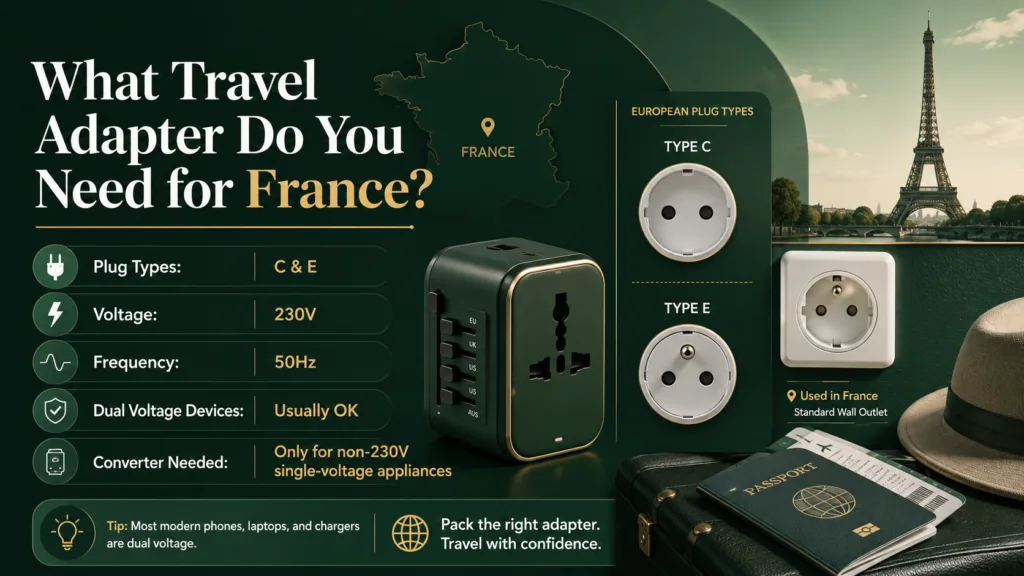
Plug Compatibility Visual
Traveling to France? You will usually need a travel adapter if your plug is not Type C or a France-compatible Type E plug. France commonly uses Type C and Type E power outlets, with 230V electricity at 50Hz. A plug adapter may solve the shape problem, but it will not make a 120V-only device safe to use.
Destination Adapter Checker for France
Use this quick decision box before packing. It is built for the most common travel situation: you know where you are coming from, and you want to know whether your charger or appliance will work in France.
France
Type C and Type E are commonly used.
230V, 50Hz
You usually need an adapter if your home plug is Type A, B, G, I, J, L, or another non-European plug shape.
A plug adapter does not convert voltage. If your device label says Input: 100–240V, it is usually designed to work on France’s 230V supply with the correct plug adapter. If it says only 110V, 120V, or a narrow range that does not include 230V, you may need a voltage converter or a different device.
Quick Answer
| Item | France Travel Power Answer |
|---|---|
| Destination | France |
| Common plug types | Type C and Type E |
| Voltage | 230V |
| Frequency | 50Hz |
| Plug adapter needed? | Usually yes for travelers from the US, Canada, UK, Australia, Japan, and many other countries with different plug shapes. |
| Voltage converter needed? | Usually no for dual-voltage phone and laptop chargers. May be needed for single-voltage appliances. |
| Best device advice | Check the label for Input: 100–240V before plugging in. |
What Plug Adapter Do You Need for France?
For France, most travelers should pack a travel adapter that fits Type E outlets and also supports Type C where needed. Type C is the familiar two-round-pin European plug. Type E also uses two round pins, but the wall socket may include a grounding pin.
If you are coming from the United States, Canada, Mexico, Japan, the United Kingdom, Ireland, Australia, New Zealand, Singapore, or countries using Type A, B, G, or I plugs, your plug will not normally fit French wall outlets directly. You will usually need a France travel adapter.
If you are coming from another European country, the answer depends on your plug. Many small two-round-pin chargers fit, but grounded plugs can vary. Some modern European plugs are designed to work with both Type E and Type F sockets. Older or non-hybrid grounded plugs may not fit every outlet in France.
What Power Outlets Are Used in France?
France commonly uses Type C and Type E sockets. In hotels, apartments, older buildings, airports, trains, and cafés, the exact outlet design can vary. The most useful travel adapter for France is one that clearly supports French Type E sockets.
Two round holes. Often used for small, ungrounded plugs and low-power chargers.
Two round holes plus a grounding pin in the socket. This is the important French outlet type to support.
Other outlet styles may appear in some places, especially in older buildings or multi-standard hotel sockets, but you should not rely on that. Pack for France’s common Type C / Type E setup.
Adapter Advice from Common Home Countries
| Home country or plug type | Will it fit in France? | What to pack |
|---|---|---|
| United States / Canada / Japan Type A or B | No, not directly | Pack a Type E-compatible travel adapter. Check voltage carefully. |
| United Kingdom / Ireland Type G | No, not directly | Pack a UK-to-France adapter. Voltage is usually less of a problem for UK devices, but still check the label. |
| Australia / New Zealand Type I | No, not directly | Pack a Type I-to-Type E/C adapter. |
| Turkey Type C / F | Many two-round-pin chargers may fit, but grounded plugs can vary | For grounded devices, use an adapter that supports French Type E if needed. |
| Most small European Type C chargers | Usually yes | You may not need a plug adapter for simple two-pin chargers. |
Voltage and Frequency in France
France uses 230V electricity at 50Hz. This matters because a plug adapter only changes the shape of the plug. It does not change the electrical supply coming from the wall.
If you are traveling from a 220–240V country, many of your devices may already be close to France’s voltage range. If you are traveling from a 100–120V country, such as the United States, Canada, or Japan, you need to check each device more carefully.
Frequency can also matter. France uses 50Hz. Many chargers do not care much about 50Hz or 60Hz if their label includes both. Some clocks, motors, and older appliances may not work correctly if they are made only for a different frequency.
How to Check the Device Label
Before using a device in France, look for the small printed label on the charger, power brick, or appliance body. You are looking for the word Input.
If the label says Input: 100–240V, 50/60Hz, the device is usually dual voltage. With the correct plug adapter, it should normally work in France.
If the label says only Input: 120V, 110V, or a narrow range that does not include 230V, do not assume it is safe. A voltage converter may be needed, or the device may not be suitable for travel use.
Always check the device label before using high-power appliances abroad. Hair dryers, curling irons, kettles, clothes irons, and similar heat-producing devices need more caution than phone chargers.
Will Your Phone Charger or Laptop Charger Work in France?
Most modern phone chargers, tablet chargers, camera chargers, and laptop power bricks are designed for international travel. Many show Input: 100–240V and 50/60Hz on the label. If yours does, you usually only need the correct plug adapter for France.
Still, do not guess based only on the device type. Check the label on the actual charger you plan to pack. A phone bought in one country may come with a different charger than the same phone sold elsewhere.
- For a phone charger, check the charger plug or USB power adapter.
- For a laptop, check the power brick, not just the laptop body.
- For a camera charger, check the charging dock or wall adapter.
- For a USB-C charger, check the printed input range before assuming it is travel-ready.
Hair Dryers, Curling Irons, Kettles, and Heat Devices
High-power appliances are the devices most likely to cause trouble when traveling to France. This includes hair dryers, curling irons, straighteners, electric kettles, clothes irons, and some grooming tools.
If a hair dryer from a 120V country is not dual voltage, plugging it into France’s 230V supply with only a plug adapter can damage the device and may be unsafe. A plug adapter does not convert voltage.
Some travel hair dryers and curling irons have a dual-voltage switch or label. If your device has a voltage switch, make sure it is set correctly before use. If the label does not clearly include 230V, it is safer not to use it in France.
Device Guidance for France
| Device | Plug adapter needed? | Voltage converter needed? | What to check |
|---|---|---|---|
| Phone charger | Usually yes if your plug shape is not Type C/E | Usually no if label says 100–240V | Check charger label for Input: 100–240V |
| Laptop charger | Usually yes if plug shape differs | Usually no for many modern power bricks | Check the power brick input range |
| Camera battery charger | Usually yes if plug shape differs | Often no, but check label | Look for 100–240V and 50/60Hz |
| Electric shaver | Usually depends on plug shape | Depends on model | Check whether the charger or shaver is dual voltage |
| Hair dryer or curling iron | Yes if plug shape differs | May be needed if not dual voltage | Check for 230V support before use |
| CPAP machine | Usually yes if plug shape differs | Often no if power supply says 100–240V, but verify carefully | Check the power supply label and pack any required medical-device accessories |
Plug Adapter vs Voltage Converter for France
A plug adapter changes the physical shape of your plug so it can fit a French wall outlet. It does not change 230V into 120V.
A voltage converter changes voltage for devices that cannot accept the destination voltage. It is mainly relevant for single-voltage appliances.
For phones and laptops, the charger label often solves the question. For heat devices and motor-based appliances, the label matters even more. If you cannot find a clear input rating, do not use the device with a simple adapter.
What to Pack for France
- A Type E-compatible travel adapter for France.
- A spare adapter if you need to charge multiple devices overnight.
- Your original phone and laptop chargers with readable input labels.
- A USB charger that clearly says Input: 100–240V, if you use USB devices.
- A voltage converter only if you have a single-voltage device that truly needs one.
- A safer alternative for high-power appliances, such as using hotel-provided hair dryers when available.
For a simple packing decision, match three things: your home plug shape, France’s outlet type, and your device voltage label. That is the core AdapterMatch idea: match your trip before you pack.
Common Mistakes to Avoid
- Buying only a cheap plug adapter and assuming it also changes voltage.
- Checking the phone but forgetting the laptop, camera charger, shaver, or CPAP power supply.
- Using a 120V-only hair dryer in France with only a plug adapter.
- Assuming every European grounded plug will fit every French outlet.
- Waiting until arrival to discover that one adapter is not enough for all devices.
FAQ
Do I need a travel adapter for France?
Usually yes if your plug is not Type C or a France-compatible Type E plug. Travelers from the US, Canada, UK, Australia, and many other countries normally need a plug adapter for France.
What plug type is used in France?
France commonly uses Type C and Type E power outlets. For travel, choose an adapter that supports French Type E sockets.
Does France use 220V or 230V?
France uses 230V at 50Hz. Some people casually say 220V when talking about European power, but you should check your device label against France’s 230V supply.
Can I charge my phone in France?
Usually yes. Most modern phone chargers are dual voltage, but check that the charger label says Input: 100–240V. You may still need a plug adapter so the charger fits the wall outlet.
Do I need a voltage converter for France?
You usually do not need a voltage converter for dual-voltage chargers. You may need one for single-voltage appliances, especially high-power items from 100–120V countries.
Can I use my hair dryer in France?
Only if the hair dryer is rated for 230V or clearly marked as dual voltage. If it is 120V-only, a simple plug adapter is not enough and may be unsafe.