
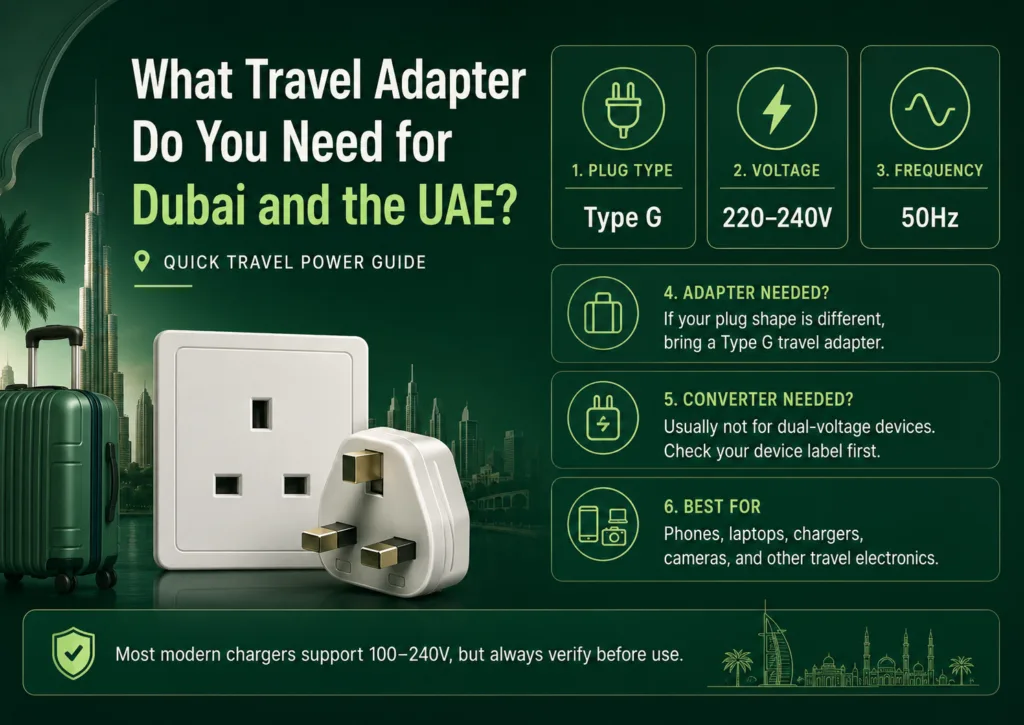
Plug Compatibility Visual
For Dubai and the UAE, travelers usually need a Type G travel adapter unless their plug already fits the same three-rectangular-pin socket used in the country. The UAE commonly uses 230V, 50Hz electricity, so many phone and laptop chargers work with only a plug adapter, but high-power appliances need closer checking.
Destination Adapter Checker for Dubai and the UAE
Use this quick decision box before packing your charger, hair dryer, laptop, camera charger, or medical device.
Dubai, Abu Dhabi, Sharjah, and the wider United Arab Emirates
Type G, the three-rectangular-pin socket.
You will usually need a Type G plug adapter if your home plug is Type A, B, C, E, F, I, J, L, or another non-Type G plug.
The UAE commonly uses 230V / 50Hz. Check your device label before plugging it in.
A plug adapter does not convert voltage. It only changes the shape of your plug so it can fit the wall outlet. If your device is not rated for 230V, you may need a voltage converter or a different travel-safe device.
Quick Answer
| Question | Answer for Dubai and the UAE |
|---|---|
| What plug adapter do I need? | Usually a Type G travel adapter. |
| What outlet type is used? | Dubai and the UAE commonly use Type G sockets. |
| What is the voltage? | Commonly 230V. |
| What is the frequency? | Commonly 50Hz. |
| Will my phone charger work? | Usually yes if the charger label says Input: 100–240V. You may still need a Type G adapter. |
| Do I need a voltage converter? | Only if your device is single-voltage and not suitable for 230V. High-power heat devices need extra caution. |
What Plug Adapter Do You Need for Dubai and the UAE?
For most travelers, the safest packing choice is a Type G plug adapter. Type G is the plug style with three rectangular pins, arranged in a triangular pattern. It is also the plug type used in the UK, Ireland, Singapore, Malaysia, and several other destinations.
If you are traveling from a country that already uses Type G plugs, your plug may fit UAE outlets without a separate plug adapter. If you are traveling from the United States, Canada, most of Europe, Australia, New Zealand, India, Japan, or many other countries, your plug shape will usually not fit directly.
Some hotels may provide multi-standard sockets or USB charging ports, but you should not rely on that. Outlet types can vary by hotel, apartment, airport lounge, and building age. A small Type G adapter is still worth packing.
Simple rule: If your plug is not Type G, pack a Type G travel adapter for Dubai and the UAE.
What Power Outlets Are Used in Dubai and the UAE?
Dubai and the wider UAE commonly use Type G power outlets. A Type G outlet has three rectangular openings. The top slot is for grounding, and the two lower slots are for the live and neutral pins.
Type G sockets are larger than the two-pin sockets used in much of Europe and are different from the flat-pin sockets used in the United States and Japan. A European Type C plug or US Type A plug will not normally fit a Type G outlet without an adapter.
Common home plug compatibility
| Home plug type | Common regions | Will it fit UAE Type G outlets? | What to pack |
|---|---|---|---|
| Type A / Type B | United States, Canada, Japan, Mexico | No, usually not | Type G plug adapter |
| Type C / Type E / Type F | Much of Europe | No, usually not | Type G plug adapter |
| Type G | UK, Ireland, Singapore, Malaysia | Usually yes | Adapter may not be needed |
| Type I | Australia, New Zealand, China, Argentina | No, usually not | Type G plug adapter |
| Type L | Italy and some other locations | No, usually not | Type G plug adapter |
Other plug types may also appear depending on your home country. The decision stays the same: match your home plug shape to the destination outlet shape. If the shapes do not match, you need a plug adapter.
Voltage and Frequency in Dubai and the UAE
The UAE commonly uses 230V electricity at 50Hz. This matters because a travel adapter only helps with plug shape. It does not make a 120V-only device safe on 230V power.
Many modern chargers are designed for travel. Phone chargers, laptop power bricks, tablet chargers, USB-C chargers, and camera chargers often support a wide input range. The label may say:
Input: 100–240V ~ 50/60Hz
If your charger label says this, it is usually designed to work on both 120V and 230V systems. You would normally need only the correct plug adapter for Dubai and the UAE.
If your device label says only 120V, 110V, or a narrow voltage range that does not include 220–240V, do not plug it directly into a UAE outlet with only an adapter. In that case, a voltage converter may be needed, or it may be better to use a travel version of the device.
The 50Hz / 60Hz frequency difference is usually not a problem for many chargers marked 50/60Hz. It can matter more for some motors, clocks, and appliances. For anything sensitive, expensive, medical, or high-power, check the label and manufacturer guidance before travel.
Plug Adapter vs Voltage Converter
A plug adapter and a voltage converter solve different problems.
A plug adapter changes the physical plug shape. For Dubai and the UAE, that usually means adapting your home plug to a Type G socket.
A plug adapter does not convert voltage.
A voltage converter changes electrical voltage. It may be needed when a single-voltage device is not designed for the UAE’s 230V supply.
Converters must be matched carefully to the device wattage, especially for heat appliances.
For phones and laptops, a converter is often not needed if the charger supports Input: 100–240V. For hair dryers, curling irons, clothes steamers, kettles, and travel irons, do not assume. These devices draw more power and are more likely to cause problems if the voltage is wrong.
Device Guidance for Dubai and the UAE
Phone chargers
Most modern phone chargers are made for international voltage ranges, but you should still check the small print on the charger. If it says Input: 100–240V, it can usually handle UAE voltage. You will usually need a Type G adapter if your charger plug is not Type G.
Laptop chargers
Laptop power bricks commonly support 100–240V, 50/60Hz. Check the label on the brick, not just the laptop. If the label includes 230V or 100–240V, a plug adapter is usually enough.
USB-C chargers and power banks
USB-C wall chargers are often dual voltage, but check the label. Power banks are charged through a wall charger, so the wall charger label is the part that matters for UAE outlet use.
Hair dryers and curling irons
Always check the device label before using high-power appliances abroad. Hair dryers, curling irons, hair straighteners, kettles, and travel irons can be risky if they are not rated for 220–240V. A plug adapter alone is not enough for a 120V-only heat appliance.
Electric shavers
Many electric shavers and toothbrush chargers are dual voltage, but some are not. Check for Input: 100–240V or a similar wide range. If the label is unclear, avoid guessing.
CPAP machines and medical devices
Many CPAP power supplies support wide voltage ranges, but you should verify the label before travel. Bring the correct Type G adapter, and consider carrying any device-specific power cable or backup plan recommended by the device maker. For medical equipment, do not rely only on a hotel adapter.
| Device | Plug adapter needed? | Voltage converter needed? | What to check |
|---|---|---|---|
| Phone charger | Usually yes, unless plug is Type G | Usually no if dual voltage | Look for Input: 100–240V |
| Laptop charger | Usually yes, unless plug is Type G | Usually no if the power brick supports 100–240V | Check the charger brick label |
| Camera charger | Usually yes, unless plug is Type G | Usually no if dual voltage | Check input voltage on the charger |
| Hair dryer | Usually yes, unless plug is Type G | May be needed if not 220–240V compatible | Check voltage and wattage carefully |
| Curling iron / straightener | Usually yes, unless plug is Type G | May be needed if single-voltage | Look for 220–240V or 100–240V |
| CPAP machine | Usually yes, unless plug is Type G | Depends on power supply label | Confirm voltage range before travel |
Adapter Advice from Common Home Countries
Traveling from the United States or Canada to Dubai
You will usually need a Type G adapter because US and Canadian Type A/B plugs do not fit UAE Type G outlets. Voltage is also different: the US and Canada commonly use around 120V, while the UAE commonly uses 230V. Phones and laptops often work if labeled Input: 100–240V, but 120V-only appliances should not be used with only an adapter.
Traveling from the UK to Dubai
UK plugs are Type G, so your plug may already fit many UAE outlets. Voltage and frequency are also generally similar. Still check your device label, especially for high-power appliances or older devices.
Traveling from Europe to Dubai
Most European Type C, E, and F plugs usually need a Type G travel adapter for Dubai and the UAE. Voltage is often similar to the UAE, so many European devices may not need a voltage converter, but plug shape is still different.
Traveling from Australia or New Zealand to Dubai
Australian and New Zealand Type I plugs do not usually fit UAE Type G outlets. You will usually need a Type G plug adapter. Voltage is often similar, but check each device label before use.
Traveling from India to Dubai
Many Indian plugs do not fit Type G outlets directly, so a Type G adapter is usually useful. Voltage is often similar, but plug shape can still be the main issue. Check the label on chargers and appliances before plugging them in.
What to Pack for Dubai and the UAE
- Type G travel adapter for each wall-powered device, or one adapter plus a suitable multi-port USB charger.
- Chargers labeled Input: 100–240V for phones, tablets, laptops, cameras, and USB devices.
- A device-specific cable for laptops, cameras, electric shavers, toothbrushes, and CPAP machines.
- A printed or saved photo of important device labels if you need to confirm voltage during travel.
- A travel-safe hair tool rated for 220–240V if you plan to use one.
- A backup charging option for important devices, especially medical or work devices.
Do not use a damaged, loose, or overheating adapter. If a plug feels unstable in the socket or a charger becomes unusually hot, unplug it and use a safer charging option.
Common Travel Power Mistakes in Dubai and the UAE
Assuming every hotel has universal sockets
Some hotels may offer multi-standard outlets, but not all rooms do. A Type G adapter is small and avoids last-minute airport shopping.
Using a plug adapter as if it were a converter
This is the biggest mistake. A plug adapter does not convert voltage. If your device cannot handle 230V, changing the plug shape does not make it safe.
Checking the cable but not the charger
The voltage label is usually on the charger, power brick, or device body. A USB cable alone does not tell you whether the wall charger is safe for 230V.
Packing a 120V-only hair dryer
A 120V-only hair dryer can be unsafe on UAE power with only a plug adapter. Use a dual-voltage travel model, a local appliance, or a hotel-provided option when available.
FAQ
Do I need a travel adapter for Dubai?
Yes, you usually need a travel adapter for Dubai if your plug is not Type G. Dubai and the UAE commonly use Type G outlets.
What plug type is used in the UAE?
The UAE commonly uses Type G sockets, the same three-rectangular-pin style used in the UK.
Can I charge my phone in Dubai?
Usually yes. Check the charger label for Input: 100–240V. If your plug is not Type G, you will also need a Type G adapter.
Do I need a voltage converter for Dubai and the UAE?
You may need a voltage converter if your device is single-voltage and not rated for 230V. Many phone and laptop chargers do not need one if they support 100–240V.
Can I use my US hair dryer in Dubai?
Only if it is clearly rated for 220–240V or 100–240V. Many US hair dryers are 120V-only, and a plug adapter alone does not make them safe for UAE power.
Is a universal adapter enough for Dubai?
A universal adapter may be enough for plug shape if it supports Type G output. It still does not convert voltage, so check the device label before use.