
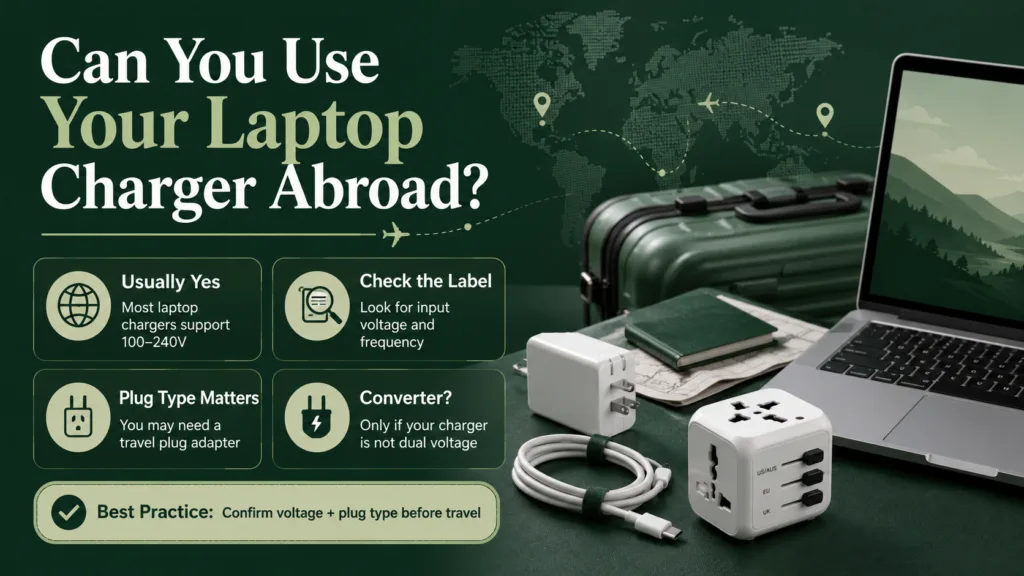
Laptop Charger Compatibility Visual
You can usually use a laptop charger abroad if the charger label says Input: 100–240V. In most cases, you only need a plug adapter for the destination outlet shape. A plug adapter does not convert voltage.
Laptop Charger Compatibility Checker
Use this quick checker before packing your charger. It is not a product recommendation; it is a practical travel power check based on the label printed on your charger.
Quick Answer
| What you checked | What it usually means | What to pack |
|---|---|---|
| Charger label says Input: 100–240V | The charger is usually dual voltage and can work in many countries. | A plug adapter for the destination outlet. |
| Charger label says only 110–120V | It may not be safe in 220–240V countries without the right voltage equipment. | Check manufacturer guidance before travel. |
| Charger label says only 220–240V | It may not work correctly in lower-voltage destinations. | Check the charger rating and destination voltage. |
| You cannot read the label | You should not guess, especially for an expensive laptop. | Bring the original charger or confirm the specifications before departure. |
Can You Use a Laptop Charger Abroad?
Yes, in many cases. Most modern laptop chargers are built to accept a wide input voltage range. The line to look for is usually printed on the power brick, not on the laptop screen or keyboard.
The label may read something like Input: 100–240V, 50–60Hz. That means the charger is usually designed to work on both lower-voltage and higher-voltage power systems. You still need to match the plug shape to the local wall outlet.
If your charger has a fixed input range, such as only 120V or only 230V, be more careful. A plug adapter alone is not enough when the voltage does not match.
How to Check the Laptop Charger Label
Look at the charger brick, usually on the side with small printed electrical text. You are looking for the word Input.
Input: 100–240V
This is the common travel-friendly range. It usually means the charger can accept power in many countries without a voltage converter.
50–60Hz
This means the charger is usually designed for both common power frequencies. Laptop chargers commonly handle frequency differences better than motor-based appliances, but the label is still the part to trust.
If the label is worn out, missing, or hidden, do not guess. Search the charger model number on the charger itself or use the original manufacturer specifications before using it abroad.
Plug Adapter vs Voltage Converter for Laptop Chargers
A travel plug adapter and a voltage converter solve different problems.
| Item | What it does | What it does not do |
|---|---|---|
| Plug adapter | Changes the physical plug shape so it can fit the destination socket type. | It does not convert voltage. |
| Voltage converter | Changes voltage for devices that cannot accept the local voltage. | It does not automatically make every device safe or suitable. |
| Laptop charger with 100–240V input | Usually accepts common international voltage ranges. | Still needs the right plug shape for the destination outlet. |
For a laptop charger marked Input: 100–240V, a plug adapter is usually enough for the outlet shape. A voltage converter is commonly not needed for that charger. For any charger with a narrow input range, check the label and destination voltage before plugging it in.
You Still Need to Match the Destination Outlet
Even when your laptop charger supports the local voltage, the plug may not physically fit the wall outlet. A laptop bought in the United States may have a Type A or Type B plug. A destination in much of Europe commonly uses Type C, Type E, or Type F outlets. The charger may handle the voltage, but the plug shape still needs an adapter.
Outlet types can vary by country, building age, hotel, airport, train, and coworking space. Some hotels provide universal-style sockets, but you should not count on that for every trip.
Laptop Chargers Compared With Other Travel Devices
Laptop chargers are usually lower-risk than heat appliances because many are dual voltage. Hair dryers, curling irons, travel kettles, and irons need extra caution because they draw more power and may be single voltage.
| Device | Plug adapter needed? | Voltage converter needed? | What to check |
|---|---|---|---|
| Laptop charger | Usually yes if the plug shape is different. | Usually no if the label says Input: 100–240V. | Charger brick input label. |
| Phone charger | Usually yes if the plug shape is different. | Usually no if it supports 100–240V. | Small print on the charger. |
| Camera charger | Often yes when outlets differ. | Depends on the input label. | Battery charger label, not just the camera model. |
| Electric shaver | Often yes when outlets differ. | Depends on whether it is dual voltage. | Device or charger label. |
| CPAP machine | Often yes when outlets differ. | Check the power supply label and medical device guidance. | Power supply, humidifier rating, and travel instructions. |
| Hair dryer or curling iron | Often yes when outlets differ. | May be needed if single voltage; many are high-power appliances. | Always check the device label before using high-power appliances abroad. |
What “Input: 100–240V” Means
Input: 100–240V means the charger is designed to accept a range of voltage, not just one country’s power system. This is why many laptop chargers work in North America, Europe, parts of Asia, Australia, and other regions when paired with the correct plug adapter.
The label may also include 50–60Hz. This refers to power frequency. For laptop chargers, a 50Hz / 60Hz label usually means the charger is made to handle both common frequency systems.
This does not mean every device connected to electricity is safe everywhere. The wide input range must be printed on the specific charger or power supply you plan to use.
When a Plug Adapter Is Usually Enough
A plug adapter is usually enough for your laptop charger when all of these are true:
- The charger label says Input: 100–240V.
- The frequency line says something like 50–60Hz.
- You have the correct adapter for the destination outlet type.
- The charger and cable are in good condition.
- You are using the original charger or a charger with the correct rating for your laptop.
If any of these checks fail, slow down before plugging in. Laptop chargers are replaceable, but the laptop and your data may not be.
When a Voltage Converter May Be Needed
A voltage converter may be needed when a device is single voltage and the destination voltage is different. For laptop chargers, this is less common with modern chargers, but it can still happen with older, unusual, damaged, or replacement chargers.
If your charger says only 110–120V and you are going to a 220–240V destination, do not use a simple plug adapter as the only solution. If your charger says only 220–240V and you are going to a lower-voltage destination, it may not charge correctly or may not work as expected.
What to Pack for a Laptop Abroad
- Your laptop charger with a readable input label.
- The correct plug adapter for the destination country.
- A spare charging cable if your charger uses a detachable cable.
- A compact power strip only if it is rated for the destination voltage and allowed by your accommodation.
- A power bank for phone backup, not as a replacement for your laptop charger.
- Manufacturer details for your charger if the label is hard to read.
For work trips, keep your charger in your carry-on bag. Airport, hotel, and coworking adapters may not match your exact plug type, and replacement chargers can be hard to find on arrival.
Common Laptop Charging Mistakes Abroad
Assuming the adapter converts voltage
This is the main mistake. A plug adapter does not convert voltage. It only changes the plug shape.
Checking the laptop instead of the charger
The voltage input is usually printed on the charger brick or power supply. The laptop model name alone is not enough.
Using a random replacement charger
A replacement charger may not have the same input range or output rating as the original. Check its label before using it abroad.
Forgetting detachable power cords
Some laptop chargers have a detachable wall cord. In that case, you may be able to use a destination-compatible cord with the same charger brick, but only if the cord and charger are rated properly.
Treating laptop chargers like hair dryers
Laptop chargers and hair dryers are not the same kind of travel power risk. Laptop chargers are often dual voltage. Hair dryers, curling irons, kettles, and irons can be high-power and need extra caution.
FAQ
Do I need a voltage converter for my laptop charger abroad?
Usually not if the charger label says Input: 100–240V. You may still need a plug adapter for the destination outlet shape.
Can I plug my laptop charger into a foreign outlet with only an adapter?
Yes, in many cases, but only after checking the charger label. If it supports the destination voltage range, a plug adapter is usually enough for the plug shape.
What happens if my laptop charger is not dual voltage?
If the charger is single voltage and the destination voltage is different, a simple plug adapter may not be safe. Check the charger specifications before using it.
Does 50Hz or 60Hz matter for laptop chargers?
Most laptop chargers that say 50–60Hz are designed for both common power frequencies. Check the printed label on the charger you are carrying.
Is a universal adapter enough for a laptop charger?
A universal adapter may solve the plug shape problem. It does not convert voltage. Your laptop charger should still say Input: 100–240V or match the destination voltage.
Should I use the same rule for hair dryers and curling irons?
No. Hair dryers, curling irons, travel kettles, and irons are high-power appliances. They need a separate label check and may need a different travel power solution.