
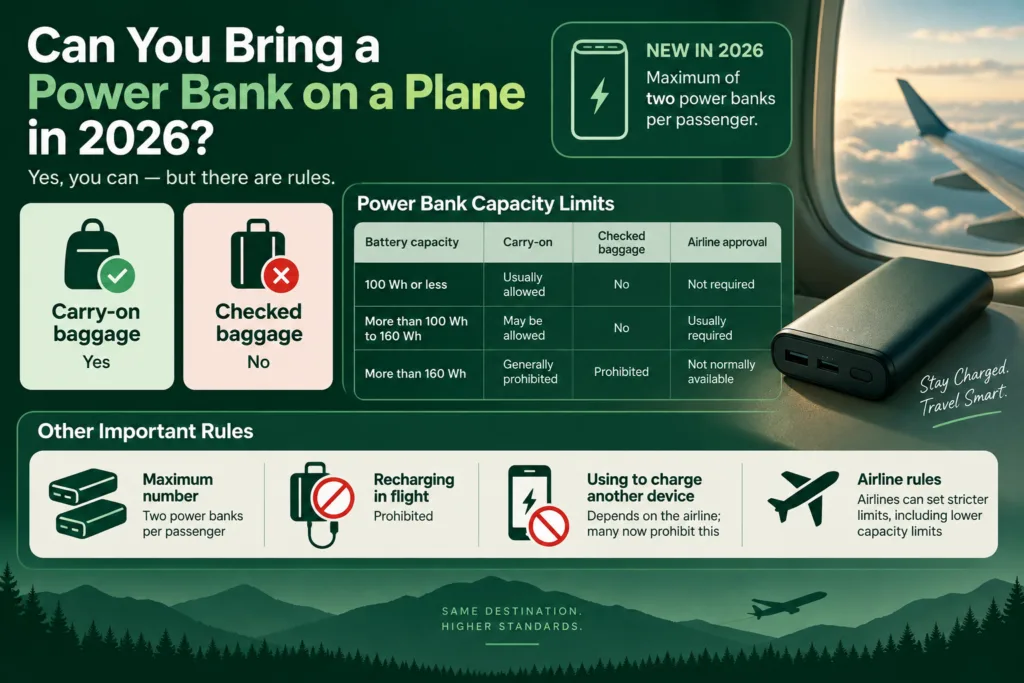
Yes, you can bring a power bank on a plane in 2026, but it belongs in your carry-on baggage, not your checked suitcase. For most travelers, a power bank rated at 100 watt-hours (Wh) or less is allowed without prior airline approval. Larger units above 100 Wh and up to 160 Wh may require airline approval, while power banks above 160 Wh are generally prohibited on passenger aircraft.
There is also an important 2026 change: ICAO’s international Technical Instructions now set a limit of no more than two power banks per passenger and prohibit recharging a power bank aboard the aircraft. However, the practical rule for a specific trip also depends on how the relevant country has implemented the ICAO change and whether the operating airline applies its own restrictions.
Power Bank Flight Rules for 2026
- Carry-on baggage: Yes
- Checked baggage: No
- ICAO maximum number: Two power banks; national implementation and airline rules must also be checked
- Up to 100 Wh: Normally allowed without airline approval
- Above 100 Wh to 160 Wh: Airline approval may be required
- Above 160 Wh: Generally prohibited on passenger aircraft
- Charging the power bank in flight: Prohibited under the 2026 ICAO rules
- Using it to charge another device: ICAO recommends against it; many airlines prohibit it
What Changed for Power Banks in 2026?
On March 27, 2026, the International Civil Aviation Organization introduced additional power-bank restrictions through an addendum to its Technical Instructions. The updated rules separate power banks from ordinary spare batteries and place a maximum of two power banks per passenger.
The rules also prohibit recharging a power bank while aboard the aircraft. ICAO recommends that passengers not use a power bank to recharge another portable electronic device during flight, and several airlines have gone further by prohibiting power-bank use entirely while airborne.
This distinction matters because being permitted to carry a power bank does not automatically mean you are permitted to use it during the flight.
ICAO rule → national implementation → airline policy: ICAO sets the international aviation baseline, but IATA’s 2026 operator guidance notes that legal enforceability depends on how each State adopts the change. Adoption may be immediate in one country and require an administrative or legislative process in another. The operating airline may also impose stricter limits.
Why the US Rule Can Look Different
The United States provides a useful example. Current FAA PackSafe guidance states that there is no general quantity limit for most rechargeable lithium batteries of 100 Wh or less when they are carried for the passenger’s personal use. The FAA’s two-spare-battery limit applies to larger lithium-ion batteries in the 101–160 Wh range, which also require airline approval.
The FAA also notes that airlines may set stricter quantity and Wh limits for power banks and portable chargers. For a US itinerary, do not assume that the ICAO two-power-bank baseline, the FAA passenger rule and an individual airline’s policy will always be worded identically. Check the rules that apply to the operating airline and route before travel.
Power banks are also a common passenger item. An IATA passenger survey found that 44% of travelers carry a power bank, compared with 83% carrying a phone and 60% carrying a laptop.
Power Bank Capacity Limits
| Battery capacity | Carry-on | Checked baggage | Airline approval |
|---|---|---|---|
| 100 Wh or less | Usually allowed | No | Normally not required |
| More than 100 Wh, up to 160 Wh | May be allowed | No | Usually required |
| More than 160 Wh | Generally prohibited | Prohibited | Not normally available for ordinary passenger power banks |
The number printed in watt-hours is more important for air travel than the advertised milliamp-hour capacity. Look for markings such as 37 Wh, 74 Wh or 99.9 Wh on the power bank itself.
How to Convert mAh to Wh
Power banks are commonly advertised as 10,000 mAh, 20,000 mAh or 30,000 mAh, while airline rules are written in watt-hours.
If the manufacturer provides the battery’s nominal voltage, you can calculate its energy rating with:
Wh = (mAh ÷ 1,000) × voltage
For example, using a nominal battery voltage of 3.7 V:
| Advertised capacity | Calculation | Approximate energy |
|---|---|---|
| 10,000 mAh | 10 × 3.7 | 37 Wh |
| 20,000 mAh | 20 × 3.7 | 74 Wh |
| 26,800 mAh | 26.8 × 3.7 | 99.16 Wh |
| 30,000 mAh | 30 × 3.7 | 111 Wh |
| 50,000 mAh | 50 × 3.7 | 185 Wh |
These are calculation examples, not a substitute for the manufacturer’s rating. Some battery packs use a different nominal voltage, so use the Wh value printed on the power bank whenever one is available.
A power bank with no readable capacity information may cause problems at security or boarding. Some aviation authorities and airlines require the battery rating to be clearly identifiable.
100W Is Not the Same as 100Wh
A label such as 100W USB-C, 140W PD or 65W output describes how quickly the power bank can deliver power. It does not describe how much energy the battery stores.
Airline battery restrictions are based primarily on watt-hours (Wh), not the charger’s maximum output in watts (W).
A 20,000 mAh power bank, for example, could support 100W or 140W USB-C charging while still having a battery capacity well below 100 Wh. Check the battery-energy line on the label rather than judging it by the USB-C charging speed.
Why Can’t a Power Bank Go in Checked Baggage?
A power bank is treated as a spare lithium battery because its primary purpose is to supply electricity to another device. Spare lithium batteries and portable chargers must remain in the aircraft cabin where a battery problem can be noticed and handled by the crew.
If your cabin bag is unexpectedly taken from you at the gate and placed in the cargo hold, remove the power bank before handing over the bag.
This applies even when you originally packed the power bank correctly in carry-on baggage.
Where Should You Keep It During the Flight?
Keeping a power bank in your cabin bag is not always the end of the rule. Some airlines now require power banks to remain accessible rather than being stored in an overhead compartment.
Depending on the airline, you may be instructed to keep it:
- in a bag under the seat in front of you;
- in the seat-back pocket; or
- in another location where it can be reached quickly if it overheats.
Do not assume the overhead bin is permitted simply because the power bank is in cabin baggage.
Can You Use a Power Bank During the Flight?
Rules on use are stricter in 2026.
Under the 2026 ICAO rules, passengers must not recharge a power bank from the aircraft’s USB socket or in-seat electrical outlet. ICAO also recommends against using a power bank to recharge another portable electronic device while aboard the aircraft. Individual airlines may turn that recommendation into a mandatory prohibition.
Singapore Airlines, Emirates, Turkish Airlines, Jet2 and Lufthansa prohibit using a power bank to charge another device during the flight. Ryanair takes a different approach: its current policy permits a power bank to charge a personal electronic device except during taxi, take-off and landing, or when the crew instructs otherwise.
Check your operating airline rather than relying only on the general battery-capacity rule.
Airlines Can Set Stricter Power Bank Limits
Jet2 issued another passenger reminder on August 26, 2026, stating that power banks belong in hand luggage rather than hold baggage and should be kept under the seat instead of in the overhead locker. Its current restricted-items rules also specify the quantity, capacity and in-flight-use limits.
| Airline | Published rule |
|---|---|
| Singapore Airlines | Maximum two power banks. Up to 100 Wh without prior approval; 100–160 Wh requires approval. No in-flight use or charging and no overhead-bin storage. |
| Emirates | Maximum one power bank, no more than 100 Wh. No in-flight use or charging and no overhead-bin storage. |
| Turkish Airlines | Maximum two power banks up to 100 Wh. They must remain accessible, cannot be stored in overhead bins and cannot be used or charged during the flight. |
| Jet2 | Maximum two power banks, each no more than 160 Wh. Carry-on only and the hand luggage containing them must be kept under the seat. They cannot be charged or used to power another device onboard. Jet2 provides automatic operator approval for power banks above 100 Wh up to 160 Wh. |
| Lufthansa | Maximum two power banks. Units up to 100 Wh can be carried in the cabin; power banks above 100 Wh up to 160 Wh require operator approval. They must not be stored in the overhead locker and cannot be used or charged onboard. |
| Ryanair | Maximum two power banks, each no more than 100 Wh. They must be carried on the passenger or in an under-seat cabin bag, not in the overhead locker. The power bank itself cannot be recharged onboard, but it may charge a personal device except during taxi, take-off and landing or when instructed otherwise by the crew. |
The differences are practical. Jet2 accepts power banks up to 160 Wh with automatic approval for the 100–160 Wh range, Lufthansa requires approval above 100 Wh, Ryanair caps power banks at 100 Wh, and Emirates permits only one. A battery that is acceptable under one airline’s policy may not meet another airline’s limits.
China Has an Additional Power Bank Rule
Passengers taking domestic flights in mainland China should check the power bank itself for its certification marking. The Civil Aviation Administration of China prohibits power banks without a valid, clearly visible CCC marking, as well as affected recalled models or batches, on domestic flights.
This requirement has applied since June 28, 2025 and remains an extra consideration beyond the usual Wh capacity limits.
India Has a Model-Specific Power Bank Ban
India has a separate restriction for one named power bank model. In a circular dated September 29, 2026, the Directorate General of Civil Aviation (DGCA) prohibited the MOBIKINS MK-PB-04 power bank from being carried or transported on any flight to, from or within India.
The prohibition covers cabin baggage, checked baggage and cargo. This is a model-specific ban, not a blanket ban on all power banks in India. Other power banks remain subject to the applicable capacity, baggage, national and airline rules.
On October 11, an IndiGo flight from Delhi to Chennai diverted to Hyderabad after a passenger’s power bank caught fire in an overhead bin. The DGCA circular predates that incident, so the October event did not create the September restriction, but it brought renewed attention to power-bank fire risk and onboard storage.
Do Not Fly With a Swollen or Damaged Power Bank
A power bank should not travel simply because its capacity is below 100 Wh. A battery that is swollen, cracked, leaking, unusually hot or subject to a safety recall may be prohibited.
Do not attempt to solve a damaged battery problem by putting the power bank in checked baggage. A damaged lithium battery can present a fire risk regardless of where it is packed.
If a power bank becomes unusually hot, expands, smokes or burns during a flight, stop handling it unnecessarily and tell the cabin crew immediately.
How to Pack a Power Bank for Airport Security
- Keep the power bank in your carry-on baggage or with you.
- Do not put it in checked luggage.
- Confirm that the Wh rating is visible on the casing.
- Check the ICAO two-power-bank baseline, the rules applicable to your route and your operating airline’s quantity limit.
- Protect the power bank from damage and accidental short circuits.
- Keep exposed battery terminals or connectors away from loose metal objects.
- Remove the power bank if your cabin bag is gate-checked.
- Do not travel with a swollen, damaged or recalled unit.
- Check whether your airline prohibits overhead-bin storage.
- Check whether your airline prohibits using the power bank during flight.
- If your trip is to, from or within India, do not carry the MOBIKINS MK-PB-04 model.
Can You Take a 20,000 mAh Power Bank on a Plane?
Usually, yes. Many 20,000 mAh power banks have an energy rating below 100 Wh and therefore fall within the standard cabin-baggage allowance.
The exact answer depends on the voltage and Wh rating printed by the manufacturer. A 20,000 mAh pack rated at 3.7 V works out to approximately 74 Wh, for example.
Can You Take a 30,000 mAh Power Bank?
Do not decide from the 30,000 mAh number alone. At a nominal 3.7 V, 30,000 mAh equals approximately 111 Wh, which is above the normal 100 Wh threshold.
A power bank in the 100–160 Wh range may be accepted only with airline approval under the applicable rules, and some airlines do not accept power banks above 100 Wh at all.
Can You Put a Power Bank in Your Personal Item?
Yes, provided your airline permits the power bank itself. A backpack, handbag or other personal item carried into the cabin can normally be used to transport it.
For airlines that prohibit overhead-bin storage, keeping the power bank in a personal item beneath the seat can also make it easier to comply with accessibility requirements.
The Safest Rule to Follow Before Boarding
For a typical phone power bank, the easiest combination is a clearly labeled unit below 100 Wh, packed in carry-on baggage and kept accessible during the flight. Do not place it in checked baggage, do not recharge the power bank aboard the aircraft, and check your airline’s policy before using it to charge another device.
For quantity limits, check all three layers that can affect the trip: the ICAO international baseline, the applicable national rules, and the operating airline’s policy. If the power bank is above 100 Wh, has no readable capacity marking, is damaged, or your trip involves a stricter airline or jurisdiction, confirm the exact requirements before arriving at the airport.