
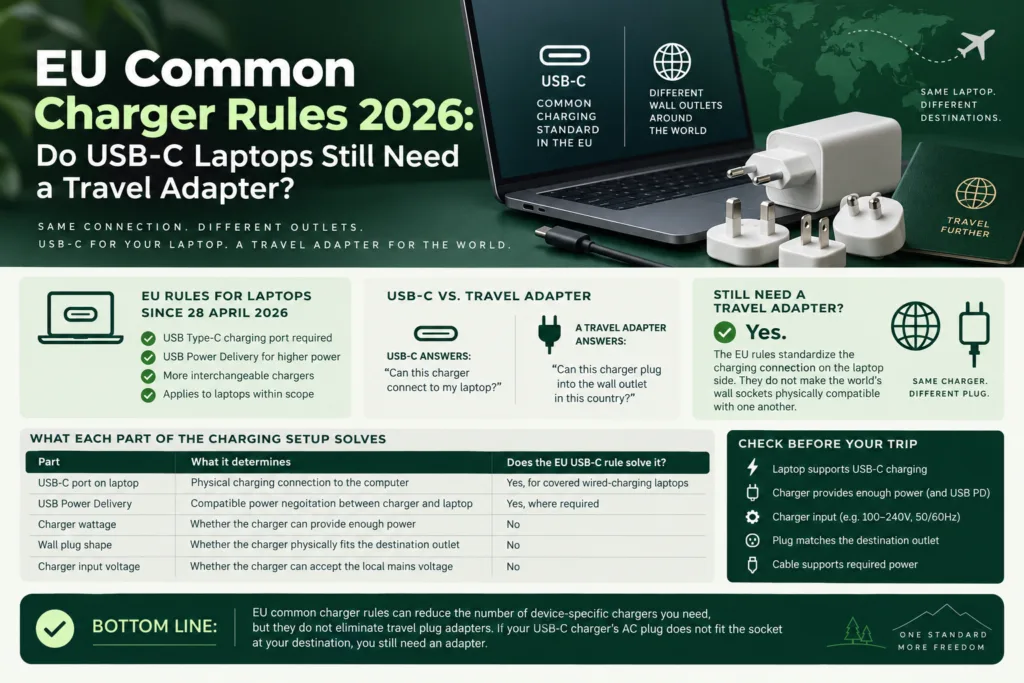
Yes. A USB-C laptop can still need a travel adapter. The EU common charger rules standardize the charging connection on the laptop side; they do not make wall sockets around the world physically compatible with one another.
Since 28 April 2026, the EU common charger requirements also apply to laptops within the rules’ scope. A laptop that uses wired charging must support the required USB Type-C charging connection, and laptops using higher-power charging must support USB Power Delivery as specified by the EU rules. That makes chargers and cables more interchangeable, but the charger still has to connect to the electrical outlet at your destination.
The travel decision
USB-C answers: “Can this charger connect to my laptop?”
A travel adapter answers: “Can this charger plug into the wall outlet in this country?”
Voltage compatibility answers: “Can the charger safely accept the electricity supplied there?”
What changed for laptops in the EU in 2026?
The EU’s common charger requirements already applied to phones and several other portable electronics from 28 December 2024. Laptops joined the covered categories on 28 April 2026.
For laptops capable of wired charging, the rules require an accessible USB Type-C charging receptacle. Where charging exceeds 5 volts, 3 amperes or 15 watts, the equipment must also incorporate USB Power Delivery. A manufacturer may support another charging technology as well, but it cannot prevent the required USB Power Delivery functionality from working.
This is why a compliant new laptop sold in the EU can increasingly share a suitable USB-C charger with other USB-C equipment instead of depending entirely on a proprietary laptop connector.
The rule does not mean that every USB-C charger delivers enough power for every laptop. A small phone charger may physically connect to a laptop but provide less power than the computer needs for normal charging, charging during heavy use or its fastest supported charging rate.
USB-C did not replace national wall plugs
The USB-C requirement concerns the connection between compatible charging equipment and the electronic device. It does not turn the world’s AC outlets into USB-C sockets, and it does not establish one physical mains plug for every country.
A laptop charger still receives power from a wall outlet. The plug attached to that charger may fit your destination directly, or it may need a plug adapter.
| Part | What it determines | Does the EU USB-C rule solve it? |
|---|---|---|
| USB-C port on laptop | Physical charging connection to the computer | Yes, for covered wired-charging laptops |
| USB Power Delivery | Compatible power negotiation between charger and laptop | Yes, where the charging characteristics trigger the USB PD requirement |
| Charger wattage | Whether the charger can provide enough power | No; you still need suitable charger output |
| Wall plug shape | Whether the charger physically fits the destination outlet | No |
| Charger input voltage | Whether the charger can accept the local mains voltage | No |
When a USB-C laptop still needs a travel adapter
You normally need a travel adapter when the mains plug on your laptop charger does not fit the outlet used at your destination.
For example, a charger fitted with a continental European two-pin plug will not plug directly into a standard UK Type G outlet. The same charger will also need the appropriate physical adapter for common outlets in countries such as the United States, Japan or Australia.
The reverse is also true. A traveler arriving in continental Europe with a charger carrying a US, UK or Australian plug may need an adapter even though the laptop itself charges through USB-C.
The connector on the laptop does not determine the wall adapter. Two travelers can own the same USB-C laptop and need different travel adapters because their charging bricks have different AC plugs.
When you do not need a travel adapter
No travel adapter is needed if your charger already has a plug that fits the destination outlet.
You may also avoid a separate adapter if your charging setup uses interchangeable AC plug heads and you have the correct head for the destination, or if you use a suitable USB-C charger designed with the destination’s mains plug.
Some hotels, airports and other locations provide USB-C charging outlets, but they should not be treated as the only charging option for a laptop. Available power can vary, and a USB-C socket that works for a phone may not provide the wattage your laptop expects.
Do you need a voltage converter as well?
Usually not for a modern USB-C laptop charger, but check the charger’s input label rather than assuming.
Many laptop power supplies accept a wide AC input range such as 100–240V, 50/60Hz. A charger marked this way is designed to accept the common mains voltages encountered in many countries. If the plug shape is different, you generally need a travel plug adapter rather than a voltage converter.
For example, if a charger says:
Input: 100–240V ~ 50/60Hz
and its required input includes the electricity supplied at your destination, the remaining issue is normally physical plug compatibility.
A travel plug adapter changes the physical connection. It does not convert the mains voltage.
If the charger’s stated input range does not include the local supply voltage, do not rely on a basic plug adapter. Check the manufacturer’s specifications for that charger before connecting it.
Your USB-C charger still needs enough power
USB-C describes the connection, not one fixed charging wattage. Laptop power requirements vary.
If your laptop normally uses a 65W USB-C charger, replacing it with a low-power USB-C phone charger does not make the chargers equivalent simply because both have USB-C connectors. The laptop may charge slowly, charge only while sleeping, display a low-power warning or continue losing battery during demanding use.
For travel, check three things together:
- The charger supports USB Power Delivery when required by the laptop.
- The charger can provide the power level your laptop needs.
- The USB-C cable supports the required charging power.
The laptop or charger documentation is the best place to confirm the expected power rating. EU charging information supplied with covered products is also intended to help buyers determine the minimum and maximum charging power supported by the equipment.
A 2026 EU laptop does not guarantee worldwide plug compatibility
The phrase “common charger” can make the rule sound broader than it is. In practical travel terms, the EU has made the device-side charging connection more interoperable. It has not abolished Type A, B, C, E, F, G, I and other mains plug systems used in different destinations.
Even travel within Europe does not make wall-plug compatibility automatic. Several European destinations use socket systems that differ from the common continental Type C/E/F arrangements. Ireland, for example, uses Type G outlets, so a charger with only a continental European plug generally needs a physical plug adapter there.
What to check before your trip
- Look at the laptop charging port. Confirm that the laptop accepts USB-C charging rather than assuming every USB-C port on a computer is a charging input.
- Check the charger’s output. Make sure it provides the power and USB Power Delivery support your laptop requires.
- Read the AC input label. An input range such as 100–240V, 50/60Hz generally removes the need for a voltage converter within that stated range.
- Compare the charger’s mains plug with the destination outlet. If they do not physically match, take the appropriate travel plug adapter.
- Check the cable rating. High-power laptop charging may require a cable rated for the charging power being used.
Bottom line: The EU’s 2026 laptop rules can reduce the number of device-specific chargers and cables you need, but they do not eliminate travel plug adapters. If your USB-C charger’s AC plug does not fit the socket at your destination, you still need an adapter. If the charger also accepts the destination’s mains voltage, a separate voltage converter is normally unnecessary.
EU common charger sources
The 2026 laptop requirements are based on Directive (EU) 2022/2380 amending the Radio Equipment Directive and the European Commission’s common charging guidance. The rules have applied to laptops since 28 April 2026 and cover USB Type-C charging, USB Power Delivery where applicable, charger unbundling and charging information supplied to consumers.