
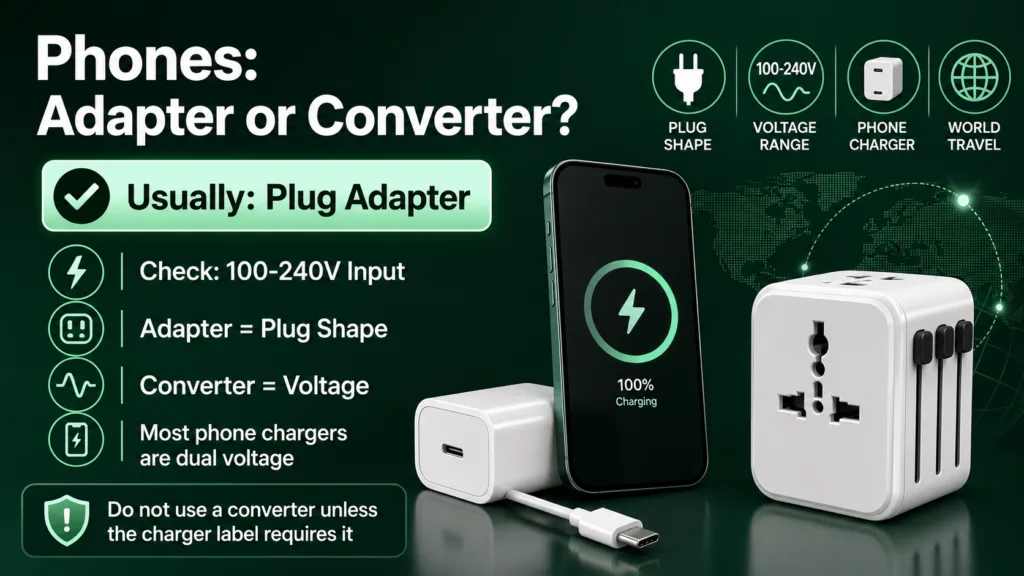
Phones usually need a plug adapter when the plug shape does not fit the destination outlet, but they usually do not need a voltage converter if the charger label says Input: 100–240V.
Phone Charger Travel Power Visual
Phone Travel Power Checker
Use this simple checker to decide whether your phone needs a plug adapter, a voltage converter, or just a charger label check before travel.
Quick Answer
Most phones do not need a voltage converter for international travel because many original and quality replacement phone chargers are designed for wide voltage input. The label should say something like Input: 100–240V, 50/60Hz. If it does, the charger can usually handle common travel voltage ranges.
You may still need a travel plug adapter. The adapter only helps the charger plug fit the wall outlet in your destination country. It does not make a 120V-only charger safe on 230V power.
| Question | Usual Answer | What to Check |
|---|---|---|
| Does a phone need a plug adapter? | Often yes, if the plug shape is different. | Compare your home plug type with the destination outlet type. |
| Does a phone need a voltage converter? | Usually no, if the charger says Input: 100–240V. | Read the charger label, not only the phone brand or model. |
| Does frequency matter? | Usually not for phone charging. | Look for 50/60Hz on the charger label. |
| Is a universal adapter enough? | It may be enough for plug shape. | It still does not convert voltage unless it clearly says it includes conversion. |
Plug Adapter vs Voltage Converter for Phones
A plug adapter changes the physical shape of the plug so it can fit a different wall outlet. For example, a charger bought in the United States may need an adapter to fit outlets in much of Europe, the UK, Australia, or many other destinations.
A voltage converter changes electrical voltage. That is a different job. Phones are low-power devices, and the charger normally handles the voltage conversion internally when it is rated for Input: 100–240V.
The safe order is simple: first match the plug shape, then check the charger label. Do not assume a plug adapter makes the charger electrically compatible.
How to Read the Phone Charger Label
Look for the small printed text on the wall charger, USB charger, wireless charging pad power supply, or travel charger. The word you need is usually Input.
Input: 100–240V, 50/60Hz
This usually means the charger can work in both 120V and 230V countries. You may still need a plug adapter for the outlet shape.
Input: 100–120V only
This is not a wide-range charger. A voltage converter may be needed, but for phones it is usually better to use a clearly rated dual-voltage charger.
If the label is worn, too small to read, missing, or printed only on packaging you no longer have, treat it with caution. A modern phone may be fine, but the charger is the part that connects to the wall power.
What “Input: 100–240V” Means
Input: 100–240V means the charger is designed to accept a range of wall voltages. This range covers the two common travel power situations: about 100–127V in some countries and about 220–240V in many others.
If the label also says 50/60Hz, the charger is normally designed for both common power frequencies. For phone chargers, frequency is usually not a problem when the charger label covers both 50Hz and 60Hz.
The output side is different. You may see text such as Output: 5V, 9V, or other USB charging values. That describes what the charger sends to the phone. For travel safety, the first thing to check is the wall-side Input rating.
When a Plug Adapter Is Enough
A plug adapter is usually enough for a phone when all three points are true:
- The destination outlet does not match your charger plug shape.
- Your charger label says Input: 100–240V.
- The charger and cable are in good condition.
In that situation, the plug adapter lets the charger fit the wall outlet, and the charger itself handles the voltage range. This is common for phone chargers, tablet chargers, camera battery chargers, and many laptop chargers.
When a Voltage Converter May Be Needed
A voltage converter may be needed if the charger is single-voltage and the destination uses a different voltage range. For example, a charger marked only for 100–120V should not be used on 220–240V power with only a plug adapter.
For phones, the better travel choice is usually not a bulky voltage converter. It is often simpler and safer to use a properly rated USB charger that clearly says Input: 100–240V. Do not use damaged chargers, loose adapters, or unclear power supplies.
Phones vs High-Power Travel Devices
Phones and laptops are usually lower-risk because their chargers often support dual voltage. High-power appliances are different. A hair dryer, curling iron, clothes iron, travel kettle, or heating tool can draw far more power and may not be safe with a basic adapter.
| Device | Plug Adapter Needed? | Voltage Converter Needed? | What to Check |
|---|---|---|---|
| Phone charger | Usually if plug shape differs | Usually no if label says Input: 100–240V | Charger input label and destination outlet type |
| Laptop charger | Usually if plug shape differs | Often no, but check label | Power brick input rating |
| Hair dryer | May be needed | May be needed if single-voltage | Voltage rating, wattage, and heat setting rules |
| Curling iron | May be needed | May be needed if single-voltage | Dual-voltage marking and heat appliance warnings |
| Electric shaver | Often needed if plug shape differs | Depends on label | Charger or shaver input rating |
| CPAP machine | Often needed if plug shape differs | Check the power supply label carefully | Medical device power supply, cable, and backup plan |
Can You Charge a Phone Through USB Abroad?
Yes, in most cases, if the wall charger or USB power source is suitable. Many travelers use a USB-C charger, multi-port USB charger, power bank, or hotel USB outlet. Still, the safest method is to use your own charger with a readable Input: 100–240V label and the correct plug adapter.
Hotel USB ports can be slow, loose, or unavailable. Airport and public charging points can vary. For a smoother trip, pack your own wall charger, cable, and the correct adapter for the destination country.
What to Pack for Phone Charging Abroad
- A plug adapter that matches the destination outlet type.
- A phone charger marked Input: 100–240V, 50/60Hz.
- A charging cable in good condition.
- A power bank for travel days, long transfers, or weak hotel outlet access.
- A spare cable if your phone uses USB-C, Lightning, or another connector you may not easily find.
If you are also packing a laptop, camera charger, electric shaver, or CPAP machine, check each device separately. One device being dual voltage does not prove the others are safe to use abroad.
Common Phone Charging Mistakes
The wall charger matters most for travel power. Read the charger label, not just the phone specifications.
A plug adapter solves shape only. It does not change voltage.
Phone chargers and heat appliances behave differently. Treat hair dryers and curling irons with extra caution.
If an adapter feels loose, warm, or unstable, stop using it and choose another outlet or charger setup.
Phone Charging FAQ
Do iPhones need a voltage converter abroad?
The phone itself does not plug directly into wall voltage. The charger does. If the charger label says Input: 100–240V, it usually does not need a voltage converter. You may still need a plug adapter.
Do Android phones need a voltage converter?
Most modern Android phone chargers are wide-range, but check the charger label. If it says Input: 100–240V, 50/60Hz, it is usually suitable for common international voltage ranges.
Can I use only a universal adapter for my phone?
Usually yes if your phone charger is dual voltage. A universal adapter may handle the plug shape, but a universal adapter does not automatically convert voltage.
What if my charger says 120V only?
Do not use it in a 220–240V country with only a plug adapter. Use a charger clearly marked Input: 100–240V or get proper advice before using a converter.
Does 50Hz or 60Hz matter for phone charging?
Usually not when the charger label says 50/60Hz. If the label lists only one frequency or is hard to read, use caution and choose a clearly rated travel charger.
Should I pack a voltage converter for my phone just in case?
Usually no. For phones, a readable dual-voltage charger and the right plug adapter are normally the cleaner travel setup. Save converter checks for single-voltage or high-power appliances.