
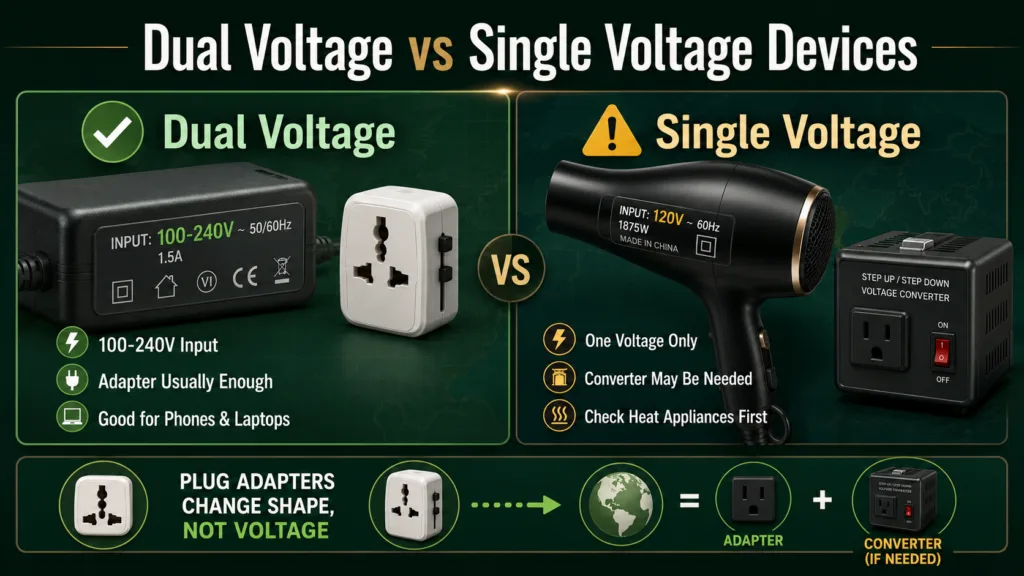
Dual voltage devices can usually work in both 120V and 230V countries with the right plug adapter. Single voltage devices may need a voltage converter if the destination voltage does not match the device label. A plug adapter does not convert voltage.
Device Label Visual
Dual Voltage or Single Voltage Checker
Use the label printed on your charger, power brick, or appliance. The result is a practical travel power check, not a product recommendation.
A plug adapter does not convert voltage. It only helps your plug fit a different socket type. A voltage converter changes electrical voltage, but it must be suitable for the device and wattage.
Quick Answer
A dual voltage device is designed to accept a range such as Input: 100-240V. That usually means it can work in many countries when paired with the correct plug adapter.
A single voltage device accepts only one voltage range, such as 120V only or 230V only. If the destination country uses a different voltage, the device may not work safely without the right voltage converter. For high-power appliances, replacing the device with a travel-rated or destination-voltage version is often the safer choice.
| Device label | What it usually means | Adapter needed? | Converter needed? |
|---|---|---|---|
| Input: 100-240V | Dual voltage | Yes, if your plug does not fit the destination outlet | Usually no |
| Input: 120V only | Single voltage for 120V areas | Possibly | May be needed in 220-240V destinations |
| Input: 230V only | Single voltage for 220-240V areas | Possibly | May be needed in 100-120V destinations |
| No readable label | Unknown | Depends on plug shape | Do not assume; check the manual or manufacturer label |
What Dual Voltage Means
A dual voltage device can accept more than one voltage range. The most common travel-friendly label is Input: 100-240V. This means the device is usually designed to work in countries that use around 100-120V and countries that use around 220-240V.
You often see this on phone chargers, laptop power bricks, tablet chargers, camera chargers, USB chargers, and many modern low-power electronics. These devices still need the right plug shape. If your charger has a US Type A plug and the destination uses Type C, Type G, Type I, or another outlet type, you will need a plug adapter.
Dual voltage does not mean the plug fits everywhere. It also does not mean every device is safe in every situation. Damaged chargers, cheap power strips, and worn outlet adapters can still cause problems.
What Single Voltage Means
A single voltage device is designed for one voltage range only. A label such as Input: 120V usually means the device is intended for 120V power. A label such as Input: 230V usually means it is intended for 220-240V power.
This matters because many destinations use a different voltage from your home country. A 120V-only hair dryer used in a 230V country can overheat, fail, or become unsafe. A 230V-only appliance used in a 120V country may run weakly, slowly, or not at all.
Always check the device label before using high-power appliances abroad. Heat-producing devices are the ones that cause the most travel power trouble.
How to Read the Device Label
Look for the word Input on the charger, power brick, or appliance body. It may be printed in small text, often near the plug, underside, handle, or power cord.
Labels like Input: 100-240V 50/60Hz usually mean the device can accept common travel voltage ranges. You normally need only the correct plug adapter, not a voltage converter.
Labels like Input: 120V 60Hz or Input: 230V 50Hz point to a device made for one electrical system. If the destination voltage differs, do not rely on a plug adapter alone.
The label may also list watts, amps, or frequency. Frequency is shown as 50Hz / 60Hz. Many chargers accept both. Some motors, clocks, pumps, and medical devices may be more sensitive, so check the full label and manual when the device matters for health, sleep, or daily use.
Plug Adapter vs Voltage Converter
A plug adapter changes the physical connection between your plug and the destination power outlet. It does not change the electricity coming from the wall.
A voltage converter changes voltage from one range to another, such as 230V down to 120V or 120V up to 230V. Converters must match the device type and wattage. Many small travel converters are not suitable for high-power appliances for long use.
| Item | Changes plug shape? | Changes voltage? | Best use |
|---|---|---|---|
| Plug adapter | Yes | No | Dual voltage chargers and devices with compatible voltage |
| Voltage converter | No, unless combined with adapter features | Yes | Some single voltage devices when the converter rating is suitable |
| Universal travel adapter | Usually yes for several plug shapes | Usually no | Multi-country trips with dual voltage electronics |
A plug adapter does not convert voltage. If a device is single voltage and the destination voltage is different, a plug adapter alone is not enough.
Device Guidance for Travelers
Phone Chargers
Phone chargers are commonly dual voltage. Check for Input: 100-240V on the charger. If it appears, you will usually only need a plug adapter for the destination outlet.
Laptop Chargers
Most laptop power bricks are designed for international voltage ranges, but still check the printed input label. A laptop charger with 100-240V can usually travel well with the correct adapter. Avoid using loose adapters or overloaded power strips.
Hair Dryers and Curling Irons
Hair dryers, curling irons, flat irons, kettles, and travel irons need more caution because they draw more power and create heat. Some are dual voltage, some are not. If the device has a voltage selector, make sure it is set correctly before plugging it in.
For single voltage heat devices, a converter may not be enough unless it is rated for the appliance wattage and use time. In many cases, using a destination-compatible device is simpler.
Electric Shavers and Toothbrush Chargers
Many electric shavers are travel-friendly, but not all chargers are dual voltage. Toothbrush charging bases can be single voltage. Check the label before packing, especially for older models.
CPAP Machines
Many CPAP power supplies are dual voltage, but this is not something to guess. Check the power brick for Input: 100-240V, confirm the plug adapter needed for the destination, and consider the power cord, humidifier, and any battery setup separately.
120V vs 230V Travel Risk
The main risk appears when a single voltage device is used in a destination with a different voltage. Outlet shape and voltage often change together, but they are still separate checks.
| Home device | Destination power | Main concern | Safer decision |
|---|---|---|---|
| 120V-only device | 220-240V destination | Overheating or damage | Use a suitable converter or leave the device at home |
| 230V-only device | 100-120V destination | Weak operation or no operation | Use a suitable converter or destination-voltage device |
| 100-240V charger | Most common travel voltages | Plug shape mismatch | Pack the correct plug adapter |
| Unknown label | Any destination | Unclear voltage support | Do not assume; verify before use |
What About 50Hz and 60Hz?
Frequency is the number shown as 50Hz or 60Hz on the device label. Many modern chargers list 50/60Hz, which means they are usually designed for both common frequency systems.
Frequency can matter more for devices with motors, timers, pumps, compressors, or medical functions. If the device label lists only one frequency and the device has a motor or timing function, check the manual before travel. For ordinary phone and laptop charging, voltage range and plug shape are usually the main checks.
What to Pack
- Pack the correct plug adapter for the destination outlet type.
- Check each device label for Input: 100-240V before assuming it is dual voltage.
- Leave single voltage high-power appliances at home unless you have a safe voltage plan.
- Check CPAP machines, shavers, toothbrush chargers, and camera chargers individually.
- Avoid overloading one adapter with several high-draw devices.
- For multi-country trips, confirm each destination country separately because outlet types can vary.
Common Mistakes
A travel adapter may make the plug fit, but it does not make a 120V-only appliance safe in a 230V outlet.
Plug compatibility tells you only whether the plug can connect. The device label tells you whether the voltage range is suitable.
Most phone chargers are dual voltage, but the label is still the real check. Older or unusual chargers can differ.
High-power appliances need extra care. Heat devices are more likely to overload weak adapters or fail on the wrong voltage.
FAQ
How do I know if my device is dual voltage?
Look for the input label. If it says Input: 100-240V, the device is usually dual voltage. If it lists only 120V or only 230V, treat it as single voltage.
Do dual voltage devices need a plug adapter?
Yes, if the plug shape does not match the destination outlet. Dual voltage solves the voltage issue, not the physical plug shape.
Can I use a single voltage device with only a travel adapter?
Only if the destination voltage matches the device voltage. If the destination voltage is different, a travel adapter alone is not enough.
Are phone and laptop chargers usually dual voltage?
They commonly are, especially modern chargers, but check the label for Input: 100-240V. Do not rely only on the device category.
Do hair dryers and curling irons need a converter?
They may need one if they are single voltage and the destination voltage is different. Because these are high-power heat devices, the converter must be suitable for the wattage. A destination-compatible appliance is often easier.
Does frequency matter when traveling?
It can matter for motors, pumps, clocks, and some medical devices. If the label says 50/60Hz, the device is usually designed for both common frequency systems.