
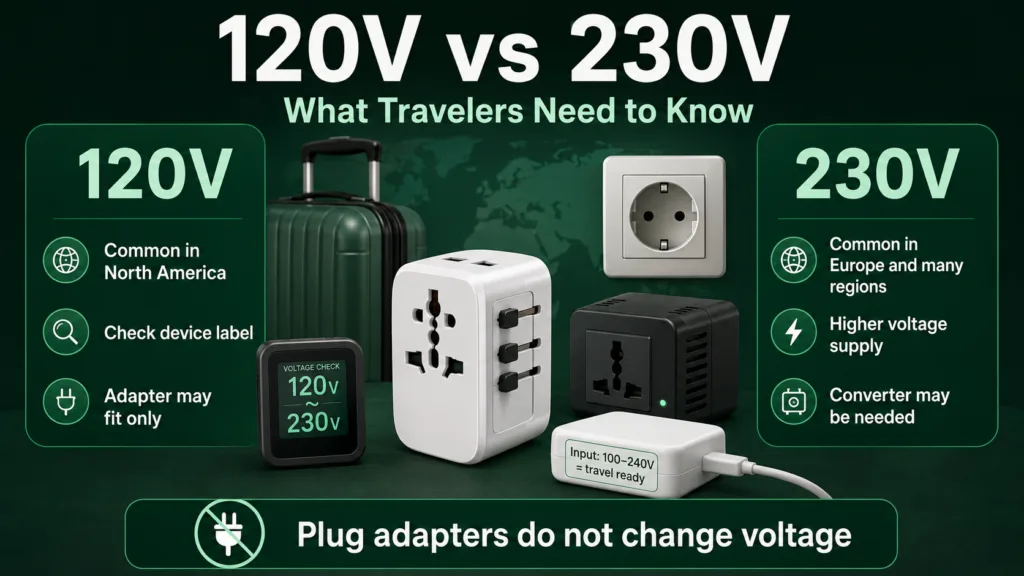
Traveling between 120V and 230V countries? Your plug shape is only half the question. You may need a plug adapter for the outlet, and some devices may also need a voltage converter. A plug adapter does not convert voltage.
Adapter vs Converter Visual
Voltage Converter Checker
Use this simple checker to sort your device into a safer travel category. It does not replace the label on your device, charger, or power supply.
A plug adapter does not convert voltage. It only helps the plug fit the wall outlet. A voltage converter changes the electrical voltage for devices that are not made for the destination voltage.
Quick Answer
120V countries and 230V countries use different electrical voltage ranges. If you travel from one system to the other, the safest first step is to read the device label. If it says Input: 100–240V, the device is usually made for both 120V and 230V travel. If it says only 110V, 120V, 220V, or 240V, do not assume it will work abroad.
| Device situation | Plug adapter needed? | Voltage converter needed? | What to check |
|---|---|---|---|
| Phone charger with Input: 100–240V | Usually yes, if plug shape differs | Usually no | Charger label and destination outlet type |
| Laptop charger with Input: 100–240V | Usually yes, if plug shape differs | Usually no | Power brick label, not only the laptop model |
| Single-voltage 120V appliance used in a 230V country | Yes, if plug shape differs | May be needed, or the device should stay home | Voltage, wattage, and device type |
| Single-voltage 230V appliance used in a 120V country | Yes, if plug shape differs | May be needed | Whether the device can run properly at lower voltage |
| Hair dryer, curling iron, kettle, or clothes iron | Often yes | High caution | Label, wattage, heat setting, and manufacturer instructions |
What 120V and 230V Mean for Travelers
Voltage is the electrical pressure supplied by a wall outlet. Many countries use around 110–120V, while many others use around 220–240V. Travelers often describe these as 120V and 230V systems.
The exact number printed on a device can vary. You may see 110V, 115V, 120V, 220V, 230V, or 240V. For travel decisions, the main question is simple: does your device accept the voltage used at your destination?
If the device accepts a wide range such as Input: 100–240V, it is usually designed for international voltage use. You still need the correct plug adapter if the plug does not fit the local power outlet.
Plug Adapter vs Voltage Converter
A plug adapter changes the physical shape of the plug so it can fit a different socket type. It does not change electricity from 230V to 120V or from 120V to 230V.
Shape only
A voltage converter changes the voltage supplied to a device. It may be needed for single-voltage devices when the destination voltage is different from the device rating.
Voltage issue
The two items solve different problems. A traveler going from a 120V country to a 230V country may need a plug adapter because the plug shape differs. The same traveler may also need a voltage converter if the device is single-voltage 120V.
How to Read the Device Label
Before packing any powered device, look for the word Input. This may be printed on the charger, power brick, handle, base, or near the cord. For laptops and phones, check the charger itself. For appliances, check the appliance body and the manual if available.
If the label says Input: 100–240V
This is the best travel-friendly label. It means the device usually accepts both common travel voltage ranges. In most cases, you only need a plug adapter that matches the destination outlet.
If the label says 110–120V only
This device is meant for 120V systems. Using it in a 230V country without the right voltage converter can damage the device or create a safety risk. This is especially serious with high-power appliances.
If the label says 220–240V only
This device is meant for 230V systems. In a 120V country, it may run weakly, heat poorly, charge slowly, or not work. A step-up converter may be needed, depending on the device.
If you cannot find the label
Treat the device as uncertain. For small chargers, you may be able to check the power brick. For heat devices, avoid guessing. Always check the device label before using high-power appliances abroad.
Phones, Laptops, and USB Chargers
Phone chargers, laptop chargers, tablet chargers, camera chargers, and many USB power adapters commonly support Input: 100–240V. That is why they often work in both 120V and 230V countries with only a plug adapter.
Still, do not rely on the device type alone. A phone may be international, but a cheap replacement charger may not be. A laptop may support global voltage, but the label on the power brick is the part that matters.
Best check: read the charger label. If it says Input: 100–240V, 50/60Hz, the charger is usually suitable for both major voltage and frequency systems. You may still need the right travel adapter for the destination country.
Hair Dryers, Curling Irons, Kettles, and Irons
Heat appliances need more care than chargers. Hair dryers, curling irons, straighteners, travel kettles, and clothes irons often draw much more power. Some are single-voltage. Some are dual-voltage but require a manual switch. Some voltage converters are not designed for high-wattage heat devices.
If a hair dryer says 120V only, do not use it in a 230V outlet with only a plug adapter. If a curling iron says 230V only, it may not heat correctly in a 120V country. If the device has a 120/240V switch, set it correctly before plugging it in.
For high-power devices, the safer travel choice is often to use a device designed for the destination voltage or use hotel-provided equipment where available.
What About 50Hz and 60Hz?
Frequency is shown as Hz. Many 120V countries use 60Hz, while many 230V countries use 50Hz, though country details vary. For modern chargers labeled 50/60Hz, frequency is usually not a problem.
Frequency can matter more for some motorized or timing-based devices. Electric clocks, some older appliances, and certain medical or mechanical devices may behave differently if they are not rated for the local frequency.
CPAP Machines and Medical Devices
Many CPAP power supplies are designed for international voltage, but you should check the power supply label before travel. Look for Input: 100–240V and 50/60Hz. You may still need a plug adapter for the destination outlet.
If you rely on a medical device, check the manufacturer instructions before the trip. Pack the correct plug adapter, keep the power supply accessible, and consider whether you need a backup battery for travel days or areas with unreliable power.
120V to 230V Travel Risk
The highest risk is plugging a 120V-only device into a 230V outlet using only a travel adapter. The plug may fit after using the adapter, but the device may receive nearly twice the voltage it was designed for.
This is why AdapterMatch treats plug compatibility and voltage compatibility as separate checks. The outlet shape tells you whether a plug adapter is needed. The device label tells you whether a voltage converter may be needed.
230V to 120V Travel Risk
Using a 230V-only device in a 120V country is usually a different problem. The device may not receive enough voltage. It may charge slowly, run weakly, or fail to operate. Heat appliances may not reach normal temperature.
A converter may help in some cases, but not every device is a good match for converter use. Check the device wattage, the converter rating, and the manufacturer instructions before relying on one.
What to Pack
- The correct plug adapter for your destination country
- Chargers labeled Input: 100–240V when possible
- A USB charger that supports the destination voltage
- Device manuals for CPAP machines or other medical equipment
- A destination-voltage hair tool if you need one
- A short list of devices that are single-voltage and should not be plugged in without checking
Common Mistakes
Buying only a plug adapter for a single-voltage appliance
A plug adapter may make the plug fit, but it will not protect a 120V-only appliance in a 230V country.
Assuming all chargers are dual voltage
Many are, but the label is the proof. Check for Input: 100–240V before travel.
Ignoring wattage on heat devices
High-power appliances can exceed what some converters are meant to handle. Hair dryers, kettles, and irons need extra care.
Forgetting that outlet types can vary
Some countries use more than one plug type. Older buildings, hotels, airports, and imported power strips may not all look the same.
FAQ
Do I need a converter for 120V to 230V travel?
You may need one if your device is labeled 110–120V only. If the label says Input: 100–240V, you usually do not need a voltage converter, but you may still need a plug adapter.
Can I use my phone charger in a 230V country?
Usually yes, if the charger label says Input: 100–240V. You will need a plug adapter if your plug does not fit the destination outlet.
Can I plug a 120V hair dryer into a 230V outlet with an adapter?
No, not safely unless the hair dryer is rated for 230V or has a correctly set dual-voltage switch. A plug adapter does not convert voltage.
What does Input: 100–240V mean?
It means the device is usually designed to accept both common travel voltage ranges. This label is common on many phone chargers, laptop chargers, and USB chargers.
Does 50Hz or 60Hz matter?
For many modern chargers labeled 50/60Hz, it usually does not matter. It may matter for some motorized, timing-based, older, or medical devices, so check the label and instructions.
Is a universal adapter enough for 120V vs 230V travel?
A universal adapter may help with plug shape in many destinations. It is not enough for voltage problems. Single-voltage devices may still need a voltage converter or should not be used abroad.