
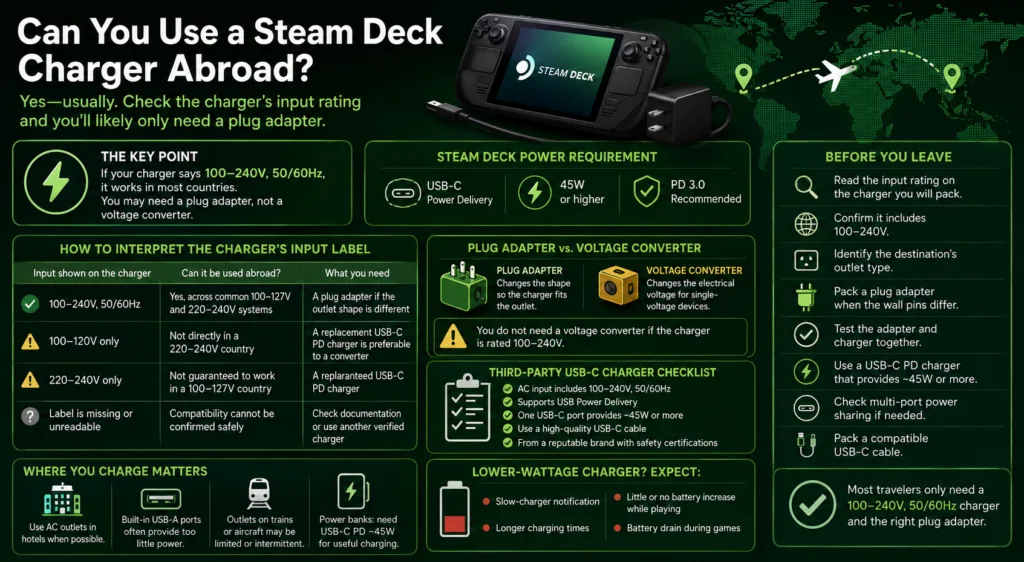
Yes, you can usually use a Steam Deck charger abroad. The deciding detail is the charger’s input rating: if the label says 100–240V, 50/60Hz, it can accept the mains voltage used in most countries. You may need a travel plug adapter so its pins fit the local outlet, but you do not need a voltage converter.
The practical decision: check the small electrical label on the charger itself. Do not rely only on where the Steam Deck was purchased or what the plug looks like.
Check the Input Rating on Your Charger
Turn the Steam Deck power adapter over and find the line beginning with Input. A travel-ready charger will show a range similar to:
Input: 100–240V AC, 50/60Hz
The exact punctuation and amperage may differ, but the voltage range is what matters for international use.
| Input shown on the charger | Can it be used abroad? | What you need |
|---|---|---|
| 100–240V, 50/60Hz | Yes, across common 100–127V and 220–240V electrical systems | A plug adapter if the outlet shape is different |
| 100–120V only | Not directly in a 220–240V country | A compatible replacement USB-C PD charger is usually preferable to a converter |
| 220–240V only | Not guaranteed to work correctly in a 100–127V country | A compatible replacement USB-C PD charger |
| Label is missing or unreadable | Compatibility cannot be confirmed safely | Check the model documentation or use another verified charger |
Do not connect a single-voltage 100–120V charger to a 220–240V outlet. A plug adapter may make the connection physically possible, but it does not reduce the voltage.
The Steam Deck Uses a 45W USB-C PD Charger
Valve specifies a 45W USB-C Power Delivery 3.0 power supply for both the Steam Deck LCD and Steam Deck OLED. The charger converts local AC electricity into the low-voltage DC power requested by the Steam Deck through USB-C.
This separation is why the Steam Deck itself does not need to match the destination country’s wall voltage. The AC input compatibility belongs to the charger, while the Steam Deck receives negotiated USB-C power.
USB Power Delivery allows a compatible charger and device to communicate before higher power is supplied. A charger with a higher maximum rating, such as 65W or 100W, does not automatically push all of that power into the Steam Deck. The device requests a supported power level.
What Changes When You Travel
International charging involves two separate questions:
- Can the charger accept the destination’s voltage? Check its input label for 100–240V.
- Do the charger’s pins fit the destination’s outlet? Compare the plug shape with the outlets used at your destination.
A voltage-compatible charger may still have the wrong wall plug. For example, a charger with flat US pins will not fit directly into many European or UK outlets. In that situation, you need only a suitable plug adapter.
The plug adapter should be rated for the local mains voltage and should hold the Steam Deck charger firmly. Loose universal adapters can sag under the weight of a charger, especially in worn hotel outlets.
Do You Need a Voltage Converter?
You do not need a voltage converter when the charger label states 100–240V. The charger already handles the voltage difference electronically.
A travel plug adapter and a voltage converter perform different jobs:
- Plug adapter: changes the physical connection so the charger fits the outlet.
- Voltage converter: changes the electrical voltage supplied to a single-voltage device.
Adding a converter to a universal-voltage USB-C charger provides no charging benefit. It adds another connection, takes up luggage space and may make the charger less stable in the outlet.
If your particular charger is not rated for the destination voltage, using a locally compatible 45W or higher USB-C PD charger is generally the cleaner option.
Using a Third-Party USB-C Charger Abroad
You do not have to carry the original Valve charger, but a replacement must be selected by more than its connector shape. A USB-C port does not automatically mean the charger supports the power level the Steam Deck needs.
Check the following specifications:
- The AC input includes the destination voltage, preferably 100–240V and 50/60Hz.
- The charger supports USB Power Delivery.
- A single USB-C port can provide about 45W or more.
- The USB-C cable is rated for the charger’s intended output.
- The charger comes from a traceable manufacturer and carries appropriate electrical safety markings for its market.
Be Careful with Multi-Port Charger Ratings
A charger advertised as 65W may provide the full 65W only when one port is in use. Connecting a phone, tablet or laptop at the same time may divide the available output and reduce the power delivered to the Steam Deck.
Review the power distribution printed on the charger or in its instructions. Look for the output available from the exact USB-C port you plan to use while the other ports are occupied.
A Higher-Wattage USB-C PD Charger Is Acceptable
A compliant 65W, 100W or higher USB-C PD charger can be used when it supports the power profile the Steam Deck requests. The wattage printed on the charger is its maximum capacity, not a fixed amount forced into every connected device.
Extra charger capacity will not make the Steam Deck charge beyond the rate it is designed to accept. It can still be useful when one charger must also power a laptop or several travel devices.
What Happens with a Lower-Wattage Charger?
A lower-power USB-C charger may charge the Steam Deck while it is sleeping or switched off, but it may be too weak during gameplay.
Possible results include:
- A slow-charger notification
- Longer charging times
- Little or no increase in battery level while playing
- Battery percentage continuing to fall during demanding games
A basic phone charger or a hotel’s built-in USB port is therefore not a dependable replacement for the 45W adapter. The connector may fit while the available power remains far below what the Steam Deck expects.
Charging from Hotel, Train and Aircraft Outlets
Use the Steam Deck charger with a proper AC outlet whenever possible. Built-in USB-A ports in hotels, seats and public charging stations commonly provide much less power than a Steam Deck requires.
A built-in USB-C port may work, but only when it supports USB Power Delivery at a suitable wattage. The presence of a USB-C socket alone does not confirm 45W charging.
Power outlets on aircraft and trains may also have output limits or may switch off temporarily. Availability depends on the vehicle, operator and seat. Keep some battery reserve rather than assuming onboard power will remain available throughout the trip.
Using a Power Bank During International Travel
The destination’s wall voltage does not directly affect a power bank while it is charging the Steam Deck. The power bank supplies DC power through USB-C.
For useful Steam Deck charging, check that the power bank:
- Has a USB-C Power Delivery output
- Can provide around 45W from the selected port
- Uses a suitable USB-C cable
- Has enough remaining capacity for the length of your journey
The charger used to refill the power bank must still be compatible with the local wall voltage and outlet.
Before You Leave
- Read the input rating on the charger you will actually pack.
- Confirm that it includes 100–240V if visiting a country with a different mains voltage.
- Identify the destination’s outlet type.
- Pack a plug adapter when the wall pins differ.
- Test the adapter and charger together before departure.
- Check that a third-party charger provides USB-C PD at approximately 45W or more.
- Check multi-port power sharing if several devices will be connected.
- Pack a compatible USB-C cable when the charger does not have a permanently attached cable.
For most travelers, the correct setup is simple: a Steam Deck charger marked 100–240V, 50/60Hz, plus a plug adapter that matches the destination outlet. A voltage converter is unnecessary unless the charger has a restricted single-voltage input.