
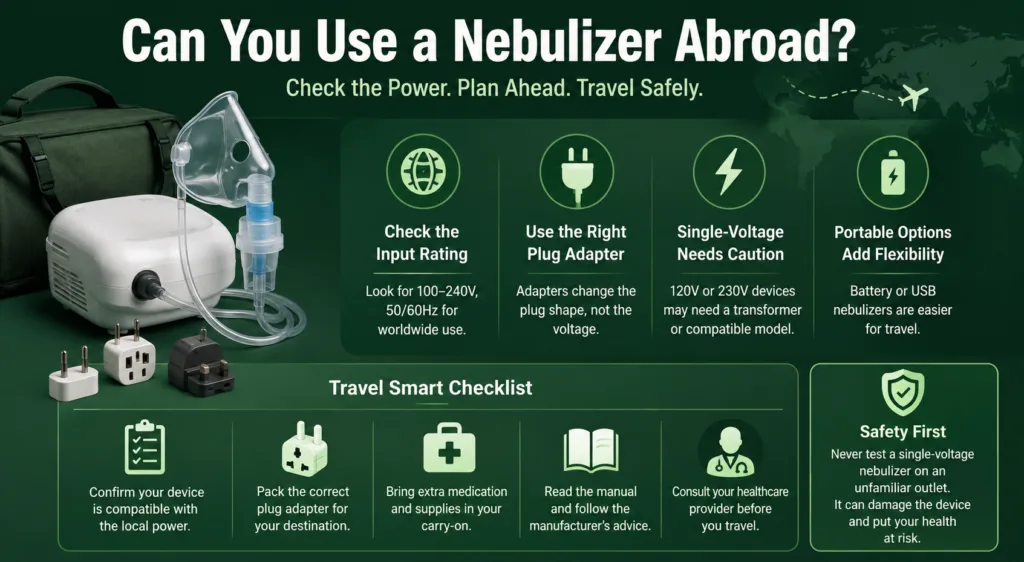
Yes, you can usually use a nebulizer abroad, but you must confirm how the device is powered before connecting it to a foreign outlet. A nebulizer marked Input: 100–240V, 50/60Hz normally needs only the correct plug adapter. A single-voltage compressor may need a manufacturer-approved power solution or a destination-compatible replacement device.
The same travel plan does not work for every nebulizer. Plug-in compressor units, rechargeable mesh nebulizers, USB-powered models and devices operated with replaceable batteries have different power and airline requirements. The medicine must also remain compatible with the device you use; changing to a smaller travel nebulizer without medical guidance may affect how the prescribed treatment is delivered.
Do not test a single-voltage nebulizer by plugging it into an unfamiliar outlet. Excess voltage can damage the compressor immediately. If missing a treatment could put your health at risk, confirm the power setup and backup plan with the device manufacturer and your clinical team before departure.
Read the Input Rating, Not Just the Plug
Look for the electrical label on the bottom or back of the nebulizer. If the machine uses an external power supply, read the label on that power supply as well. The adapter may accept a wider voltage range than the nebulizer itself.
| Power information | What it means abroad | Likely travel requirement |
|---|---|---|
| 100–240V, 50/60Hz | The power supply is designed for the common voltage and frequency systems used internationally. | A plug adapter matching the destination outlet is normally sufficient. |
| 120V, 60Hz | The unit is intended for a lower-voltage system and may not tolerate 220–240V electricity. | Do not connect it directly in a 220–240V country. Ask the manufacturer about an approved transformer or compatible power supply. |
| 220–240V, 50Hz | The unit may not operate properly from a 100–120V outlet. | A suitable transformer or a locally compatible nebulizer may be required. |
| USB 5V, 1A, 5V, 2A or another USB rating | The device needs a specific low-voltage supply even though the connector may look familiar. | Use a charger, cable or power bank that provides the exact output permitted by the manufacturer. |
| No readable input information | Voltage compatibility cannot be confirmed safely from the plug shape or country of purchase. | Check the manual or contact the manufacturer before using the device abroad. |
A plug adapter only changes the physical connection between the plug and the wall outlet. It does not reduce 230V to 120V, increase 120V to 230V or change 50Hz electricity into 60Hz electricity.
Universal-Voltage Nebulizers Are the Simplest to Travel With
If the nebulizer or its external power supply clearly states 100–240V, 50/60Hz, it can usually accept the destination’s electricity without a voltage converter. You still need a plug adapter if the outlet shape differs from the device’s plug.
For example, a universal-voltage nebulizer purchased in the United States may work electrically in the United Kingdom, France or Australia. The traveler would select the appropriate plug adapter for the destination rather than a voltage converter.
Check every part of the setup. A universal-voltage power supply does not help if it is connected to the nebulizer through an unofficial cable, damaged connector or extension accessory that the manufacturer does not permit.
Single-Voltage Compressor Nebulizers Need More Caution
Many tabletop jet nebulizers use an electric compressor. Some are manufactured for one electrical system, such as 120V at 60Hz or 230V at 50Hz. These units should not be treated like low-power phone chargers.
A voltage transformer must be rated for the nebulizer’s operating load and any higher current drawn when the compressor starts. A small travel converter selected only because its advertised wattage appears adequate may overheat, shut down or fail to start the motor.
Frequency can create another problem. A transformer can change voltage, but an ordinary travel transformer does not change 50Hz into 60Hz. If the nebulizer label permits only one frequency, ask the manufacturer whether operation on the destination frequency is allowed.
For a single-voltage compressor used for medically necessary treatment, a destination-compatible nebulizer or an approved international power supply is often a more dependable plan than carrying a general-purpose travel converter.
Portable Mesh and USB Nebulizers
Portable mesh nebulizers can be easier to power during travel because they may use internal rechargeable batteries, replaceable batteries or USB electricity. Their portability does not automatically make them interchangeable with the prescribed home unit.
Different nebulizer designs produce mist in different ways. Jet nebulizers use compressed air, mesh models pass medicine through a fine mesh, and ultrasonic units use high-frequency vibration. The suitable device may depend on the medicine being administered, so confirm compatibility before changing devices for a trip.
For a USB-powered nebulizer, check all of the following:
- The required input voltage and current
- Whether the device accepts power while operating or only while charging
- Whether the supplied cable contains any special electronics
- The expected number of treatments per full charge
- Whether replaceable batteries are permitted as a backup
- Whether the manufacturer allows operation from a power bank
A USB-C connector does not prove that a nebulizer supports every USB-C charger. Use the output rating listed in the manual rather than choosing a charger only by connector shape.
Flying with a Nebulizer
Keep the nebulizer, medication, mask or mouthpiece, tubing and essential accessories in your cabin baggage. This reduces the chance of arriving without treatment equipment because checked baggage was delayed, lost or damaged.
Rules depend on the departure country and airline. At airports in the United States, nebulizers are permitted through security screening and may be inspected separately. U.S. accessibility rules also require covered airlines to accept qualifying medical assistive devices in the cabin without counting them against the normal carry-on allowance, subject to safety and storage requirements.
European aviation security rules permit essential medicines in quantities above the ordinary 100 ml liquid limit when needed for the journey, although passengers may be asked to prove that the medicine is genuine and medically required. Other countries may apply different documentation or import requirements.
Carry nebulizer medicine in its original labelled packaging. A prescription copy or clinician’s letter can help explain the device, medicine, dosage and medical need during security checks or customs inspection.
Using the nebulizer during the flight
Carrying a nebulizer onboard does not automatically mean you may operate it during the flight. Contact the airline before travel and provide the device name, model, battery type and power requirements. Ask whether medical clearance, advance notice or a specific form is required.
Do not depend on an aircraft seat outlet. The aircraft assigned to the route can change, an outlet may be unavailable or disabled, and its output may not be suitable for the nebulizer. A permitted battery-powered setup offers more independence, but the battery must comply with airline rules.
FAA guidance recognizes medically necessary portable electronic devices and encourages airlines to include them in accessibility procedures, but the operator still controls onboard use, safe storage and crew instructions.
Battery Rules for Air Travel
Rechargeable nebulizers and their spare batteries may fall under portable medical electronic device rules. Check the battery label for its watt-hour rating, written as Wh.
Under current international airline guidance, spare lithium batteries and power banks belong in carry-on baggage and must be protected against short circuits. Devices placed in checked baggage must generally be completely switched off and protected from damage. Airline approval may be required for larger batteries, including many lithium-ion batteries rated above 100Wh.
- Keep spare batteries in their original packaging or separate protective pouches.
- Cover exposed terminals where necessary.
- Do not travel with a swollen, damaged, leaking or recalled battery.
- Keep the battery capacity label readable.
- Ask the airline before carrying a battery above its standard limit.
- Do not assume a power bank may be used or charged during the flight.
Battery-powered devices should remain accessible in the cabin when possible. If a battery becomes unusually hot, expands, smokes or develops a strong smell, stop using it and alert the cabin crew immediately.
Medication and Device Supplies
Bring enough prescribed medication for the planned trip and a reasonable delay. Keep the medicine leaflet or storage instructions with you, especially when travelling to a hot, humid or freezing destination.
Heat can damage medicines and some medical devices. Avoid leaving nebulizer medication in a parked vehicle, direct sunlight or an unventilated bag. Follow the temperature range printed on the packaging rather than assuming a hotel room, refrigerator or cool bag is suitable.
Useful spare parts depend on the model, but may include:
- A spare medicine cup or mesh cap approved for the device
- Replacement tubing for a compressor model
- A spare mask or mouthpiece
- Required air filters
- The original power supply and cable
- A destination plug adapter
- Permitted batteries or a charged backup unit
- A copy of the prescription and device manual
Cleaning the Nebulizer While Abroad
Follow the manufacturer’s cleaning instructions rather than creating a new routine for travel. Nebulizer cups and mouthpieces generally need washing and thorough air-drying after use because moisture and residue can support bacterial growth. Compressor tubing is commonly handled differently and should not be washed unless the manufacturer specifically instructs you to do so.
Pack the cleaning supplies required by the manual. Do not seal wet parts inside an airtight travel case. Allow them to dry in a clean area before packing, and keep used components separate from unused medication.
Local tap-water quality varies. Check the nebulizer instructions and medical advice for the permitted cleaning and disinfection method instead of assuming that bottled drinking water, hotel tap water or improvised disinfectants are suitable.
Build a Backup Plan Before Departure
Test the exact travel setup at home. Connect the nebulizer to the planned adapter, approved power supply or battery arrangement and complete a normal treatment. Confirm that the device starts correctly, runs for the full session and does not become unusually hot.
For a battery model, calculate capacity by treatments rather than by standby time. Include airport waits, flight delays, transfers, power cuts and time spent away from the hotel.
Ask the prescribing clinician whether an inhaler and spacer, a second nebulizer or another medically appropriate option should be carried as a backup. Do not replace nebulized medicine with an inhaler or change the dose without clinical instructions.
If your treatment depends on medical oxygen, a cylinder or an oxygen concentrator, plan that separately with your clinical team and airline. A standard electric compressor nebulizer does not provide supplemental oxygen, and carrying the nebulizer does not authorize an oxygen supply onboard.
Before You Leave
- Photograph the nebulizer’s input label and serial number.
- Confirm whether the device accepts 100–240V and 50/60Hz.
- Select the destination plug adapter only after confirming voltage compatibility.
- Ask the manufacturer before using a transformer with a compressor model.
- Verify that the prescribed medicine is suitable for any portable replacement nebulizer.
- Test the complete travel power setup before packing.
- Keep the device, medicine and batteries in cabin baggage.
- Check the airline’s medical-device and battery policies.
- Carry original medication packaging and supporting documents.
- Plan for treatment during delays and power outages.
You can use a nebulizer abroad when its power requirements, medication compatibility and travel arrangements have all been confirmed. A universal-voltage unit generally needs only a plug adapter. A single-voltage compressor, frequency-limited motor or battery-powered model requires a more specific plan based on the label and manufacturer’s instructions.