
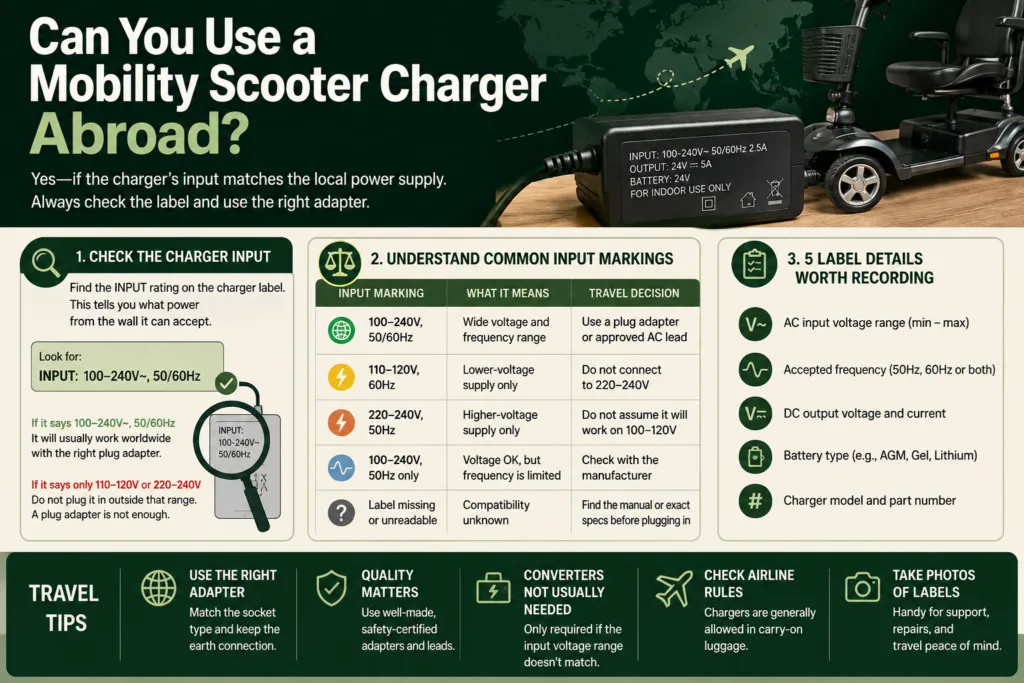
A mobility scooter charger can often be used abroad, but the answer comes from the charger label rather than the country where the scooter was purchased. The wall-side input voltage and frequency must accept the electricity supply at the destination, while the scooter-side output and charging profile must remain correct for the battery.
When a plug adapter is enough
If the charger is marked INPUT: 100–240V AC, 50/60Hz, it can normally accept both common household voltage systems. You would usually need only a well-made plug adapter, or an approved destination-specific AC lead, provided the adapter preserves any earth connection required by the charger.
If the label states only 110–120V or only 220–240V, do not connect it directly to a supply outside that range. A plug adapter changes the physical plug connection; it does not make an incompatible charger safe.
Start with the input line on the charger
Turn the charger over and find the rating plate. It may be printed on the case, moulded into the plastic, or shown on a separate label. Look for INPUT, not only the larger output number.
For example, one Pride Mobility charger manual lists an input of 100–240V AC at 50/60Hz and describes that model as having universal AC input. The same specification page lists a separate 24V DC output for the scooter battery.[Charger specification] This is an example of how a label should be read, not proof that every mobility scooter charger has the same range.
Input and output answer different questions
Input tells you what may enter the charger from the wall outlet. It is the value used to decide whether the charger can work with the destination’s electricity.
Output tells you what the charger sends to the scooter battery. It is used to confirm compatibility with the scooter, battery pack and charging system. A label such as “24V DC, 5A output” does not mean the charger should be connected to a 24V wall supply.
| Input marking | What it tells you | Travel decision |
|---|---|---|
| 100–240V, 50/60Hz | Wide voltage and frequency range | Usually a plug adapter or approved AC lead only |
| 110–120V, 60Hz | Designed for a lower-voltage supply | Do not connect directly to 220–240V |
| 220–240V, 50Hz | Designed for a higher-voltage supply | Do not assume it will work correctly on 100–120V |
| 100–240V, 50Hz only | Voltage range is broad, frequency range is not | Ask the manufacturer before using it on 60Hz |
| Label missing or unreadable | Compatibility cannot be confirmed | Use the model manual or obtain the exact specification before plugging in |
The five label details worth recording
- Minimum and maximum AC input voltage
- Accepted frequency: 50Hz, 60Hz or both
- DC output voltage and output current
- Battery chemistry named in the manual or on the charger
- Charger model number and any manufacturer part number
A clear photograph of the charger label and battery label is more useful abroad than a handwritten note. It preserves model numbers, symbols and small-print limitations that may be needed by a dealer, airline or repair service.
Plug adapter, replacement lead or voltage converter
A travel adapter lets one plug shape fit another socket. It does not convert voltage or frequency. Electrical Safety First also advises checking the appliance rating plate and explains that dual-voltage equipment may show an input such as 110–240V.[Adapter function]
Use a plug adapter when the input already matches
A plug adapter is the normal solution when the destination voltage and frequency fall within the charger’s stated input range. Choose one that:
- Fits the exact socket type used at the destination
- Accepts the charger’s plug without loose movement
- Supports at least the current or wattage shown on the charger
- Continues the earth connection when the charger has an earthed plug
- Comes from a traceable manufacturer or established electrical retailer
Do not stack several small adapters to reach the socket. A heavy charger hanging from a loose adapter can pull the connection partly out of the wall and create heat at the contact points.
A destination-specific AC lead may be cleaner
Some off-board chargers use a removable AC lead between the wall outlet and the charger body. Where the charger manufacturer permits it, a correctly rated lead with the destination’s native plug can remove the need for a travel adapter.
This applies only to the AC input lead. Do not replace the cable between the charger and scooter with a look-alike cable unless the manufacturer identifies it as compatible. Connector wiring and polarity may differ even when the plug appears to fit.
A voltage converter is not the automatic answer
A converter or transformer may change the supply voltage, but that does not confirm compatibility with the charger’s frequency, earthing arrangement, power draw or electronic design. Mobility scooter charging can continue for several hours, so a small converter intended for brief use with low-power travel items may be unsuitable.
Do not test a single-voltage charger by plugging it in briefly
A 120V-only charger can be damaged immediately on a 230V supply. A 230V-only charger connected to 120V may fail to start, charge incorrectly or behave unpredictably. Use an international charger approved for the scooter and battery, or obtain a manufacturer-approved solution for the destination supply.
The wall side can match while the battery side is wrong
International voltage compatibility does not make a charger interchangeable between scooters. The charger must still match the battery pack and the scooter’s charging circuit.
The Pride charger documentation separates chargers intended for AGM or GEL sealed lead-acid batteries from chargers intended for lithium batteries. That distinction shows why the battery chemistry and charging profile must be checked rather than inferred from the connector alone.[Battery profile]
Match all of these before using another charger
A matching XLR plug does not prove compatibility
Two chargers may use the same three-pin connector while having different polarity, voltage or charging logic. Do not select a replacement charger by plug shape, advertised wattage or battery voltage alone. A laptop power supply, generic DC adapter or automotive battery charger is not a substitute for the scooter’s approved charger.
Grounding and socket condition still matter
An adapter should not remove an earth connection that the charger was designed to use. If the charger has a three-pin earthed plug, choose an adapter that carries that connection through to a grounded destination socket.
Some chargers are double-insulated and display a square-inside-a-square symbol. Those products are designed without a protective earth, but the symbol should be confirmed on the exact charger. Do not assume that a two-pin travel adapter is acceptable simply because it fits.
Electrical Safety First advises that some travel adapters are unsuitable for equipment requiring an earth connection. Its accommodation guidance also warns against damaged sockets, damaged cables, burning smells, arcing sounds and signs of overheating.[Electrical safety]
Check the socket before beginning an overnight charge
- The plug should remain firm without being held in place
- The socket face should not be cracked, loose, scorched or partly detached
- The adapter should not wobble under the charger cable’s weight
- The outlet should not be labelled for shavers or limited bathroom use
- The cable should not run under a rug, mattress or closed door
Set up a safe charging place in the room
A Pride Mobility charger manual instructs users to place the charger in a safe, clean environment on a dry, nonflammable surface. Pride scooter instructions also call for a properly wired outlet, ventilation, inspection of the charger and connectors, and use of the supplied off-board charger rather than an automotive charger.[Charging conditions]
- Park and switch off the scooter. Remove the key if the model uses one, and make sure the scooter cannot roll.
- Place the charger on a hard, dry surface. Keep ventilation openings uncovered and leave space around the charger.
- Inspect the cables and ports. Do not use a charger with crushed insulation, exposed wire, bent pins or a damaged case.
- Connect in the order stated in the manual. Some manufacturers specify connecting the scooter before the wall supply; follow the instructions for the exact charger.
- Check the first few minutes of operation. Confirm the normal indicator pattern and make sure the plug and adapter remain secure.
- Stop if the setup behaves abnormally. Disconnect power if there is a burning smell, repeated crackling, visible sparking, smoke, rapid adapter heating or repeated breaker operation.
Do not charge in a bathroom, beside a sink, in rain, on a bed, under clothing or inside a closed bag. Avoid leaving the charger where another person can trip over the cable or pull the scooter-side connector sideways.
Charging a removable battery away from the scooter
Travel scooters may allow the battery box or lithium pack to be removed and charged separately. That can be useful when the scooter must stay in a hotel storage area or when the accessible outlet is inside the room.
Use only the off-board port, charging cradle or dock specified for that battery. A removable battery is not automatically designed to accept the charger directly. Some packs require a dock that provides mechanical alignment, communication or protective circuitry.
- Place the battery upright in the orientation shown in the manual
- Keep terminals away from keys, coins and other metal items
- Make sure the battery is fully seated in its charging dock
- Do not cover the battery or charger during charging
- Keep the pack away from direct sun, heaters and freezing conditions
- Let a battery that has been in an unusually hot or cold environment return to the permitted charging range before charging
When reinstalling the battery, check that latches and electrical connectors are fully engaged before driving. A partly seated battery can interrupt power or damage a connector when the scooter moves.
Four travel situations and the correct response
A US charger marked 100–240V, 50/60Hz is taken to Europe
The destination supply falls within the charger’s stated range. Use the correct local plug adapter or an approved European AC lead. Preserve grounding when the charger requires it. No voltage converter is normally needed.
A US charger marked 120V, 60Hz is taken to a 230V destination
Do not connect it through a simple plug adapter. Ask the scooter manufacturer for a 230V or universal-input charger approved for the same scooter and battery. Use a transformer only when the charger manufacturer confirms the arrangement.
A 230V-only charger is taken to Canada or the United States
A plug adapter alone cannot raise the local supply voltage. The charger may not start or may not charge correctly. A manufacturer-approved North American or universal-input charger is the cleaner solution.
The scooter is taken on a cruise
Do not select equipment only from the voltage used at the departure port. Cabin socket types and voltages can vary by ship and may differ within a cruise operator’s fleet. Ask the cruise line for the cabin outlet voltage, frequency, plug type and any restrictions on extension leads or power strips before departure.
Air travel involves the scooter battery, not only the charger
Electrical compatibility at the destination and permission to carry the mobility scooter on an aircraft are separate checks.
The 2026 IATA guidance states that operator approval is required for battery-powered wheelchairs and mobility aids and recommends arranging approval in advance. The document separates requirements by battery type and calls for protection against accidental activation and short circuit.[Airline approval]
IATA’s recommended approval information includes the device manufacturer and model, battery type, total weight, dimensions, removable parts and whether the battery must be removed for transport.[Mobility aid details] Add the method for switching off the scooter, isolating its circuits and placing it into or out of freewheel mode when the manufacturer provides those instructions.
Information to keep with the scooter
- Scooter manufacturer, model and serial number
- Battery chemistry, voltage and watt-hour rating when applicable
- Number of installed and spare batteries
- Whether each battery is removable
- Battery removal and terminal-protection instructions
- Power isolation and accidental-activation prevention instructions
- Scooter weight and folded dimensions
- Location of freewheel controls and tie-down points
- Charger model and its input specification
For travel governed by US rules, the FAA PackSafe page describes a 300Wh limit in specified lithium mobility-device battery situations, along with carry-on rules for removed or spare lithium batteries. It also warns that individual airlines may apply more restrictive conditions.[US lithium rules] Do not treat “under 300Wh” as automatic acceptance on every route; the battery installation, protection, spare-battery status, airline policy and applicable national rules still matter.
Pack for charger continuity, not just plug fit
- The original or manufacturer-approved charger
- A correctly rated grounded travel adapter, when needed
- An approved destination-specific AC lead, when supported
- Clear photographs of the charger and battery labels
- The scooter and charger manuals saved for offline access
- The charger part number and the seller or manufacturer’s support details
- A protective bag that prevents bent pins and crushed cables
- The airline information for the scooter and battery when flying
US State Department accessibility guidance advises travellers with wheelchairs and scooters to check destination voltage, outlet type and electrical reliability, and to keep the equipment make, model and battery type available.[Travel preparation]
When the charger worked at home but not abroad
| What happens | Possible cause | Safe response |
|---|---|---|
| No charger lights | No power, loose adapter, wrong input range or charger fault | Disconnect, confirm the label and test only with a known safe compatible outlet |
| Power light is on but charging does not begin | Scooter connector not seated, battery not installed correctly or charger fault | Switch off, reconnect according to the manual and check the normal indicator meanings |
| Adapter becomes hot quickly | Loose contact, poor-quality adapter or overloaded adapter | Unplug it and replace the adapter; do not continue by repositioning it |
| Charging takes much longer | Battery temperature, battery age, poor connection or charging fault | Check the manual’s temperature range and indicator codes; seek service if the pattern continues |
| Full-charge light appears immediately | Battery may be full, disconnected or unable to accept charge | Check the scooter’s actual battery level and have the battery tested if range is unusually low |
| Breaker or fuse operates repeatedly | Outlet, adapter, cable or charger fault | Stop using that setup and ask the accommodation or a qualified technician to inspect it |
Do not open the charger, bypass a fuse, change connector pins, splice the cable or repeatedly reset a tripping circuit. Those actions can hide the fault while increasing shock, fire and battery-damage risk.
Questions that come up before departure
Can I use a US mobility scooter charger in Europe?
Yes, when its input range includes the local voltage and frequency. A label showing 100–240V and 50/60Hz will usually need only the correct plug connection. A charger marked 120V only should not be connected directly to a 230V outlet.
Does a travel adapter convert 230V to 120V?
No. It changes how the plug fits the socket. Voltage conversion requires separate equipment, and that equipment still needs manufacturer approval for use with the charger.
Can I buy any local charger with the same three-pin plug?
No. Confirm battery chemistry, pack voltage, charging voltage, output current, connector pin assignment and manufacturer compatibility. A physical fit is not an electrical match.
Does 50Hz versus 60Hz matter?
It does when the charger is rated for only one frequency. A charger labelled 50/60Hz accepts both. Where only one frequency appears, obtain confirmation from the charger or scooter manufacturer before use.
Can I charge the battery in my hotel room without the scooter?
Only when the battery is designed for off-board charging and the approved dock, cradle or charging port is available. Do not connect the charger directly to exposed battery terminals.
Is a universal laptop power supply suitable?
No. Mobility batteries use chemistry-specific charging stages and may rely on a particular connector layout or control circuit. Matching the voltage printed on the case is not enough.
Should I leave the scooter charging overnight abroad?
Follow the scooter and charger manuals. Before any long unattended period, confirm that the outlet, adapter, cable, charger indicators and ventilation are normal. Do not continue charging through a loose, damaged or overheating connection.