
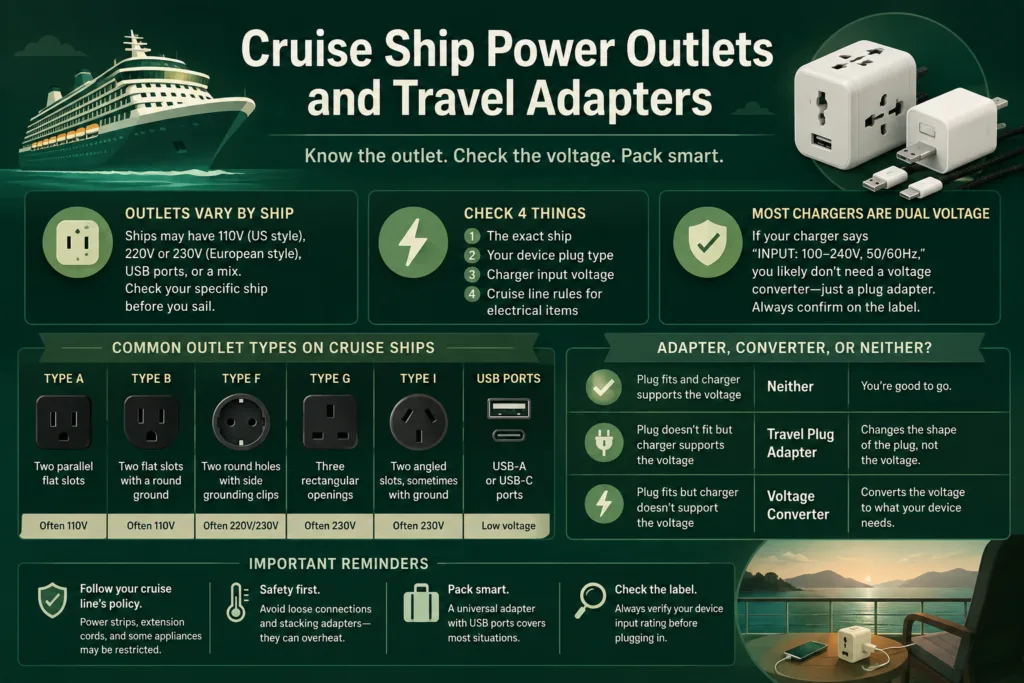
Cruise ship power outlets are determined by the ship’s design, not by the countries on the itinerary. A cabin may have North American 110V outlets, European 220V or 230V outlets, USB ports, or a mixture of these. The right charging setup depends on four checks: the exact ship, the plug on the device, the input voltage printed on the charger, and the cruise line’s rules for electrical accessories.
Most phone, tablet, camera, and laptop chargers do not need a voltage converter if their label says “INPUT: 100–240V, 50/60Hz.” They may still need a travel plug adapter. Power strips, multi-plug adapters, extension cords, garment steamers, and other electrical items must be checked against the policy for the booked cruise line before packing.
The departure country does not determine the cabin outlet
A Mediterranean sailing does not guarantee a European socket, and a cruise leaving Miami does not guarantee that every cabin outlet will accept a US plug. Ships are built for international service, and many provide two AC standards in the same stateroom.
The ship name matters as much as the cruise line. Disney Cruise Line, for example, lists 110V Type A and B outlets plus 220V Type F outlets on its ships except Disney Adventure. Disney Adventure instead has 230V Type F, G, and I outlets, along with USB-A and USB-C ports. The published wattage limits also differ between the 110V and higher-voltage outlets.[Ship outlet specification]
Use this checking order: cruise line, ship name, cabin or stateroom information, device input label, then prohibited-items policy. The departure port should not be used as a substitute for ship-specific information.
Recognize the socket before choosing an adapter
The socket shape identifies whether a plug adapter may be needed. It does not prove that the voltage is safe for the connected device.
| Outlet | How to recognize it | What to check |
|---|---|---|
| Type A | Two parallel flat slots | Often paired with 110V or 120V service; verify the ship’s stated voltage. |
| Type B | Two flat slots with a round grounding opening | Use a grounded connection when the device plug includes a grounding pin. |
| Type F | Two round pin openings with side grounding contacts | Often paired with 220V or 230V service; a plug adapter does not reduce that voltage. |
| Type G | Three rectangular openings | Common on UK-style equipment; confirm both voltage and grounding. |
| Type I | Two angled flat openings, sometimes with a vertical ground opening | Pin layout and voltage must match the device or approved adapter. |
| USB-A or USB-C | A low-voltage charging port rather than an AC wall socket | The connector shape does not reveal charging speed or USB Power Delivery support. |
A loose fit, partially inserted plug, missing ground connection, or a stack of adapters can create heat and unreliable contact. An adapter should fit firmly without forcing the outlet or leaving exposed metal.
Choose between an adapter, a converter, or neither
| Situation | Likely requirement | Reason |
|---|---|---|
| Plug fits and the charger supports the cabin voltage | Neither | The device can connect directly, subject to the cruise line’s equipment rules. |
| Plug does not fit, but the charger supports the cabin voltage | Travel plug adapter | The adapter changes the physical connection only. |
| Plug fits, but the device does not support the cabin voltage | Do not connect it directly | A matching plug does not make the voltage compatible. |
| Device is single-voltage and no matching cabin outlet is available | Voltage conversion may be required | The converter must support the device type and wattage, and the device must still be permitted on board. |
| Device is prohibited by the cruise line | Leave it at home | An adapter or converter does not change the prohibited status. |
A plug adapter changes shape. A voltage converter changes voltage. Neither one grants permission to use a restricted power strip, extension cord, steamer, kettle, iron, or other appliance.
Read the charger’s input line
The useful electrical information is usually printed on the charger brick or power supply, not on the front of the phone or laptop.
Keep the ground connection and wattage limit in the decision
If a device uses a grounded three-pin plug, use an adapter that preserves the ground connection. Do not remove, bypass, or defeat a grounding pin to make the plug fit.
Wattage also matters. A charger that accepts the correct voltage may still exceed an outlet limit if it is a high-power appliance. Disney, for example, publishes a 1,500-watt limit for its 110V outlets and a 2,000-watt limit for its 220V outlets on ships other than Disney Adventure; the Disney Adventure limit is 2,000 watts at 230V.[Outlet wattage limit]
Published cabin power examples by cruise line
The table below shows why a single “cruise adapter” answer is unreliable. It describes published fleet information, not a guarantee of outlet count, bedside placement, or charging speed in every cabin.
| Cruise line | Published cabin power information | Packing implication |
|---|---|---|
| Disney Cruise Line | Most ships: 110V Type A/B and 220V Type F. Disney Adventure: 230V Type F/G/I plus USB-A and USB-C.[Fleet outlet difference] | Check the exact ship rather than relying on the cruise line name alone. |
| Norwegian Cruise Line | North American 110V and European 220/230V outlets are listed across the fleet.[Cabin voltage] | A compatible adapter can make the second outlet standard useful. |
| MSC Cruises | Cabin electricity is listed as 110/220V, and guests may request outlet adapters from the Information Office.[Cabin power] | Do not depend on borrowing an adapter; bring a verified one when it is needed. |
| Celebrity Cruises | Staterooms are described as having dual-voltage 110/220V AC outlets.[Stateroom voltage] | Device voltage compatibility still has to be checked before use. |
| Holland America Line | Staterooms are listed with standard 110V and 220V AC outlets.[Stateroom outlets] | Hotel stays before or after the cruise may require a different adapter plan. |
| Virgin Voyages | Cabins and suites are listed with North American 110V and European 220V outlets.[Cabin voltage] | Travelers may be able to use either outlet standard with the correct charger and plug. |
Do not treat a fleet-level voltage statement as a cabin inventory. Outlet quantity, location, socket orientation, USB availability, and furniture clearance can differ by ship, cabin category, and refurbishment history.
Power strips and extension cords follow the cruise line’s policy
The phrase “cruise approved” on a product listing is not a universal permission. Cruise lines publish different rules, and security staff may inspect or refuse an item that does not meet the line’s requirements.
| Cruise line | Published approach | Safer packing decision |
|---|---|---|
| Royal Caribbean | Extension cords, power strips, and multi-plug outlets are prohibited. Recognized device and USB chargers are listed as an exception.[Power accessory rule] | Use permitted individual or multi-port chargers rather than an AC power strip. |
| Carnival Cruise Line | Power strips, multi-plug box outlets or adapters, and extension cords without surge protectors are allowed when used with proper caution; hazardous devices may still be removed.[Power accessory rule] | Confirm that the product has no surge protection and does not include a prohibited heating function. |
| Holland America Line | Small fans, power strips, multi-plug outlets or adapters, and extension cords without surge protectors are listed as allowed when used with caution.[Electrical accessory rule] | Remove any surge-protected model from the packing list. |
| MSC Cruises | Cabin use is limited to listed personal devices such as shavers, hairdryers, battery chargers, and computers; heat-generating devices are not allowed.[Cabin appliance rule] | Check the exact accessory rather than assuming a non-surge label is enough. |
| Celebrity Cruises | Electrical extension cords and heat-producing items are prohibited, with limited stated exceptions for certain low-watt personal items.[Electrical item rule] | Use the cabin outlets and permitted chargers without adding an extension cord. |
Surge protection is a frequent reason for refusal. A product that looks like a basic multi-port charger may also contain AC outlets, an extension lead, or surge-protection circuitry. Check the technical description, plug, cord, and onboard policy rather than relying on the product name.
Build one charging setup for the devices in the cabin
Most cabins do not need several AC accessories. A compact charging plan can cover phones, watches, tablets, cameras, and many laptops while leaving the wall outlet available for another approved device.
| Cabin use | Practical setup | Check before packing |
|---|---|---|
| One traveler | One multi-port USB charger, the required plug adapter, and the device cables | Charger input must cover the ship’s voltage. |
| Two travelers | A higher-output USB charger with enough ports for phones, watches, and a tablet | Total output should meet the devices that will charge at the same time. |
| Family cabin | One permitted multi-port charger plus a charging schedule for tablets and game devices | Avoid turning one AC outlet into a chain of adapters and splitters. |
| Laptop or remote work | The original laptop charger or a compatible USB-C Power Delivery charger | The charger’s output wattage must meet the laptop’s requirement. |
| Camera equipment | A charger that handles several batteries through USB or approved AC input | Confirm battery and power-bank transport rules for the flights connected to the cruise. |
A charger with several USB outputs is not the same product category as an AC power strip. It can reduce the number of wall sockets needed, but its conformity markings, input voltage, output capacity, cable quality, and cruise line acceptance still matter.
A USB-C port does not guarantee laptop charging
USB-A and USB-C describe connector shapes. They do not reveal the port’s wattage, charging protocol, or ability to power a laptop. A USB-C port may provide basic charging without supporting USB Power Delivery at the level required by a computer.
Disney Adventure is listed with both USB-A and USB-C ports, but the published outlet page does not assign a charging wattage to those USB ports.[USB port type] Carnival publishes a ship-by-ship USB-A list and identifies the listed cabin ports as 5V at 1000mA, which equals 5 watts.[USB charging output] That output can charge many phones slowly, but it should not be treated as evidence of laptop-capable USB-C charging.
| Connection | Reasonable expectation | Do not assume |
|---|---|---|
| USB-A | Basic low-voltage charging | Fast charging or enough power for a laptop |
| USB-C | A reversible modern connector | USB Power Delivery, a specific wattage, or video support |
| AC outlet with personal charger | Charging performance based on the charger’s own rating | Compatibility before the input voltage and plug are checked |
Heating appliances need both an electrical and policy check
Hair dryers, curling irons, straighteners, garment steamers, irons, kettles, bottle warmers, heating pads, and coffee makers cannot be evaluated by plug shape alone. These devices may draw much more power than a charger and may be restricted because they produce heat.
| Device | Main issue | Packing approach |
|---|---|---|
| Phone or tablet charger | Plug, input voltage, and output capacity | Usually manageable with a compatible charger and adapter. |
| Laptop charger | Plug, input voltage, grounding, and wattage | Use the original unit or a properly rated replacement. |
| Hair dryer | High wattage and ship policy | Use the cabin-provided dryer when available. |
| Curling iron or straightener | Voltage, wattage, and line-specific exception | Pack only after checking the device label and cruise policy. |
| Garment steamer or clothing iron | Heat and fire rules | Leave it home unless the cruise line explicitly states otherwise. |
| Kettle, hot plate, or personal coffee maker | Heating element and prohibited-item policy | Use the ship’s beverage or room-service options instead. |
MSC states that heat-generating devices such as electric kettles, bottle warmers, and electric blankets are not allowed in cabins.[Heat-producing device rule] Royal Caribbean lists clothing irons and garment steamers as prohibited and states that a hair dryer is provided in the stateroom.[Heating appliance rule]
CPAP, BiPAP, and powered medical equipment need a separate plan
A medical device may need continuous overnight power, a bedside connection, distilled water, or an approved extension arrangement. The ordinary cabin rule should not be assumed to cover these needs.
Carnival’s CPAP information states that CPAP, BiPAP, concentrator, and nebulizer equipment should be hand-carried. It describes a desk or vanity outlet with 110V and 220V connections, permits extension cords and power banks for this use, prohibits surge protectors, and warns that a cabin keycard switch may cut power when the card is removed.[Medical power arrangement]
MSC gives a different arrangement: its CPAP and BiPAP page lists 120V/60Hz or 240V/60Hz power, says cabin outlets accept US-style and Northern European-style plugs, offers distilled water and extension cords on board, and tells guests not to bring their own extension cords. The extension cord should be requested when booking.[Medical equipment support]
Medical-device arrangements are line-specific. Contact the cruise line’s accessibility or special-needs team with the device model, input voltage, plug type, expected overnight use, and distance from the bed. Do not assume that a medical exception permits the same cord or power accessory for general cabin use.
Medical power details to confirm before sailing
- The device input voltage and frequency match an available cabin outlet.
- The plug will fit directly or through an approved grounded adapter.
- An extension cord will be supplied, permitted, or arranged by the cruise line.
- The cabin’s keycard energy switch will not interrupt required overnight power.
- Distilled water, battery backup, and other supplies are arranged under the line’s rules.
- The equipment will travel in hand luggage when instructed by the cruise line or transport provider.
The cruise cabin and the hotel may need different adapters
A traveler may use a Type F outlet in a hotel before departure, a Type A or Type B outlet in the cabin, and a Type G outlet during a post-cruise stay. The cruise ship does not change its outlet standard when it enters another country.
Build the power plan in two parts:
- On board: use the exact ship’s outlet and prohibited-item information.
- On land: check the hotel and destination plug standard separately.
- In transit: apply the airline or rail operator’s battery and power-bank rules.
Holland America’s electrical-appliance information makes this distinction directly by noting that pre-cruise or post-cruise hotel stays may require converters or adapters even though its staterooms provide 110V and 220V outlets.[Hotel adapter check]
When a cabin outlet or charger does not work
- Disconnect the device if there is heat, a burning smell, sparking, discoloration, buzzing, or a loose connection.
- Read the input label again before trying a different-voltage outlet.
- Check the cabin power controls. Some cabins use a keycard slot or wall switch to energize outlets.
- Remove stacked adapters. Connect the charger through one correct, firmly fitted adapter where possible.
- Try another permitted outlet only after confirming the device supports that outlet’s voltage.
- Ask Guest Services or the cabin attendant to inspect a dead, damaged, or unusually loose outlet.
- Do not use a public-area outlet as a replacement for unattended charging or medical equipment without permission.
A charger that works at home can still fail on board because of a damaged cable, poor adapter contact, insufficient USB output, an inactive cabin power switch, or an unsupported voltage. Changing several variables at once makes the cause harder to identify.
Pack only what the ship and devices require
- Confirm the cruise line and exact ship.
- Identify the cabin’s AC outlet types and voltages.
- Read the input label on every charger and powered device.
- Use a grounded travel adapter where grounding is required.
- Check charger output for laptops, tablets, cameras, and USB-C devices.
- Read the line’s policy for power strips, extension cords, multi-plug products, and surge protection.
- Remove steamers, irons, kettles, and other heat-producing devices unless explicitly permitted.
- Arrange CPAP or other medical power needs with the cruise line before departure.
- Check hotel adapters separately from the cabin setup.
- Bring the correct cables rather than relying only on built-in USB ports.