
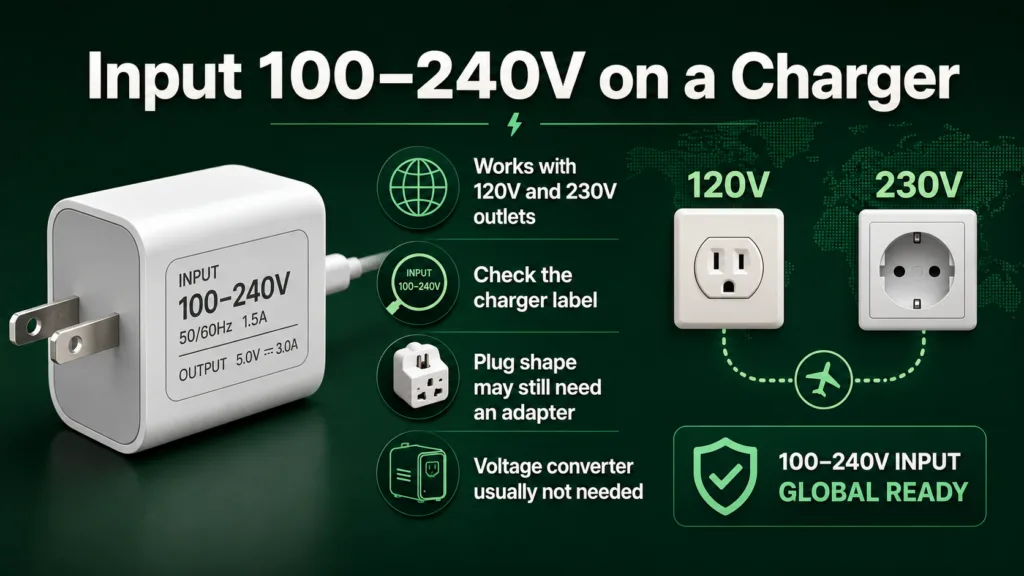
If a charger label says Input: 100–240V, it is usually designed to work on common household voltage ranges in many countries. For most phone chargers, laptop chargers, camera chargers, and USB power bricks, that means you normally need the right plug adapter for the wall outlet, not a voltage converter.
Charger Label Visual
Device Label Checker
Use this simple checker to understand what a charger label usually means for travel. It does not replace the label on your own device.
A plug adapter does not convert voltage. It only helps the plug fit a different wall outlet. If your device is single voltage, a voltage converter may be needed when the destination voltage is different.
Quick Answer
Input: 100–240V means the charger can usually accept power from 100 volts up to 240 volts. This range covers the common 120V systems used in places such as the United States and Canada, and the 220–240V systems used in many parts of Europe, Asia, Africa, and Oceania.
For travel, this label is good news. In most cases, a charger marked Input: 100–240V can be used abroad with a suitable plug adapter. The adapter changes the plug shape. The charger itself handles the voltage range.
| Label or Device | Adapter Needed? | Voltage Converter Needed? | What to Check |
|---|---|---|---|
| Phone charger marked Input: 100–240V | Usually yes, if the plug shape is different | Usually no | Destination outlet type and charger label |
| Laptop charger marked Input: 100–240V | Usually yes, if the plug does not fit | Usually no | Power brick label, cable, and outlet type |
| Device marked 120V only | May be needed | May be needed in 220–240V destinations | Device wattage and converter rating |
| Hair dryer or curling iron | May be needed | Extra caution needed | Voltage switch, wattage, and destination voltage |
| No readable input label | May be needed | Do not assume | Manual, manufacturer label, or replacement charger |
What “Input: 100–240V” Means
The word Input tells you what power the charger can receive from the wall outlet. The range 100–240V means the charger is built to accept different household voltage systems.
This is common on modern chargers for phones, tablets, laptops, cameras, power banks, Bluetooth headphones, and many USB devices. These chargers usually convert wall power into a lower output that the device can safely use.
The label may also show 50/60Hz. That refers to frequency, not voltage. Many modern chargers marked 100–240V also accept both 50Hz and 60Hz. If the label says 50/60Hz, the charger is usually suitable for destinations using either common frequency.
Does Input 100–240V Mean Dual Voltage?
Yes, for normal travel use, a charger marked Input: 100–240V is usually considered dual voltage or wide-range voltage. It can normally work in both 120V and 230V countries.
This does not mean every device connected to it is automatically safe in every setup. It means the charger or power supply is designed for that input range. Use the correct charger for the device, avoid damaged cords, and check any removable cable for the right plug shape and fit.
Do You Still Need a Plug Adapter?
Often, yes. Voltage compatibility and plug compatibility are different checks.
- Voltage check: Does the charger label say Input: 100–240V?
- Plug shape check: Does your plug fit the destination country’s wall outlet?
- Device check: Is the device a low-power charger or a high-power appliance?
If the voltage range is fine but the plug shape is different, you usually need a travel plug adapter. For example, a US Type A or Type B plug will not fit many Type C, Type E, Type F, Type G, Type I, or Type L outlets without an adapter.
A plug adapter does not convert voltage. It only changes the physical connection between your plug and the power outlet.
When a Voltage Converter Is Usually Not Needed
If your charger says Input: 100–240V, a voltage converter is usually not needed for that charger. This is why most travelers can charge phones and laptops abroad with only a plug adapter.
- Phone chargers
- Laptop chargers
- Tablet chargers
- Camera battery chargers
- USB-C power adapters
- Power bank chargers
- Hair dryers
- Curling irons
- Travel kettles
- Clothes irons
- Some electric shavers
- Some medical power supplies
When a Voltage Converter May Be Needed
A voltage converter may be needed when a device is single voltage and the destination voltage is different. A label that says only 120V is not the same as a label that says 100–240V. A label that says only 220–240V is also single-range for many travel situations.
High-power appliances need extra caution because they draw much more power than a phone charger. Hair dryers, curling irons, kettles, and irons can overload weak adapters or unsuitable converters. Some travel versions have a voltage switch, but the switch must be set correctly before use.
Always check the device label before using high-power appliances abroad. If the label is missing, unclear, or damaged, do not guess.
How to Read the Charger Label
Look for small printed text on the charger body, power brick, or device power supply. The line you want usually starts with Input.
- Input: 100–240V 50/60Hz means the charger is usually suitable for common international voltage and frequency ranges.
- Input: 120V 60Hz means the device is likely made for 120V systems only.
- Input: 220–240V 50Hz means the device is likely made for higher-voltage systems only.
- Output is different. Output tells you what the charger sends to the device, not what it receives from the wall.
Phone Chargers and USB Chargers
Most modern phone chargers are marked Input: 100–240V. If yours has that label, you can usually use it in another country with the correct plug adapter.
Do not assume every old charger is the same. Some very old or low-quality chargers may have a narrower input range. Check the printed label before packing.
Laptop Chargers
Laptop chargers commonly support Input: 100–240V, especially modern power bricks. This means the charger can usually handle both 120V and 230V destinations.
You may still need a destination plug adapter, or sometimes a different detachable power cable that fits the local socket type. If your laptop uses USB-C charging, check the USB-C charger label, not only the laptop body.
CPAP Machines and Medical Devices
Many CPAP power supplies are dual voltage, but this is not something to assume. Check the power supply label for Input: 100–240V and confirm the plug type for the destination country.
For medical devices, also think about backup power, airline rules, distilled water needs, and access to reliable outlets. A simple plug adapter may solve the wall connection, but the full travel setup may need more planning.
What to Pack
- A travel plug adapter that matches your destination outlet type
- Your original phone or laptop charger marked Input: 100–240V
- A short charging cable you know works
- A backup USB charger if you rely on multiple devices
- A voltage converter only if your single-voltage device truly needs one
- A destination-safe option for hair dryers or heat tools, if needed
Common Mistakes
Reading “Output” Instead of “Input”
The output line is not the travel voltage range. For travel power, look for the Input line on the charger.
Thinking a Universal Adapter Converts Voltage
A universal adapter may fit several outlet types, but it still does not convert voltage unless it clearly includes a converter feature. Most plug adapters are shape adapters only.
Using Heat Devices Without Checking Wattage
Heat devices can draw high wattage. Even when an adapter fits, the device may not be safe for the destination voltage.
Assuming Every Outlet in a Country Is Identical
Outlet types can vary by building, region, and age of installation. Hotels may also provide multi-standard sockets, but travelers should still pack for the normal destination outlet type.
FAQ
Can I use a charger marked Input: 100–240V in Europe?
Usually yes. Most European destinations use around 220–240V, and a charger marked Input: 100–240V is usually built for that range. You will still need the right plug adapter if your plug does not fit the outlet.
Does Input: 100–240V mean I do not need an adapter?
No. It only means the charger usually accepts a wide voltage range. You may still need a plug adapter for the destination socket type.
Does a plug adapter change 220V to 110V?
No. A plug adapter does not convert voltage. If a device is single voltage and the destination voltage is different, a voltage converter may be needed.
Is Input: 100–240V safe for phones and laptops?
In most cases, yes, when the charger is in good condition and used with the correct device. Check the printed label and use a plug adapter that fits the destination outlet.
What if my charger only says 120V?
A 120V-only charger should not be treated as dual voltage. In a 220–240V destination, it may need a suitable voltage converter or a replacement charger rated for Input: 100–240V.
Does 50Hz or 60Hz matter for chargers?
For many modern chargers marked 100–240V 50/60Hz, frequency is usually covered. Motors, clocks, and some appliances may be more sensitive, so check the device label before use.