
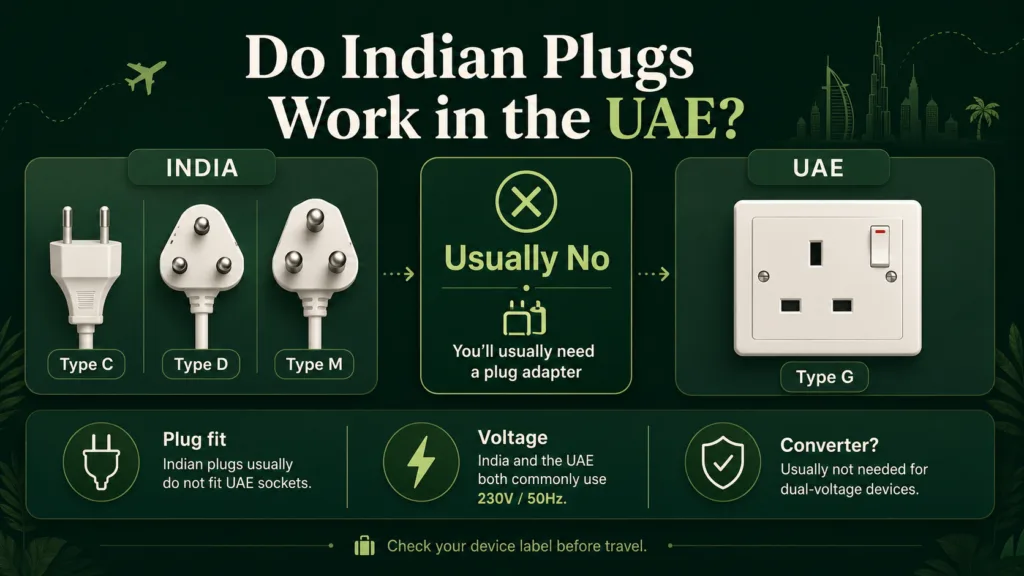
Plug Compatibility Visual
Indian plugs usually do not work directly in standard UAE wall outlets. If you are traveling from India to Dubai, Abu Dhabi, Sharjah, or another emirate, you will usually need a Type G plug adapter. The good news: India and the UAE commonly use 230V, 50Hz, so many Indian devices do not need a voltage converter.
Trip Match Summary
Use this quick match to understand the basic adapter and voltage decision for India to UAE travel.
India
Common plugs: Type D and Type M. Some two-pin Type C-style plugs may also be seen on small devices.
United Arab Emirates
Standard outlet: Type G, the three-rectangular-pin outlet also used in the UK.
Usually needed.
Most Indian Type D or Type M plugs will not fit a standard UAE Type G socket.
AdapterMatch result: Pack an India to UAE plug adapter that accepts Indian Type D/M plugs and fits a UAE Type G outlet. For most Indian phone chargers and laptop chargers, a plug adapter is usually enough if the charger label supports the voltage range.
A plug adapter does not convert voltage. It only changes the plug shape. Always check the device label before using appliances abroad.
Do Indian Plugs Fit UAE Sockets?
In most cases, Indian plugs do not fit UAE sockets directly. India commonly uses round-pin plugs, especially Type D and Type M. The UAE uses Type G outlets, which have three rectangular slots.
That means a charger or appliance bought in India may be electrically suitable for the UAE, but the physical plug shape is different. You need an adapter that lets the Indian plug connect to a UAE Type G socket.
Some hotels, serviced apartments, airports, and newer buildings may have multi-standard outlets that accept more than one plug shape. Do not rely on that. For normal travel, pack a proper Type G travel adapter before you go.
India to UAE Device Compatibility Checker
Choose the device you plan to use in the UAE. The basic route match stays the same: Indian plug shape to UAE Type G outlet.
JavaScript is only used to change the device note. The core travel decision is readable on this page: Indian plug shape usually needs a UAE Type G adapter, while voltage conversion depends on the device label.
India to UAE Plug Adapter Decision
| Trip item | What it means |
|---|---|
| Home country | India |
| Destination country | United Arab Emirates |
| Common Indian plug type | Type D and Type M round-pin plugs; small two-pin plugs may vary by device |
| UAE outlet type | Type G, with three rectangular slots |
| Plug adapter needed? | Usually yes. Indian Type D/M plugs do not normally fit UAE Type G sockets. |
| Voltage converter needed? | Usually not for many Indian devices, because India and the UAE are commonly 230V, 50Hz. Still check the label. |
| Best device advice | Phones and laptops are usually low-risk with the right adapter. Heat appliances need more caution. |
Voltage Difference Between India and the UAE
For many travelers from India, the main issue in the UAE is plug shape, not voltage. India and the UAE commonly use 230V power at 50Hz.
This is helpful because many Indian devices are already made for that voltage range. Still, do not skip the label check. A device label tells you what the device is designed to accept.
If the label says Input: 100–240V, 50/60Hz, the device is usually designed for international use across common voltage ranges. In that case, you normally need only the correct plug adapter for the UAE outlet.
If the label says only one voltage, such as 230V, it may still be suitable for the UAE because the voltage is similar. But with high-power devices, poor adapters and loose socket fit can be a bigger problem than the voltage number itself.
Do You Need a Voltage Converter in the UAE?
Most travelers from India will not need a voltage converter for ordinary electronics such as phone chargers, laptop chargers, camera chargers, and power banks, as long as the label supports the voltage.
You may need extra caution with appliances that heat, spin, or draw more power. This includes hair dryers, curling irons, kettles, travel irons, and some grooming devices. Even when the voltage is compatible, these devices can pull more current than a small travel adapter is designed to handle.
Always check the device label before using high-power appliances abroad. Do not use a small lightweight travel adapter with a high-wattage device unless the adapter rating and device rating are clearly suitable.
Phone Chargers and Laptop Chargers from India
Indian phone chargers and laptop chargers are usually the easiest devices to use in the UAE. Many modern chargers are dual voltage and show a label such as Input: 100–240V.
For these devices, the usual setup is simple: plug the Indian charger into a travel adapter, then plug the adapter into the UAE Type G wall socket. The adapter handles the physical plug shape. The charger itself handles the voltage if its label allows it.
Do not assume every charger is universal. Look at the small printed text on the charger body. You are looking for the input line, not the output line. The output line is for what the charger sends to your phone or laptop, not what it accepts from the wall.
Hair Dryers, Curling Irons, Kettles, and Irons
Heat appliances need more care. A hair dryer or curling iron from India may be made for 230V, which is usually close to UAE mains voltage. But the issue is often wattage, heat, and adapter quality.
Small travel adapters are often designed for chargers and light electronics, not powerful heating appliances. A high-wattage appliance can overheat a weak adapter, fit loosely, or draw more current than the adapter should carry.
If you must use a heat appliance in the UAE, check three things before plugging it in:
- The device label shows a voltage suitable for 230V power.
- The wattage of the device is within the adapter rating.
- The adapter fits firmly and is intended for high-power use.
For hotel stays, it is often easier to use the hair dryer or kettle provided in the room instead of packing a high-power appliance from India.
What to Pack for India to UAE Travel
- Type G travel adapter for UAE wall outlets.
- Phone charger with label checked for Input: 100–240V or a suitable 230V input.
- Laptop charger with the input label checked before travel.
- USB charger or power bank if you use multiple devices.
- A suitable adapter for grounded plugs if your Indian device has a three-pin plug.
- Extra caution for hair dryers, curling irons, kettles, irons, and other high-power appliances.
Common Mistakes to Avoid
Buying only a voltage converter
A voltage converter does not solve plug shape by itself. For India to UAE travel, you usually need a plug adapter first because the socket shape is different.
Assuming the adapter changes voltage
A plug adapter does not convert voltage. It only lets one plug shape fit another socket shape. Voltage compatibility comes from the device label or a separate converter when needed.
Using a cheap adapter with a high-power appliance
Phone chargers and laptop chargers draw less power than many heat appliances. Do not treat a hair dryer the same way you treat a phone charger.
Ignoring grounded plugs
If your Indian device uses a grounded three-pin plug, use an adapter that supports grounding properly. Do not force a plug into a socket or use a loose connection.
FAQ
Can I use an Indian charger in Dubai?
Usually yes, if you have a Type G plug adapter and the charger label supports the UAE voltage. Many phone and laptop chargers show Input: 100–240V, which is normally suitable for travel.
Do Indian three-pin plugs fit UAE sockets?
Usually no. Indian Type D or Type M round-pin plugs do not normally fit standard UAE Type G sockets. You should pack an India to UAE plug adapter.
Do I need a voltage converter from India to the UAE?
In most cases, no. India and the UAE commonly use 230V and 50Hz. Still, check the device label, especially for heat appliances or older devices.
Will my Indian laptop charger work in the UAE?
Most laptop chargers work if the label says Input: 100–240V or supports 230V. You will still usually need a Type G plug adapter for the UAE outlet.
Can I use an Indian hair dryer in the UAE?
Maybe, but be careful. The voltage may be similar, but hair dryers draw high power. Check the device wattage, voltage label, and adapter rating before using it.
Are UAE sockets the same as Indian sockets?
No. The UAE mainly uses Type G outlets with rectangular slots. India commonly uses round-pin plug types, so a travel adapter is usually needed.