
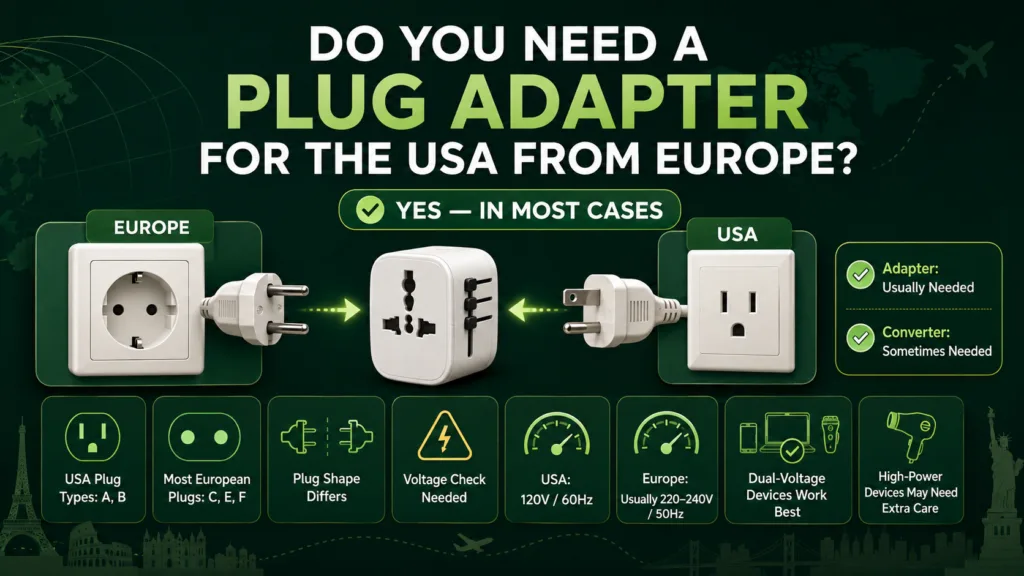
Traveling from Europe to the USA? You will usually need a plug adapter because most European plugs do not fit American Type A or Type B outlets. A voltage converter is a separate question: phones and laptops are often fine with the right adapter, but 230V-only appliances such as hair dryers and curling irons need extra caution.
Trip Match Visual
Trip Match Summary
Use this quick match before packing. It separates the plug shape problem from the voltage problem.
Europe
Many countries use Type C, E, or F plugs. The UK and Ireland commonly use Type G. Italy, Switzerland, Denmark, and a few others may use different national plug types.
United States
The USA commonly uses Type A and Type B outlets, with a nominal supply of 120V and 60Hz.
Usually needed
Most European plugs do not physically fit American outlets, so pack a Europe-to-USA plug adapter.
A plug adapter does not convert voltage. It only changes the plug shape so your device can fit the wall outlet. For voltage, read the device label before plugging it in.
| Trip Detail | What It Means |
|---|---|
| Home region | Europe |
| Destination country | United States |
| Common European plugs | Type C, E, F in many countries; Type G in the UK and Ireland; other types may appear in some European countries |
| USA outlet types | Type A and Type B |
| Plug adapter needed? | Usually yes |
| Voltage converter needed? | Depends on the device label |
| Best device advice | Phones and laptops are often dual voltage. High-power appliances need extra checking. |
Quick Answer
Yes, most travelers going from Europe to the USA should pack a plug adapter for Type A or Type B outlets. A European two-pin or three-pin plug usually will not fit directly into an American wall socket.
The bigger safety question is voltage. Most of Europe uses around 230V at 50Hz, while the USA uses around 120V at 60Hz. If your device label says Input: 100–240V, 50/60Hz, it is usually designed for international travel and may only need a plug adapter. If it says only 220–240V, it may not work properly in the USA without a suitable transformer or travel-ready replacement.
Always check the device label before using high-power appliances abroad.
Plug Compatibility from Europe to the USA
European plugs and American outlets are shaped differently. The USA mainly uses Type A outlets with two flat slots and Type B outlets with two flat slots plus a grounding hole. Many European countries use round-pin plugs, so the plug shape usually does not match.
That is why a Europe-to-USA travel adapter is normally needed. The adapter lets your European plug fit into a USA outlet. It does not make the power safer for every device, and it does not change 120V into 230V.
Common European Plug Situations
- Type C plug: common for many small European devices, but it does not fit USA Type A/B outlets without an adapter.
- Type E or Type F plug: common in many parts of mainland Europe, but the round pins and grounding design do not match USA outlets.
- Type G plug: common in the UK and Ireland, and it also needs a USA plug adapter.
- Type L, J, or K plugs: used in some European countries and also need a matching USA adapter.
Because “Europe” is not one plug system, it helps to check your actual home country plug. But the practical result is the same for most travelers: pack an adapter for USA Type A/B outlets.
Voltage Difference Between Europe and the USA
The USA and Europe do not only use different plug shapes. They also commonly use different voltage and frequency standards.
| Region | Common Voltage | Common Frequency | Traveler Meaning |
|---|---|---|---|
| Europe | About 230V | 50Hz | Your device may be designed for higher voltage. |
| USA | About 120V | 60Hz | European 230V-only devices may run weakly, not heat properly, or not work. |
For many chargers, this difference is not a problem because they are made for wide voltage ranges. For heat-producing appliances, the difference matters much more.
A plug adapter does not convert voltage. If a European appliance is rated only for 220–240V, plugging it into a USA outlet with only a shape adapter does not turn the USA outlet into 230V power.
How to Read the Device Label
Before using a European device in the USA, look for the word Input on the charger, power brick, handle, or device body. This label tells you what voltage and frequency the device is designed to accept.
If the Label Says Input: 100–240V
If your charger or device label says Input: 100–240V, it usually accepts both European and American voltage ranges. Many phone chargers, laptop chargers, camera chargers, tablet chargers, and USB-C chargers fall into this category.
In that case, you usually need only a plug adapter for the USA outlet shape. Still check the full label. A label that says 50/60Hz is better for international use because it covers both common frequency systems.
If the Label Says 220–240V Only
If the label says only 220–240V, the device is made for European-style voltage. In the USA, it may not receive enough voltage to work as intended. A European hair dryer, kettle, iron, or curling iron may run poorly or may not heat correctly.
For these devices, a plug adapter is not enough. A suitable voltage transformer may be required, but for high-power appliances, that can be bulky, inconvenient, and easy to mismatch. For travel, it is often safer to use a dual-voltage travel appliance or a device made for the USA.
If the Label Says 230V 50Hz Only
A label that lists only 230V 50Hz should be treated carefully. The USA supply is commonly 120V 60Hz. Some devices are sensitive to voltage, some are sensitive to frequency, and some are sensitive to both. When the label is narrow, do not assume a plug adapter will solve the problem.
Device Guidance for Europe to USA Travel
| Device | Plug Adapter Needed? | Voltage Converter Needed? | What to Check |
|---|---|---|---|
| Phone charger | Usually yes | Usually no if the label says 100–240V | Check for Input: 100–240V, 50/60Hz |
| Laptop charger | Usually yes | Usually no if the power brick is dual voltage | Check the charger brick, not only the laptop body |
| Camera charger | Usually yes | Usually no if dual voltage | Check the charger label before plugging in |
| Electric shaver | Usually yes | Depends on the label | Some are dual voltage, some are not |
| Hair dryer | Yes | May be needed if not dual voltage | High-power appliance; check voltage and wattage carefully |
| Curling iron or hair straightener | Yes | May be needed if not dual voltage | Heat devices need extra caution |
| CPAP machine | Usually yes | Depends on the power supply label | Check the exact medical device power supply and bring the correct adapter |
Will Your Phone or Laptop Charger Work in the USA?
Most modern phone and laptop chargers are designed for international voltage ranges, but do not guess. Check the charger label. If it says Input: 100–240V and 50/60Hz, it usually works in the USA with a plug adapter.
For USB-C laptop chargers, the same rule applies. The plug shape may need adapting, but the voltage support depends on the charger’s input rating. Do not judge by the cable alone. The useful information is usually printed on the charger block.
Simple rule: if the charger label covers 100–240V, you usually need a USA plug adapter, not a voltage converter.
Hair Dryer, Curling Iron, Kettle, and Iron Warning
High-power appliances are the risky category for Europe to USA travel. Hair dryers, curling irons, straighteners, kettles, garment steamers, and travel irons often draw much more power than a phone charger.
If a European hair dryer is rated only for 220–240V, it may run weakly or fail to heat properly on USA 120V power. A plug adapter only changes the pin shape. It does not make a 230V appliance behave correctly on a 120V outlet.
If the appliance has a clear dual-voltage setting, read the instructions before switching it. Some dual-voltage hair tools must be manually set to the correct voltage before use. If you are unsure, leave the appliance at home or use a travel appliance made for 100–240V operation.
Do not use a high-power appliance abroad unless the label and instructions clearly support the destination voltage.
Does 50Hz vs 60Hz Matter?
Europe commonly uses 50Hz, while the USA commonly uses 60Hz. Many modern chargers are marked 50/60Hz, which means they are designed for both common frequency systems.
Frequency can matter more for some motors, clocks, pumps, and appliances that depend on AC timing. For ordinary phone and laptop charging, a charger marked 100–240V and 50/60Hz is usually low-risk. For medical equipment, motors, and older appliances, read the label and manufacturer instructions carefully.
What to Pack for the USA from Europe
- USA plug adapter: choose one that accepts your home plug type and fits USA Type A/B outlets.
- Your original phone charger: check that it says Input: 100–240V.
- Your laptop charger: check the power brick for 100–240V and 50/60Hz.
- USB charging cable: useful for phones, tablets, headphones, cameras, and power banks.
- Dual-voltage travel appliance: better than relying on a heavy converter for hair tools.
- Extra adapter if needed: useful if you need to charge more than one device at the same time.
A universal adapter can be useful if you travel often, but it still follows the same rule: it may solve plug shape, not voltage conversion.
Common Mistakes to Avoid
Buying Only by Destination Name
“USA adapter” is helpful, but also check whether the adapter accepts your exact European plug. A Type C plug, UK Type G plug, and Swiss Type J plug are not the same shape.
Assuming an Adapter Is a Converter
This is the main mistake. A plug adapter does not convert voltage. If the device is not rated for USA voltage, the adapter alone does not fix that.
Ignoring the Charger Brick
For laptops, the power brick matters more than the laptop body. For phones, the wall charger matters more than the USB cable.
Packing High-Power Heat Devices Without Checking
Hair dryers and curling irons are not the same as phone chargers. They use much more power and are more likely to have voltage limits.
Mini Device Compatibility Checker
Choose the type of device you plan to bring. This checker gives a practical travel power result for Europe to USA trips.
A plug adapter does not convert voltage. Use the checker as a packing aid, not as a replacement for the device label.
FAQ
Do European plugs fit in USA outlets?
Usually no. The USA commonly uses Type A and Type B outlets, while many European plugs use round pins or different grounding designs. Most travelers from Europe need a plug adapter for the USA.
Do I need a voltage converter for the USA from Europe?
It depends on your device label. If the label says Input: 100–240V, a voltage converter is usually not needed. If it says only 220–240V, the device may not work properly on USA 120V power.
Can I charge my European phone in the USA?
Usually yes, if your phone charger says Input: 100–240V, 50/60Hz. You will normally still need a plug adapter so the charger can fit the USA outlet.
Can I use a European laptop charger in the USA?
Usually yes, if the laptop power brick supports 100–240V and 50/60Hz. Check the printed label on the charger. The plug shape will usually require a USA adapter.
Can I use my European hair dryer in the USA?
Only if the hair dryer clearly supports USA voltage or has a correct dual-voltage setting. Many European hair dryers are 220–240V only, and a plug adapter alone will not make them work correctly on 120V.
Is a universal adapter enough for the USA?
A universal adapter may be enough for plug shape if it supports USA Type A/B outlets and accepts your European plug. It does not convert voltage, so you still need to check every device label.