
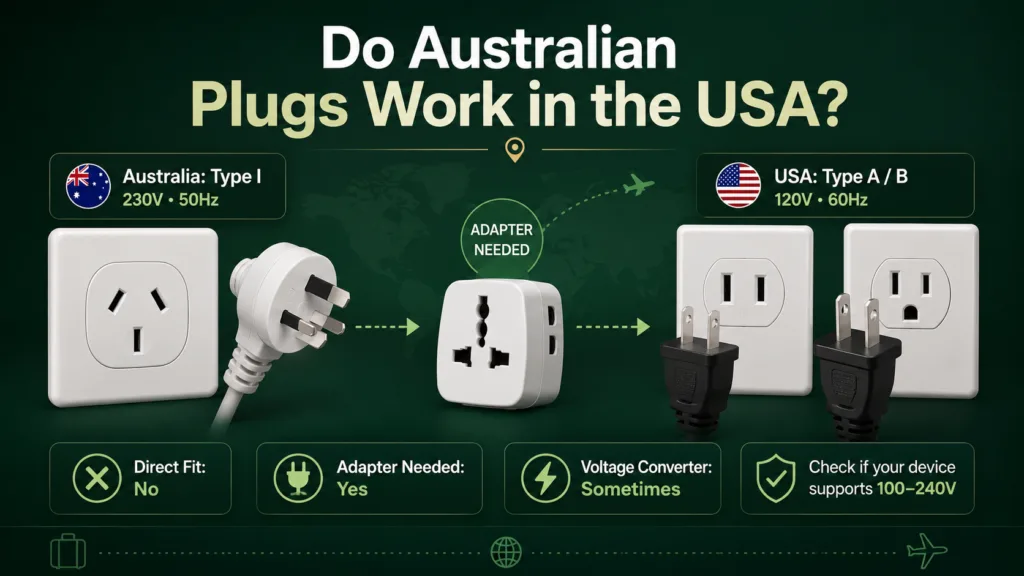
Plug Compatibility Visual
Australian plugs do not normally work directly in USA wall outlets. Australia uses Type I plugs, while the United States commonly uses Type A and Type B outlets. If you are traveling from Australia to the USA, you will usually need a Type I to Type A/B plug adapter. For voltage, the bigger question is your device label.
Trip Match Summary
Use this quick match box to understand the travel power decision before you pack. This is written for travelers going from Australia to the United States.
Australia
Common plug: Type I
United States
Common outlets: Type A and Type B
You will usually need a plug adapter.
Australian Type I plugs do not fit US Type A/B outlets.
A voltage converter may be needed for single-voltage 230V-only devices.
Check the label before plugging in.
Best short answer: pack a Type I to Type A/B travel adapter for the USA. For phones and laptops, the adapter is usually enough if the charger says Input: 100–240V. For hair dryers, curling irons, kettles, irons, and other high-power appliances, check the label carefully before use.
A plug adapter does not convert voltage. It only changes the plug shape so your Australian plug can fit into a US outlet.
Quick Answer
If your device has an Australian Type I plug, it will not fit most USA outlets by itself. You usually need a travel adapter that accepts an Australian plug and fits into a US Type A or Type B socket.
The United States uses a lower voltage than Australia. Australia is commonly around 230V and 50Hz, while the USA is commonly around 120V and 60Hz. That voltage difference matters more for heat-producing appliances than for many modern chargers.
| Trip detail | Australia | United States | What it means for you |
|---|---|---|---|
| Plug type | Type I | Type A / Type B | You will usually need a plug adapter. |
| Voltage | Usually 230V | Usually 120V | Single-voltage devices need checking. |
| Frequency | 50Hz | 60Hz | Most chargers are fine, but some motor or timing devices may care. |
| Phone and laptop chargers | Often dual voltage | Works if label allows 100–240V | Check for Input: 100–240V. |
| Hair dryers and heat tools | Often high wattage | Voltage difference matters | Use only if rated for 120V or clearly dual voltage. |
Do Australian Plugs Fit USA Outlets?
No, not in normal wall outlets. Australian plugs are Type I, with two angled flat pins and sometimes a grounding pin. US outlets are usually Type A or Type B, with flat parallel slots and, for Type B, a round grounding hole.
Because the shapes are different, an Australian plug cannot be inserted safely into a standard US outlet. The practical solution is a travel plug adapter made for an Australian Type I plug going into a US Type A or Type B outlet.
Some hotels, airports, or newer buildings may offer USB charging ports or multi-standard sockets, but you should not rely on that. A small adapter is easier to pack and gives you more control over where you can charge.
Do You Need a Plug Adapter from Australia to the USA?
Yes, in most cases. You need a plug adapter because the plug compatibility is different. Your Australian plug shape does not match the common US power outlet shape.
AdapterMatch rule: first match the plug shape, then check voltage. The adapter solves the socket type problem, but it does not decide whether the device is safe for the local voltage.
What kind of adapter should you look for?
Look for an adapter that accepts an Australian Type I plug and has a US Type A or Type B plug on the wall side. If your Australian device has a grounded plug, a grounded Type B-style adapter is often the better match where available.
A simple adapter is enough only when your device can already handle the USA voltage. That is why the device label matters.
Voltage Difference Between Australia and the USA
Australia commonly uses 230V electricity. The United States commonly uses 120V electricity. This means an Australian device made only for 230V may not work properly on US power, even if the plug fits through an adapter.
Lower voltage usually means a 230V-only heat device may run weakly, heat slowly, or not work as expected. With some devices, using the wrong voltage can also create a safety risk or damage the device.
What “Input: 100–240V” Means
Look at the charger, power brick, or device label. If it says Input: 100–240V, it is usually designed to work across both Australian and US voltage ranges. You will still need the plug adapter, but you usually do not need a voltage converter for that charger.
You may also see something like 50/60Hz on the label. That means the device is usually designed for both common frequency ranges. This is common on phone chargers, laptop chargers, camera chargers, and many USB power supplies.
Always check the device label before using high-power appliances abroad. Do not assume a plug adapter makes a 230V-only appliance suitable for the USA.
Do You Need a Voltage Converter?
You do not need a voltage converter just because the plug shape is different. You may need one if the device is single voltage and not rated for the USA power supply.
| Device label | Plug adapter needed? | Voltage converter needed? | Practical advice |
|---|---|---|---|
| Input: 100–240V, 50/60Hz | Usually yes | Usually no | Good match for phones, laptops, cameras, and many USB chargers. |
| Input: 230V only | Yes | May be needed | Use extra caution. The device may not work correctly on 120V. |
| Dual voltage switch or setting | Yes | Usually no if set correctly | Set the device to the correct voltage before use. |
| No readable label | Yes | Unknown | Do not guess with high-power appliances. |
For a short trip, it is often easier to avoid bringing Australian heat appliances unless they are clearly dual voltage or designed for 120V use. Voltage converters for high-wattage items can be bulky, and not every converter is suitable for every appliance.
Will Common Australian Devices Work in the USA?
Most modern phone chargers are dual voltage. Check for Input: 100–240V. If you see it, a plug adapter is usually enough.
Laptop power bricks commonly support 100–240V and 50/60Hz. Check the label on the charger, not only the laptop body.
Many camera battery chargers are travel-friendly, but the label still decides. A plug adapter is usually needed for the wall outlet.
Some shavers are dual voltage, while others are not. Check the charging base or power cord label before using it in the USA.
These are high-power appliances. Use only if the label clearly supports 120V or a correct dual-voltage setting.
Many CPAP power supplies support 100–240V, but you should check the exact power brick label. For medical equipment, confirm before travel and pack the right adapter.
Device Compatibility Checker
Choose a device type for a practical travel power note. This checker is a guide, not a replacement for the label on your own device.
What to Pack for the USA
- Type I to Type A/B plug adapter for Australian plugs going into US outlets.
- USB charger or power brick that says Input: 100–240V.
- Charging cables for phone, laptop, camera, watch, or tablet.
- A small power strip only if it is rated for the local voltage and suitable for travel use.
- Dual-voltage grooming tools if you plan to bring a shaver, hair dryer, or curling iron.
- For CPAP machines or other needed equipment, the power supply label and the correct adapter packed in your carry-on.
Avoid packing heavy 230V-only heat appliances unless you have checked the label and understand the power requirements. In many cases, using a local US appliance or a travel-rated dual-voltage device is simpler.
Common Mistakes to Avoid
Thinking the adapter changes electricity
A travel adapter changes the plug shape. It does not change 120V into 230V or 230V into 120V. A plug adapter does not convert voltage.
Checking the cable but not the power brick
For laptops and many chargers, the useful label is usually on the power brick. Look for the input range there.
Assuming all hotel outlets are the same
Most US rooms use Type A/B outlets, but outlet placement and condition can vary. Some rooms may have USB ports; others may not.
Using heat appliances without checking wattage and voltage
Hair dryers, curling irons, straighteners, irons, and kettles draw more power than small chargers. They need a more careful check before use.
FAQ
Can I plug an Australian charger into a USA outlet?
Not directly in most cases. Australian Type I plugs do not fit USA Type A or Type B outlets. You usually need a Type I to Type A/B plug adapter.
Will my Australian phone charger work in the USA?
Usually yes, if the charger label says Input: 100–240V and 50/60Hz. You will still need a plug adapter for the US outlet.
Do I need a voltage converter for Australia to USA travel?
For many phone, laptop, and camera chargers, usually no. For 230V-only devices, especially high-power appliances, a converter may be needed or the device may not be a good travel choice.
Can I use an Australian hair dryer in the USA?
Only if the label clearly supports 120V or has a correct dual-voltage setting. A plug adapter alone is not enough for a 230V-only hair dryer.
Does 50Hz and 60Hz matter?
For many modern chargers, it usually does not matter if the label says 50/60Hz. Some motor-based, clock-based, or medical devices may need closer checking.
What adapter should I buy for the USA from Australia?
Look for a travel adapter that accepts an Australian Type I plug and fits US Type A or Type B outlets. If your device has a grounded plug, consider a grounded adapter where appropriate.