
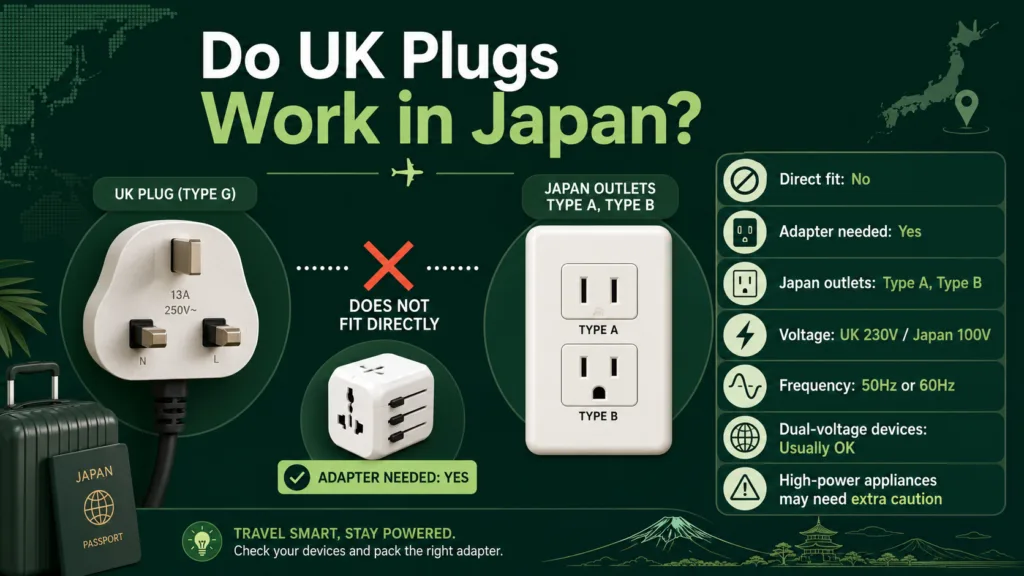
Trip Match Visual
No, UK plugs do not work in Japan directly. UK plugs are usually Type G, while Japan commonly uses Type A and Type B outlets. For most trips from the UK to Japan, you will need a UK to Japan plug adapter. You may also need to check voltage because the UK uses 230V and Japan uses 100V.
Trip Match Summary
Use this quick trip match to separate the plug shape question from the voltage question. A plug adapter does not convert voltage.
United Kingdom
Common plug: Type G
Japan
Common outlets: Type A / Type B
Usually needed
Pack a UK Type G to Japan Type A/B travel adapter.
Depends on device label
Dual-voltage chargers are usually fine. Single-voltage 220–240V appliances may not work properly on 100V.
Best practical answer: for a UK phone charger, laptop charger, camera charger, or USB charger marked Input: 100–240V, a plug adapter is usually enough. For UK hair dryers, curling irons, kettles, clothes irons, and other high-power appliances, do not assume an adapter is enough.
UK to Japan Device Compatibility Checker
Choose the type of device you plan to pack. This checker gives a safe, general decision for UK travelers going to Japan.
Always check the device label before using UK appliances in Japan. Japan’s 100V supply is much lower than the UK’s 230V supply, and a simple plug adapter only changes the plug shape.
Quick Answer: Do UK Plugs Fit Japanese Outlets?
UK Type G plugs do not fit Japanese Type A or Type B outlets. The pin shape is different, so you will usually need a UK to Japan travel adapter.
| Trip detail | UK | Japan | What it means |
|---|---|---|---|
| Common plug or outlet type | Type G | Type A / Type B | A UK plug needs an adapter for Japanese outlets. |
| Voltage | 230V | 100V | Single-voltage UK appliances may not work properly. |
| Frequency | 50Hz | 50Hz / 60Hz | Most chargers are fine if rated 50/60Hz, but check the label. |
| Phone and laptop chargers | Often 100–240V | 100V supply | Usually okay with a plug adapter if the label confirms it. |
| Hair dryers and heat tools | Often high wattage | Lower voltage | Use extra caution. A plug adapter alone may not be enough. |
Plug Compatibility from the UK to Japan
The UK uses the large three-pin Type G plug. Japan commonly uses Type A outlets with two flat slots, and some locations may have Type B outlets with two flat slots plus a grounding hole.
Because Type G and Type A/B are physically different, a UK plug will not go into a normal Japanese wall outlet. You need a plug adapter that accepts UK Type G and fits Japan Type A or Type B outlets.
In many hotels, apartments, older buildings, trains, cafes, and public charging areas, outlet availability can vary. Some places may have only two-slot outlets. If your adapter has a grounding pin on the Japan side, it may not fit every outlet. For basic charging, many travelers use a compact adapter that fits common Japanese two-flat-pin sockets, but the right choice still depends on your device and the adapter design.
Voltage Difference Between the UK and Japan
The plug adapter question is only half of the decision. The UK uses 230V / 50Hz. Japan uses 100V, with 50Hz in eastern Japan and 60Hz in western Japan.
That means a UK appliance designed only for 220–240V may receive much less voltage in Japan. Some devices may run weakly, charge slowly, heat poorly, or fail to work. This is different from traveling from a lower-voltage country to a higher-voltage country, where overheating and damage may be a bigger risk. Either way, the safe move is the same: read the label before plugging in.
A plug adapter does not convert voltage. It only changes the shape of the plug so it can fit the wall outlet. If your device is not rated for Japan’s 100V supply, a plug adapter alone does not solve that problem.
Do You Need a Plug Adapter in Japan?
Yes, in most cases. A UK traveler going to Japan should pack a UK to Japan plug adapter. Look for Japan support, Type A/B support, or a travel adapter that clearly covers Japan.
A universal travel adapter may also work if it supports Japan’s outlet shape, but read the markings carefully. Some universal adapters are bulky and may not sit firmly in every wall socket. Also, some adapters are made only for low-power charging, not for high-wattage appliances.
Best adapter match for a UK traveler
- Home plug side: accepts UK Type G
- Destination side: fits Japan Type A or Type B
- Suitable for the device power rating
- Compact enough for hotel outlets, power strips, and wall sockets
- No claim that it converts voltage unless it is a real voltage transformer or converter
Do You Need a Voltage Converter?
You may need a converter or transformer only if your device is not compatible with Japan’s 100V supply. For many modern chargers, you usually do not need one. For some high-power UK appliances, a converter may be required, but it is often easier and safer to use a travel-ready dual-voltage device or use what your accommodation provides.
Check the printed label on the charger, plug, power brick, or appliance body. You are looking for the input rating.
What “Input: 100–240V” means
If the label says Input: 100–240V, the device is usually designed to accept power in Japan, the UK, and many other countries. You still need a plug adapter because the plug shape is different, but you usually do not need a voltage converter.
You may also see something like 50/60Hz. That means the device is usually designed for both common frequency ranges. This matters in Japan because the country uses both 50Hz and 60Hz depending on region.
When a converter may be needed
If your device label says only 220–240V, 230V, or 240V, it is not clearly rated for Japan’s 100V supply. In that case, a plug adapter alone is not enough. The device may need a step-up transformer, or it may be better not to bring it.
Be especially careful with high-power appliances. Hair dryers, curling irons, straighteners, kettles, and travel irons draw much more power than a phone charger. They can also exceed the wattage limit of many small converters or travel adapters.
Phone Charger Guidance
Most modern phone chargers are made for international use, but do not guess. Check the small print on the charger. If it says Input: 100–240V, 50/60Hz, it should usually work in Japan with a UK to Japan plug adapter.
If you charge through USB, the same rule applies to the USB wall charger. The cable itself is not the voltage decision. The wall charger or power brick is what you need to check.
Laptop Charger Guidance
Laptop chargers are commonly dual voltage. Many laptop power bricks are marked Input: 100–240V. If yours says that, it will usually work in Japan with the right plug adapter.
Still, check the full input line. Some chargers also list 50–60Hz. That is a good sign for Japan because Tokyo and eastern Japan use 50Hz, while Osaka, Kyoto, Nagoya, Hiroshima, and much of western Japan use 60Hz.
Hair Dryer, Curling Iron, and Straightener Warning
UK hair dryers and heat styling tools need extra care in Japan. Many are built for UK voltage only, and many draw high wattage. A small travel adapter does not make them safe or effective on Japan’s 100V supply.
If the tool is marked dual voltage and includes 100V in its input range, it may work with a plug adapter. Some dual-voltage hair tools also have a manual voltage switch. If yours has a switch, set it correctly before plugging it in.
Do not use a UK-only 230V heat appliance in Japan just because the plug fits an adapter. Check the label, the wattage, and the adapter or converter rating first.
Electric Shavers, Toothbrushes, and Small Bathroom Devices
Electric shavers and toothbrush chargers vary. Some are dual voltage and travel-friendly. Others are made for a narrower voltage range. Check the charger base or plug for Input: 100–240V.
Some Japan hotel bathrooms may have limited shaver outlets, but do not rely on that as your main plan. If the device matters for your trip, pack the right plug adapter and confirm the label before leaving the UK.
CPAP Machines and Medical Devices
For a CPAP machine or any medical device, treat the label check as a must-do step. Many CPAP power supplies are designed for international voltage, but not all setups are the same. Check the power brick for Input: 100–240V, 50/60Hz.
You should also check whether your plug adapter fits securely, whether your accommodation has a reachable outlet near the bed, and whether you need an extension lead that is safe for the device. For medical equipment, it is better to confirm the power requirements before travel rather than solve it after arrival.
What to Pack for Japan from the UK
- A UK Type G to Japan Type A/B plug adapter
- Your phone charger with the label checked for Input: 100–240V
- Your laptop charger, camera charger, or USB charger if rated for 100–240V
- A compact USB charger or multi-port charger that clearly supports 100V
- A travel-ready dual-voltage hair tool if you need one
- No UK-only high-wattage appliance unless you have checked the voltage, wattage, and converter requirements
Common Mistakes UK Travelers Make in Japan
Thinking the adapter changes voltage
This is the main mistake. A plug adapter does not convert voltage. It only helps the plug fit the outlet.
Assuming every outlet has a grounding hole
Many Japanese outlets are two-slot Type A style. Type B outlets exist, but you should not assume every place will have one. This can matter if your adapter is bulky or depends on a grounded socket shape.
Bringing UK heat appliances without checking the label
Hair dryers, straighteners, curling irons, kettles, and irons are the devices most likely to cause problems. They use more power and are often not as travel-friendly as phone or laptop chargers.
Ignoring frequency
Japan uses 50Hz in the east and 60Hz in the west. Most modern chargers are fine if marked 50/60Hz. Some older motors, clocks, and timing devices may behave differently.
Simple Rule for UK to Japan Power
If your device is a modern charger and the label says Input: 100–240V, 50/60Hz, you will usually need only a plug adapter. If your device says only 220–240V, or if it is a high-power heat appliance, stop and check more carefully.
| Device | Plug adapter needed? | Voltage converter needed? | What to check |
|---|---|---|---|
| Phone charger | Usually yes | Usually no if dual voltage | Look for Input: 100–240V |
| Laptop charger | Usually yes | Usually no if dual voltage | Check the power brick input label |
| Camera battery charger | Usually yes | Usually no if marked 100–240V | Check the charger, not just the camera |
| Electric shaver | Usually yes | Depends on label | Some are dual voltage, some are not |
| Hair dryer or curling iron | Yes | May be needed, but high wattage is a concern | Check voltage, wattage, and dual-voltage setting |
| CPAP machine | Usually yes | Depends on power supply label | Confirm 100–240V, 50/60Hz before travel |
FAQ
Can I plug a UK plug into a Japanese outlet?
No. A UK Type G plug does not fit Japan’s common Type A or Type B outlets. You will usually need a UK to Japan plug adapter.
Do I need a voltage converter for Japan from the UK?
It depends on the device. If the label says Input: 100–240V, you usually do not need a converter. If it says only 220–240V or 230V, it is not clearly rated for Japan’s 100V supply.
Will my UK phone charger work in Japan?
Most modern phone chargers work if they are marked Input: 100–240V, 50/60Hz. You will still need a plug adapter because the plug shape is different.
Will my UK laptop charger work in Japan?
Usually yes, if the laptop charger is dual voltage. Check the power brick for Input: 100–240V. If it has that rating, a plug adapter is usually enough.
Can I use a UK hair dryer in Japan?
Be careful. Many UK hair dryers are designed for 220–240V and draw high wattage. Japan uses 100V. A plug adapter alone may not be enough, and a small converter may not handle the wattage.
Does Japan use 50Hz or 60Hz?
Japan uses both. Eastern Japan, including Tokyo, uses 50Hz. Western Japan, including Osaka and Kyoto, uses 60Hz. Most modern chargers are fine if marked 50/60Hz.