
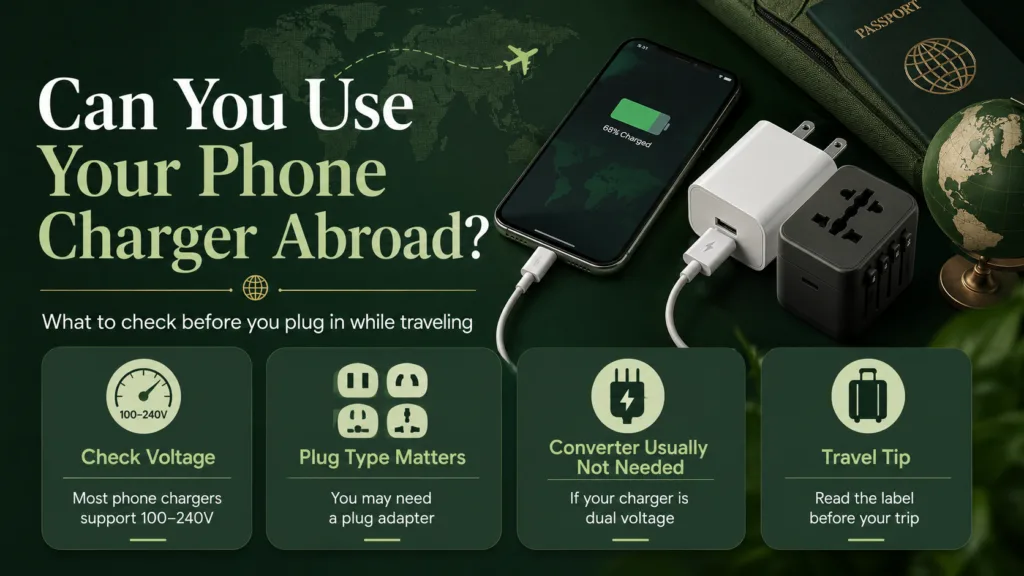
Yes, you can usually use your phone charger abroad if the charger label says Input: 100–240V. You may still need a plug adapter so the charger physically fits the wall outlet in your destination country.
Phone Charger Travel Match Visual
Phone Charger Compatibility Checker
Use this simple checker before you pack. It does not need your destination country because most modern phone chargers are made for a wide voltage range. The main checks are the charger label and the wall outlet shape.
Most common result: modern phone chargers are often dual voltage. If the charger says Input: 100–240V, it can usually handle both 120V and 230V countries. You may only need a travel plug adapter.
A plug adapter does not convert voltage. It only changes the physical plug shape so your charger can fit into a different power outlet.
Quick Answer
In most cases, your phone charger will work abroad if it supports Input: 100–240V. That label means the charger is designed to accept the common voltage ranges used in many countries. You will usually need to think about two separate things:
- Plug shape: will your charger plug fit the destination outlet?
- Voltage: can your charger accept the local voltage?
If the plug shape is different, use a plug adapter. If the charger is not dual voltage, a voltage converter may be needed, but this is uncommon for modern phone chargers.
| Item to Check | What It Means | Usual Result |
|---|---|---|
| Charger label | Look for Input: 100–240V | Usually safe for international voltage ranges |
| Plug type | Your home plug may not fit the destination socket type | A plug adapter may be needed |
| USB cable | The cable must fit your charger and phone | Pack your normal charging cable |
| Fast charging | Fast charging depends on charger output, cable, and phone support | It may work, but speed can vary |
| Power strip or extension | Some are made for one voltage range only | Check the label before using abroad |
Can You Use a Phone Charger in Another Country?
Usually, yes. Phone chargers are low-power devices compared with hair dryers, kettles, irons, and heat styling tools. Many modern chargers are built to work across a wide input range, which is why the label often says Input: 100–240V, 50/60Hz.
That label is the part that matters most. Do not judge by the phone brand, the cable, or the country you bought it in. Turn the charger over and read the small printed input line.
If your charger says Input: 100–240V, it can usually accept power in both lower-voltage countries and higher-voltage countries. In that case, the remaining problem is normally plug compatibility. Your charger may be safe electrically but still unable to fit the wall outlet without an adapter.
If the label says only 120V or only 220–240V, be more careful. That charger is single voltage and may not be suitable for every destination. In that case, use a charger rated for the destination voltage or get proper advice before using it.
What “Input: 100–240V” Means on a Phone Charger
Input: 100–240V means the charger is designed to receive electricity within that voltage range. It does not mean every plug will fit every outlet. It only tells you that the charger can usually handle the voltage supplied by the wall socket.
You may also see 50/60Hz on the label. That refers to electrical frequency. Many phone chargers accept both 50Hz and 60Hz, so frequency is normally not a problem for phone charging. It can matter more for some motors, clocks, and older appliances.
Input: 100–240V ~ 50/60Hz
Output: 5V, 9V, 12V, or similar USB charging output
The input side tells you what the charger can receive from the wall. The output side tells you what it sends to your phone.
Plug Adapter vs Voltage Converter for Phone Chargers
A plug adapter changes the shape of the plug. It lets a charger from one country fit into a power outlet in another country. For example, a flat-pin plug may need an adapter for a round-pin socket.
A voltage converter changes the electrical voltage. It is used when a device is made for one voltage range but the destination country supplies a different voltage. Most modern phone chargers do not need a converter if they say Input: 100–240V.
| Item | What It Changes | Does a Phone Charger Usually Need It? |
|---|---|---|
| Plug adapter | Plug shape only | Often yes, depending on destination outlet type |
| Voltage converter | Voltage level | Usually no if the charger says Input: 100–240V |
| USB cable | Connection between charger and phone | Yes, pack the cable that fits your phone |
Always check the device label before using high-power appliances abroad. The advice for phone chargers does not automatically apply to hair dryers, curling irons, travel kettles, steamers, or irons.
Will Fast Charging Work Abroad?
Fast charging may work abroad, but it depends on your charger, cable, phone, and power source. If your charger supports the correct fast-charging standard and the input label says 100–240V, travel itself does not usually stop fast charging.
Charging can feel slower if you use a low-power USB port in a hotel, airplane, train, rental car, or public charging station. Wall chargers usually provide better charging performance than shared USB ports. For privacy and reliability, many travelers prefer using their own charger with a proper travel plug adapter.
Why the Destination Outlet Still Matters
Your phone charger may support worldwide voltage, but the plug pins may not fit the socket type in your destination country. That is the most common reason travelers need an adapter for a phone charger.
Outlet types can vary by country, region, hotel, building age, and socket installation. Some hotels provide multi-standard outlets or USB charging points, but you should not rely on that. Packing the right travel adapter is usually safer than hoping the room has the outlet you need.
- Phone charger
- Tablet charger
- Laptop charger
- Camera battery charger
- Power bank charger
These are often dual voltage, but the label still matters.
- Hair dryer
- Curling iron
- Hair straightener
- Travel kettle
- Clothes iron or steamer
These may draw more power and can be single voltage.
Device-by-Device Travel Power Advice
| Device | Plug Adapter Needed? | Voltage Converter Needed? | What to Check |
|---|---|---|---|
| Phone charger | Usually, if plug shape differs | Usually no if marked Input: 100–240V | Charger label and destination outlet type |
| Laptop charger | Often, if plug shape differs | Often no, but check the power brick label | Input range, plug type, and grounded plug needs |
| Camera battery charger | May be needed | Usually no if dual voltage | Input label on the charger |
| Electric shaver | May be needed | Depends on model | Input label and bathroom outlet rules |
| CPAP machine | May be needed | Depends on the power supply label | Input range, plug type, airline rules, and backup plan |
| Hair dryer or curling iron | May be needed | May be needed if single voltage | Voltage, wattage, and heat-device rating |
What to Pack for Charging Your Phone Abroad
For a normal trip, you usually do not need a heavy voltage converter just for a modern phone charger. A cleaner packing list is better:
- Your normal phone charger with a readable Input: 100–240V label
- The USB cable that fits your phone
- A plug adapter that matches the destination country’s power outlet
- A spare cable if you depend on your phone for maps, boarding passes, or payments
- A power bank, if allowed by your airline and useful for long travel days
If you are visiting more than one country, check each destination. Neighboring countries may use different plug types. A universal travel adapter may help with plug shape across several destinations, but it still does not convert voltage.
Common Mistakes to Avoid
Assuming the adapter changes electricity
A small plug adapter can make your charger fit the wall, but it does not change voltage, frequency, or charging output. A plug adapter does not convert voltage.
Reading only the phone model, not the charger
The phone itself is not plugged directly into the wall. The charger is. Check the charger label, not only the phone model.
Using a power strip without checking it
Some power strips and extension cords are designed for one voltage range. A dual-voltage phone charger plugged into the wrong power strip can still be unsafe if the strip is not rated for the destination voltage.
Treating hair tools like phone chargers
Phone chargers and heat appliances are very different. Hair dryers, curling irons, straighteners, kettles, and irons can draw much more power. They need a separate voltage and wattage check.
Safe Phone Charging Tips for Travel
- Use a charger with a clear input label.
- Do not use damaged chargers, loose adapters, or cracked cables.
- Avoid forcing a plug into a socket that does not match.
- Keep chargers away from sinks, wet counters, and damp bathroom areas.
- Unplug the charger if it becomes unusually hot, smells odd, or makes noise.
- For medical or work-critical devices, pack a backup charging plan.
Best simple rule: if your phone charger says Input: 100–240V, focus on matching the plug shape to the destination outlet. If the label shows only one voltage, do not assume it is safe abroad.
FAQ
Do I need a voltage converter for my phone charger?
Usually no, if the charger label says Input: 100–240V. You may still need a plug adapter for the destination outlet shape.
Can I plug my phone charger into a travel adapter?
Yes, in most cases. The travel adapter helps the plug fit the wall outlet. Check that your charger supports the destination voltage before using it.
What happens if my charger says 120V only?
A 120V-only charger may not be suitable in countries that commonly use 220–240V. Use a charger rated for the destination voltage or get proper advice before plugging it in.
Does a universal adapter make my phone charger safe everywhere?
No. A universal adapter can help with plug shape in many places, but it does not convert voltage. The charger label still matters.
Is 50Hz or 60Hz important for phone charging?
For many modern phone chargers, no. If the label says 50/60Hz, it is usually designed for both common frequencies.
Can I use the same adapter for my phone charger and hair dryer?
The plug adapter may physically fit both, but the electrical risk is different. Hair dryers and curling irons are high-power appliances and need a separate voltage and wattage check.