
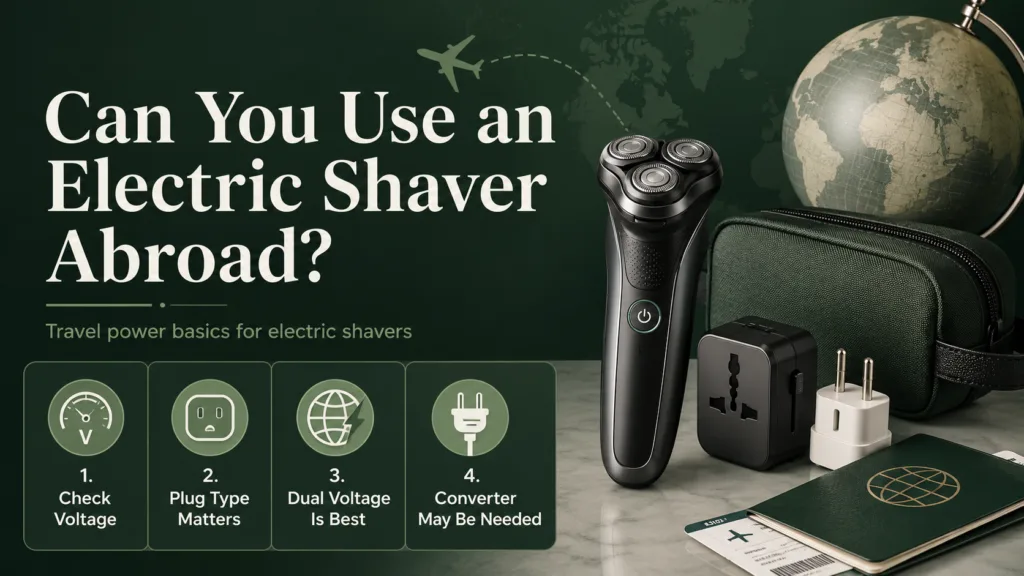
Electric Shaver Travel Power Visual
You can usually use an electric shaver abroad if the charger or shaver label supports the destination voltage. Many modern rechargeable shavers are dual voltage, but not all are. Before you pack, check the label for Input: 100–240V. You may still need a plug adapter so the plug fits the wall outlet.
Electric Shaver Compatibility Checker
Use this simple checker to decide whether a plug adapter is likely enough, or whether you need to be more careful with voltage.
A plug adapter does not convert voltage. It only helps the plug fit a different power outlet shape. The voltage decision comes from the label on your shaver, charger, or charging stand.
Quick Answer
| Shaver or charger label | Can you use it abroad? | Plug adapter needed? | Voltage converter needed? |
|---|---|---|---|
| Input: 100–240V, 50/60Hz | Usually yes | Often yes, depending on the destination outlet | Usually no |
| 110–120V only | Only in countries with matching voltage, unless properly converted | May be needed | May be needed in 220–240V countries |
| 220–240V only | Only in countries with matching voltage, unless properly converted | May be needed | May be needed in 100–120V countries |
| No clear label | Use caution | May be needed | Do not assume it is safe |
Can You Use an Electric Shaver Abroad?
Yes, in many cases. Electric shavers are often easier to travel with than high-power appliances such as hair dryers, curling irons, clothes irons, and kettles. A shaver usually uses much less power and many rechargeable models are designed for international charging.
The main question is not only “Will the plug fit?” The better question is: Does the shaver support the voltage in the country I am visiting?
There are two separate checks:
- Plug shape: Does your plug fit the destination power outlet?
- Voltage: Can your shaver or charger safely accept the destination voltage?
If the plug shape is different, you usually need a travel adapter. If the voltage is not supported, a plug adapter alone is not enough.
How to Check the Electric Shaver Label
Look on the shaver body, charger plug, charging stand, travel case charger, or power supply. The label may be printed in small text. You are looking for the word Input.
If the label says Input: 100–240V, the shaver is usually made to handle the common voltage ranges used in many countries. It may also say 50/60Hz, which means it can work with both common power frequencies.
Examples of travel-friendly labels include:
- Input: 100–240V ~ 50/60Hz
- 100-240V AC
- Input: 5V USB when charged from a USB charger that itself supports the destination voltage
Labels that need more caution include:
- Input: 120V only
- 110V 60Hz
- 220–240V only
- No readable voltage label
If the label is missing or unclear, do not guess. Use the manufacturer’s manual or pack a travel-ready charger made for your shaver model.
When a Plug Adapter Is Enough
A plug adapter is usually enough when your shaver or charger says Input: 100–240V and the only problem is that the plug does not fit the destination outlet.
For example, a US two-pin plug may not fit many European outlets. In that case, a plug adapter changes the physical shape so the plug can fit. It does not change the electrical voltage.
A plug adapter does not convert voltage. If your electric shaver is single-voltage, the adapter will not make it safe for a different voltage range.
When a Voltage Converter May Be Needed
A voltage converter may be needed if your electric shaver is single-voltage and the destination uses a different voltage range. This is more common with older corded shavers, older chargers, and some grooming devices that were sold for one region only.
If a shaver says 120V only, using it in a 220–240V country with only a plug adapter can damage the device and may create a safety risk. If a shaver says 230V only, using it in a 100–120V country may not charge or run correctly.
For many travelers, the simpler choice is to bring a dual-voltage shaver or a USB rechargeable travel shaver rather than rely on a converter. Converters must match the device type and power draw, and some are not suitable for motorized or electronic devices.
Rechargeable Shavers vs Corded Shavers
Rechargeable electric shavers are often more travel-friendly because many use small charging adapters designed for different voltage ranges. Corded shavers need more care because they run directly from the wall while shaving.
| Shaver type | Travel power risk | What to check |
|---|---|---|
| Rechargeable shaver with dual-voltage charger | Lower | Confirm Input: 100–240V on the charger or stand |
| USB-powered shaver | Lower, if the USB charger is travel-ready | Check the USB wall charger label, not only the shaver |
| Corded shaver | Medium to high | Check whether the shaver itself is dual voltage |
| Older single-voltage shaver | Higher | Do not use abroad unless voltage is compatible or properly converted |
What “Input: 100–240V” Means
Input: 100–240V means the charger is designed to accept a wide voltage range. This range covers many countries that use around 100–120V and many countries that use around 220–240V.
It does not mean the plug will fit everywhere. It means the voltage side is usually handled. You may still need the correct plug adapter for the destination country.
If the label also says 50/60Hz, the charger is normally designed for both common power frequencies. For small chargers, frequency is usually less of a concern than voltage, but the label is still worth checking.
Electric Shaver vs Hair Dryer, Curling Iron, and Other Appliances
Electric shavers should not be treated the same as hair dryers, curling irons, kettles, and travel irons. Those are high-power appliances. They draw much more power and can be risky when the voltage is wrong.
Phones, laptops, camera chargers, and many electric shaver chargers are often dual voltage. Hair dryers and heat styling tools are more likely to need special attention, even when they are labeled as travel models.
| Device | Usually low-risk if dual voltage? | Main concern |
|---|---|---|
| Phone charger | Yes | Plug adapter and charger label |
| Laptop charger | Yes | Plug adapter and charger label |
| Electric shaver | Often yes | Charger or shaver input rating |
| CPAP machine | Often yes, but check carefully | Medical device label, power supply, plug adapter, backup plan |
| Hair dryer | Not always | High wattage and voltage compatibility |
| Curling iron | Not always | Heat device voltage and wattage |
Do You Need a Travel Adapter for an Electric Shaver?
You need a travel adapter when your shaver plug does not match the outlet type in the destination country. This can happen even if the shaver is fully dual voltage.
A travel adapter is about physical fit. It lets a plug from your home country connect to a different socket type abroad. It does not make a 120V-only device safe in a 230V country.
Before buying or packing one, check:
- Your home plug type
- The outlet types commonly used in the destination country
- Whether your hotel, cruise cabin, or airport lounge may use a different outlet type
- Whether your shaver charger has a two-pin plug, grounded plug, or USB connection
Travel Checklist for Using an Electric Shaver Abroad
- Check the shaver, charger, or charging stand for Input: 100–240V.
- Check whether the label also says 50/60Hz.
- Match your home plug to the destination outlet type.
- Pack a plug adapter if the plug shape is different.
- Do not assume a plug adapter changes voltage.
- Charge the shaver before departure in case outlets are limited during travel.
- For USB shavers, check the USB wall charger label.
- Avoid using damaged chargers, loose adapters, or wet bathroom outlets.
Always check the device label before using a single-voltage electric shaver abroad. A wrong voltage match can damage the shaver, charger, or outlet.
Common Mistakes to Avoid
Assuming all shavers are dual voltage
Many are, but not all. Older models and some corded shavers may be single-voltage. The label is the best check.
Checking the shaver but not the charger
For rechargeable models, the charger or charging stand may be the part that connects to the wall. Check that label too.
Using a plug adapter as a voltage converter
This is the most common travel power mistake. A plug adapter changes the plug shape only. A plug adapter does not convert voltage.
Ignoring bathroom outlet limits
Some hotel bathroom outlets are designed for low-power shavers only, while others may not support all devices. If an outlet is marked for shavers, avoid using it for high-power appliances.
FAQ
Can I use my electric shaver in Europe?
Usually yes if the shaver or charger says Input: 100–240V. You will often need a plug adapter because European outlet shapes may differ from your home plug.
Can I use a US electric shaver in a 220V country?
Only if the shaver or charger supports that voltage range. If it says 120V only, do not use it with only a plug adapter in a 220–240V country.
Do rechargeable shavers need a voltage converter?
Many rechargeable shaver chargers are dual voltage and do not need a converter. Check for Input: 100–240V before plugging in.
Is a USB shaver safe to charge abroad?
It can be, but check the USB wall charger. If the USB charger says Input: 100–240V, it is usually suitable for international voltage ranges with the correct plug adapter.
What happens if I plug a 120V shaver into 230V?
It may overheat, fail, or become unsafe. Do not rely on a plug adapter for voltage change.
Should I pack a plug adapter or voltage converter for my shaver?
Pack a plug adapter if your plug does not fit the destination outlet. Consider a voltage converter only if your shaver is single-voltage and the destination voltage is different.