
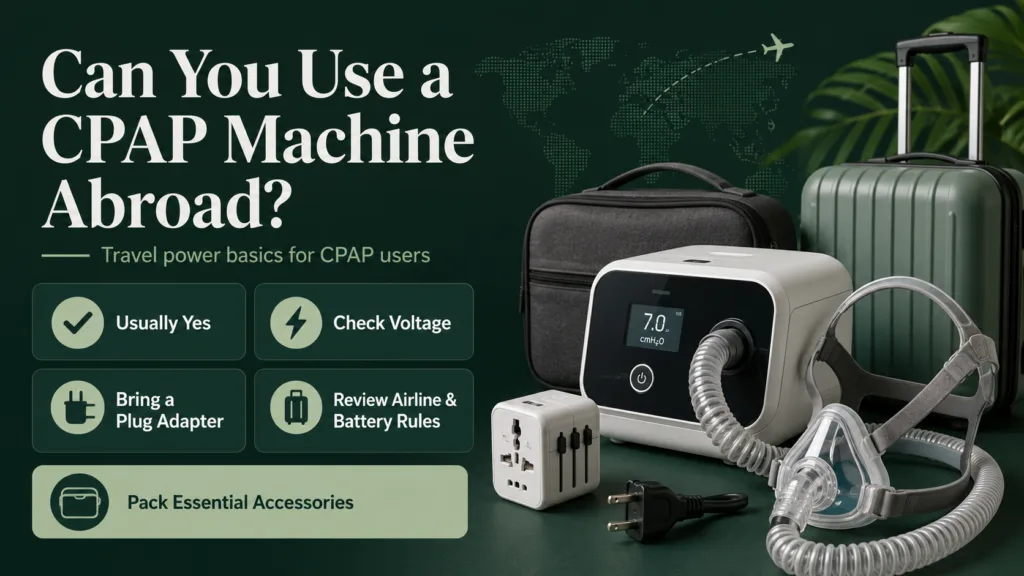
CPAP Travel Power Visual
You can usually use a CPAP machine abroad if the power supply label supports international voltage, the plug fits the destination outlet through the right adapter, and you pack the parts you need for sleep therapy. The main checks are simple: plug shape, voltage, frequency, humidifier use, battery rules, and backup planning.
CPAP Abroad Compatibility Checker
Use this decision box before packing a CPAP machine for international travel. It does not replace medical advice or airline rules, but it helps you separate plug adapter issues from voltage issues.
You may need a travel adapter if your home plug does not fit the destination power outlet.
Look for Input: 100–240V on the CPAP power supply or device label.
Pack your mask, hose, power supply, prescription copy if needed, and any travel documents your airline requests.
A plug adapter does not convert voltage. It only helps the plug fit the wall outlet. The CPAP power supply must be suitable for the local voltage.
Quick Answer
| Travel question | Usual answer | What to check |
|---|---|---|
| Can a CPAP machine work abroad? | Usually yes, if the power supply supports the destination voltage. | Check the label for Input: 100–240V. |
| Do you need a plug adapter? | Often yes when the destination uses a different plug type. | Match your home plug to the destination outlet type. |
| Do you need a voltage converter? | Usually not if the CPAP power supply is dual voltage. | If the label says only 110V, 120V, 220V, or 230V, ask the manufacturer or provider before use. |
| Does 50Hz / 60Hz matter? | Many modern power supplies accept both, but you should still check the label. | Look for 50/60Hz near the input rating. |
| Can you use a humidifier abroad? | Usually, but it adds power use and packing needs. | Check the CPAP manual, water requirements, and power label. |
Can You Use a CPAP Machine Abroad?
Yes, in most cases you can travel internationally with a CPAP machine. The device itself is not the only issue. You need to check whether the power supply accepts the local voltage, whether your plug fits the wall outlet, and whether your airline or accommodation has any rules that affect use.
Many CPAP machines use an external power supply, similar to a laptop charger. That power brick often handles a wide voltage range, but you should not assume. Turn it over and read the small print before travel.
The line you want to find is usually written like this: Input: 100–240V, 50/60Hz. If your CPAP power supply shows that range, it is usually designed to work in countries that use either lower-voltage or higher-voltage mains power. You may still need the correct plug adapter for the destination outlet.
How to Check the CPAP Power Label
Before packing, check the label on the CPAP power supply, not only the label on the machine body. The power supply is the part that connects the wall outlet to the device. Some travel problems happen because the machine is compatible, but the traveler packs the wrong cable or forgets the power brick.
What “Input: 100–240V” Means
If the label says Input: 100–240V, the power supply is usually made for a broad international voltage range. This is the same idea used by many phone chargers and laptop chargers. It means the power supply can normally accept power in countries that use around 100–120V and countries that use around 220–240V.
If the label only lists one voltage, such as 120V or 230V, do not guess. A single-voltage device may need a suitable voltage converter, a different manufacturer-approved power supply, or another travel setup. For a medical device used while sleeping, guessing is not worth the risk.
What 50Hz / 60Hz Means
Power frequency is shown as 50Hz or 60Hz. Many modern external power supplies accept both, often written as 50/60Hz. If your CPAP label shows only one frequency, ask the device provider or manufacturer before using it abroad.
Frequency is separate from plug shape. A plug adapter may make the plug fit, but it does not change 50Hz to 60Hz, and it does not change voltage.
Plug Adapter vs Voltage Converter for CPAP Machines
| Item | What it does | What it does not do | CPAP travel note |
|---|---|---|---|
| Plug adapter | Changes the plug shape so it can fit the destination outlet. | It does not change voltage or frequency. | Often needed when traveling between countries with different socket types. |
| Voltage converter | Changes voltage for a device that cannot accept the local voltage. | It does not automatically make every medical device safe to use. | May be needed only if the CPAP setup is not dual voltage. |
| Manufacturer-approved power supply | Provides power in the way the CPAP model expects. | It may still need a plug adapter abroad. | Often the safest path when the original power supply is not suitable. |
Do not use a CPAP machine abroad only because the plug fits. Plug shape and voltage are separate checks.
When a Plug Adapter Is Enough
A plug adapter is usually enough when all three points are true:
- The CPAP power supply label says Input: 100–240V.
- The frequency rating includes the destination frequency, often shown as 50/60Hz.
- You have the correct travel adapter for the destination power outlet.
For example, a traveler going from a Type A/B plug country to a Type C, E, F, G, I, or L outlet country may need a plug adapter even when the CPAP power supply is already dual voltage. In that case, the adapter solves the shape problem only.
When a Voltage Converter May Be Needed
A voltage converter may be needed if the CPAP power supply is single voltage and the destination voltage is different. This is less common with many modern external power supplies, but it still needs checking.
Be careful with medical equipment and generic converters. Some converters are made for simple appliances, not medical devices used for several hours while sleeping. If the label does not clearly support the destination voltage, ask your CPAP provider or the device manufacturer before travel.
CPAP Machines, Humidifiers, and Heated Hoses
A CPAP machine may draw more power when used with a heated humidifier or heated hose. That does not automatically mean you need a voltage converter, but it does mean you should check the full setup, not just the main device.
| CPAP setup | Travel power concern | Before you travel |
|---|---|---|
| CPAP machine only | Plug shape and voltage compatibility. | Check the power supply label and destination outlet type. |
| CPAP with humidifier | Higher power use and water availability. | Check the device instructions and plan for safe water use. |
| CPAP with heated hose | Added power demand and accessory compatibility. | Confirm that the complete setup is approved for travel use. |
| CPAP with battery | Airline battery rules and runtime. | Check airline rules before flying and test the battery before the trip. |
Flying with a CPAP Machine
Most travelers carry a CPAP machine in cabin baggage rather than checking it. This helps protect the machine and keeps it available if checked luggage is delayed. Airline rules can vary, especially for batteries, so check your airline before the flight.
If you plan to use the CPAP machine on a plane, contact the airline before travel. Some aircraft seats have power outlets, but outlet availability, power limits, and permission to use medical devices can vary. A battery may be useful, but battery type, capacity, and packing rules matter.
Keep the machine, mask, hose, power supply, and travel adapter together. A CPAP machine without its power supply is not useful at the hotel.
Hotel and Accommodation Checks
Before using your CPAP machine at your destination, look at the room setup. You may need an outlet close to the bed. Some rooms have limited outlets, loose sockets, or power controlled by a wall switch or key card.
- Check that the bedside outlet stays powered while you sleep.
- Avoid overloading a small travel adapter with several devices.
- Keep the CPAP machine on a stable surface near the bed.
- Pack the correct hose, mask, filter, and power supply.
- Consider a backup plan if your room has no suitable outlet near the bed.
If you need an extension cord, check whether it is suitable for the destination plug type and local voltage. Do not force loose connections or stack several adapters together.
CPAP vs Phone Chargers and Hair Dryers
CPAP machines are closer to laptops than hair dryers in travel power planning because many use external power supplies. Phones and laptops are often dual voltage, but you still check the label. Hair dryers, curling irons, kettles, and irons are different because they are high-power appliances and often need more caution.
| Device | Plug adapter needed? | Voltage converter needed? | What to check |
|---|---|---|---|
| CPAP machine | Usually if the plug does not fit. | Usually not if the power supply says 100–240V. | Power supply label, frequency, airline rules, accessories. |
| Phone charger | Usually if the plug does not fit. | Often not needed if the charger says 100–240V. | Charger label. |
| Laptop charger | Usually if the plug does not fit. | Often not needed if the charger says 100–240V. | Power brick label. |
| Hair dryer or curling iron | May be needed. | May be needed unless the device is dual voltage. | Voltage rating, wattage, heat setting, destination voltage. |
What to Pack for CPAP Travel Abroad
- CPAP machine.
- Original or approved power supply.
- Correct power cable.
- Plug adapter for the destination country.
- Mask, hose, filters, and spare small parts.
- Humidifier chamber if you use one.
- Travel battery if needed and allowed by the airline.
- Prescription copy or medical documentation if recommended for your trip.
- Manual or label photo showing input voltage.
- Backup plan for a bedside outlet.
AdapterMatch tip: match your trip in this order: destination outlet type first, then device label, then CPAP accessories, then airline and accommodation rules.
Common CPAP Travel Power Mistakes
Using only the plug shape as proof
If the plug fits, that does not prove the CPAP machine is safe to use. A plug adapter does not convert voltage. Always check the input rating.
Checking the machine but not the power brick
The external power supply is often where the real input rating is printed. Read that label carefully.
Forgetting the humidifier setup
A humidifier or heated hose may change how you pack and how much power the setup uses. Check the full CPAP system before travel.
Relying on hotel outlets without a backup
Some hotel rooms have outlets far from the bed or outlets that switch off when a room key is removed. Check the setup before bedtime.
Waiting until the first night to test everything
Test your CPAP travel setup before the trip. Make sure the cable, adapter, battery, mask, and hose all work together.
FAQ
Do I need a special adapter for a CPAP machine abroad?
You need a plug adapter that matches the destination outlet if your home plug does not fit. The adapter does not need to be CPAP-specific, but it should be suitable for the plug and destination socket. Check the CPAP power supply label separately.
Can I plug my CPAP into 220V or 240V abroad?
Usually yes if the power supply label says Input: 100–240V. If it only lists 110V, 120V, 220V, or 230V, do not assume it will work in another voltage system.
Will a travel adapter convert voltage for my CPAP machine?
No. A plug adapter does not convert voltage. It only changes plug shape. Voltage compatibility comes from the CPAP power supply or from a suitable converter when one is truly needed.
Can I use a CPAP machine on an airplane?
It may be possible, but airline rules vary. Contact the airline before travel, especially if you plan to use a battery or in-seat power. Keep the CPAP machine and power supply in your carry-on bag.
Does a CPAP humidifier change the travel power check?
It can. A heated humidifier or heated hose may add power demand and packing needs. Check the full CPAP setup, not only the main machine.
What should I check first before using my CPAP abroad?
Start with the power supply label. Look for Input: 100–240V and 50/60Hz. Then check the destination plug type and pack the correct travel adapter.