
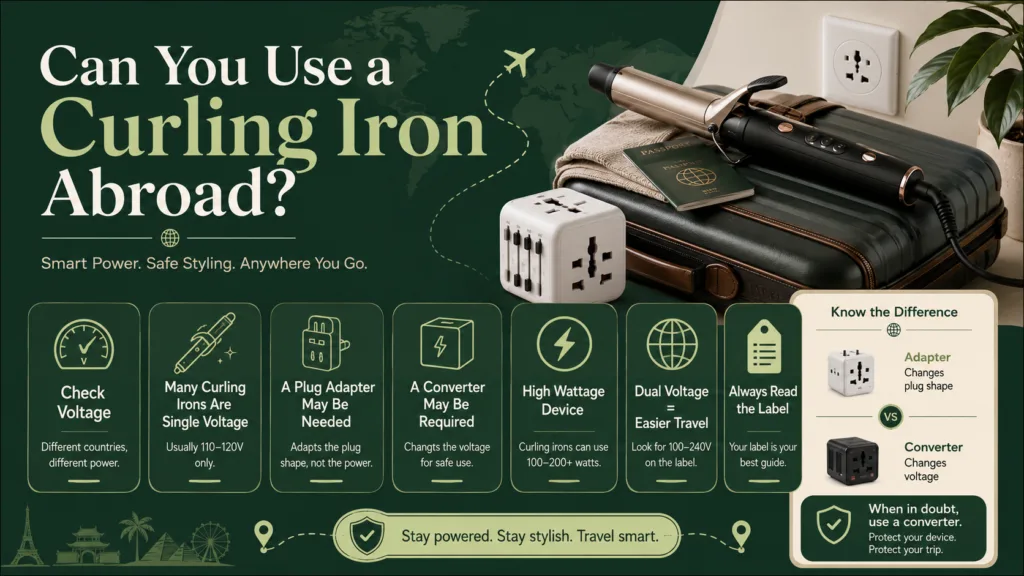
Yes, you can use a curling iron abroad, but only if the plug shape and voltage match what your curling iron can handle. Many curling irons are single voltage, which means a simple travel adapter may not be safe. Check the device label before packing it.
Device Compatibility Visual
Curling Iron Compatibility Checker
Use this simple checker before packing. It does not replace the label on your own device, but it shows the decision you need to make.
Plain rule: if your curling iron says Input: 100–240V, you usually need only the correct plug adapter for the destination outlet. If it says 120V only or 220–240V only, voltage matters much more.
Quick Answer
You can usually use a curling iron abroad only when the device is made for the destination voltage. A plug adapter helps the plug fit the wall socket, but it does not make a 120V curling iron safe in a 230V country.
| Device label | Plug adapter needed? | Voltage converter needed? | Best device advice |
|---|---|---|---|
| Input: 100–240V | Usually yes, if the plug shape does not fit | Usually no | Use the correct travel adapter for the destination socket type. |
| 120V only | Usually yes outside 120V countries | May be needed in 220–240V countries | High heat devices need extra caution; a travel-ready curling iron may be safer. |
| 220–240V only | Usually yes in countries with different plug types | May be needed in 100–127V countries | Performance may be weak or unsafe if voltage does not match. |
| No clear label | Depends on destination outlet | Do not guess | Check the manual or avoid using the device abroad. |
Can You Use a Curling Iron Abroad?
Yes, but a curling iron is not like a phone charger. It is a high-power heat appliance, and heat appliances are less forgiving when the voltage is wrong.
A phone charger or laptop charger often supports international voltage ranges. A curling iron may not. Some modern travel curling irons are dual voltage, but many regular models are designed for one electrical system only.
The safe answer comes from the device label, not from the destination alone. Look for the word Input, followed by a voltage range. The most travel-friendly label is Input: 100–240V. That means the device is usually designed to work in both common voltage ranges used around the world.
Always check the device label before using high-power appliances abroad. A curling iron that is not rated for the local voltage can overheat, fail, trip protection, or become unsafe.
How to Check the Device Label
Before you choose a plug adapter or voltage converter, find the label on your curling iron. It may be printed on the handle, near the cord, on the plug, or in the manual.
What to look for
- Input: 100–240V means the curling iron is usually dual voltage.
- 120V or 125V only means it is usually made for lower-voltage countries.
- 220V, 230V, or 240V only means it is usually made for higher-voltage countries.
- 50Hz / 60Hz tells you the frequency range. Heat appliances often care more about voltage than frequency, but the label should still be checked.
- W or watts shows power draw. Curling irons can draw enough power that cheap or weak converters may not be suitable.
If the label is worn off or unclear, do not treat it as dual voltage. For a curling iron, guessing is not a good travel power plan.
Plug Adapter vs Voltage Converter
A plug adapter changes the shape of your plug so it can fit a foreign power outlet. It does not change electricity. A plug adapter does not convert voltage.
A voltage converter changes voltage, such as stepping 230V down for a 120V appliance. This is the part that matters most for a curling iron when your device voltage and destination voltage do not match.
| Item | What it does | What it does not do | Curling iron note |
|---|---|---|---|
| Plug adapter | Fits your plug into a different socket type | Does not change voltage | Often needed when outlet shapes are different. |
| Voltage converter | Changes voltage for some single-voltage devices | Does not always support high-watt heat tools | Check wattage rating carefully before use. |
| Dual-voltage curling iron | Works across common voltage ranges when set or rated correctly | Still does not change plug shape | You may still need a travel adapter. |
What “Input: 100–240V” Means
If your curling iron label says Input: 100–240V, it is usually designed for use in both lower-voltage and higher-voltage countries. That can make international travel easier.
Still, check whether the device switches voltage automatically or has a manual voltage switch. Some older dual-voltage hair tools require you to move a small switch from 120V to 240V before use. If there is a manual switch and it is set incorrectly, the device may not work safely.
AdapterMatch rule: dual voltage answers the voltage question, not the plug shape question. You still need to match your home plug to the destination power outlet.
When a Plug Adapter Is Enough
A plug adapter is usually enough only when two things are true:
- Your curling iron label says Input: 100–240V, or the device is correctly set for the destination voltage.
- Your only problem is the plug shape, not the voltage.
For example, if you are taking a dual-voltage curling iron to a country with different outlet types, the travel adapter lets the plug fit. The curling iron itself handles the voltage range.
Outlet types can vary by country, hotel, airport, train, cruise ship, and older buildings. If your destination uses more than one socket type, a multi-region adapter may be useful, but it still will not convert voltage.
When a Voltage Converter May Be Needed
A voltage converter may be needed when your curling iron is single voltage and the destination voltage is different. A 120V-only curling iron used in a 230V country is the common risk case.
There is one extra problem: curling irons are heat devices. They may draw more power than small electronics, and not every converter is made for heat appliances. Even when a converter seems to match the voltage, it must also support the curling iron’s wattage.
Do not use a weak converter with a high-power appliance. If your curling iron is single voltage, the safer travel choice is often a dual-voltage curling iron or a locally compatible styling tool.
120V vs 230V travel risk
The biggest risk is using a 120V-only curling iron in a 220–240V destination with only a plug adapter. The plug may fit, but the voltage is still wrong. That can damage the device quickly.
Using a 230V-only curling iron in a 120V country is different: the device may heat poorly or not work as intended. It can still be unsafe to rely on it without checking the label and manual.
Does 50Hz / 60Hz Matter for a Curling Iron?
Frequency is shown as 50Hz or 60Hz. Many simple heat appliances are less sensitive to frequency than motor-based devices, but you should still read the full input label.
If the label says 50/60Hz, the device is usually rated for both common frequencies. If it lists only one frequency, check the manual before using it abroad.
Curling Iron Compared With Other Travel Devices
Travel power risk depends on the device. A curling iron belongs in the higher-caution group because it creates heat.
| Device | Adapter needed? | Converter needed? | What to check |
|---|---|---|---|
| Phone charger | Often yes, depending on outlet type | Usually no if label says 100–240V | Charger label and plug shape |
| Laptop charger | Often yes, depending on outlet type | Usually no if label says 100–240V | Power brick input label |
| Curling iron | Often yes abroad | Depends on voltage label | Input voltage, wattage, and manual switch |
| Hair dryer | Often yes abroad | May be needed if single voltage | High wattage and destination voltage |
| Electric shaver | Often yes, depending on outlet type | Depends on label | Input range and charger type |
| CPAP machine | Often yes abroad | Usually no if power supply says 100–240V | Power supply label, plug type, and backup plan |
What to Pack for a Curling Iron Abroad
Before the trip, match your device to your destination country instead of buying an adapter at the last minute.
- Check your curling iron label for Input: 100–240V or single-voltage wording.
- Check whether the destination country uses a different plug type.
- Pack the correct travel adapter for the destination outlet.
- If your curling iron is single voltage, check whether a converter is rated for the device wattage.
- Look for a manual 120V / 240V switch if the device is dual voltage.
- Avoid using heat appliances with loose, damaged, or poor-quality outlets.
- Do not leave a curling iron plugged in unattended.
If you travel often, a dual-voltage curling iron can be simpler than carrying a heavy converter. For one short trip, it may also be easier to use a locally compatible styling tool at the destination.
Common Mistakes to Avoid
Assuming every adapter changes voltage
This is the most common travel power mistake. A plug adapter only helps the plug fit. A plug adapter does not convert voltage.
Using a 120V curling iron in a 230V country
If the device is not dual voltage, this can damage the curling iron and may be unsafe. The plug fitting into the wall does not mean the device is compatible.
Ignoring wattage on converters
A converter must match both voltage and power draw. Heat appliances can require more wattage than small electronics.
Forgetting a manual voltage switch
Some dual-voltage styling tools do not switch automatically. Check the small switch before plugging in the device.
FAQ
Can I use my US curling iron in Europe?
Only if it supports European voltage. Many European countries use around 220–240V. If your US curling iron says 120V only, a plug adapter alone is not enough. If it says Input: 100–240V, you usually need only the correct plug adapter.
Do I need a converter for a dual-voltage curling iron?
Usually no. If the label says Input: 100–240V, the curling iron is normally made for international voltage ranges. You may still need a plug adapter for the destination outlet.
Can I use a curling iron with just a travel adapter?
Yes, but only when the curling iron is compatible with the destination voltage. A travel adapter changes plug shape. It does not change voltage.
What happens if I plug a 120V curling iron into 230V?
It may overheat, fail, or become unsafe very quickly. Do not use a 120V-only curling iron in a 230V country with only a plug adapter.
Is a travel curling iron better for international trips?
Often yes, especially if it is clearly labeled Input: 100–240V. Check whether it switches voltage automatically or needs a manual setting.
Does frequency matter for curling irons?
Voltage is usually the bigger issue for curling irons, but frequency still matters if the label limits use to only 50Hz or only 60Hz. A label that says 50/60Hz is usually more travel-friendly.