
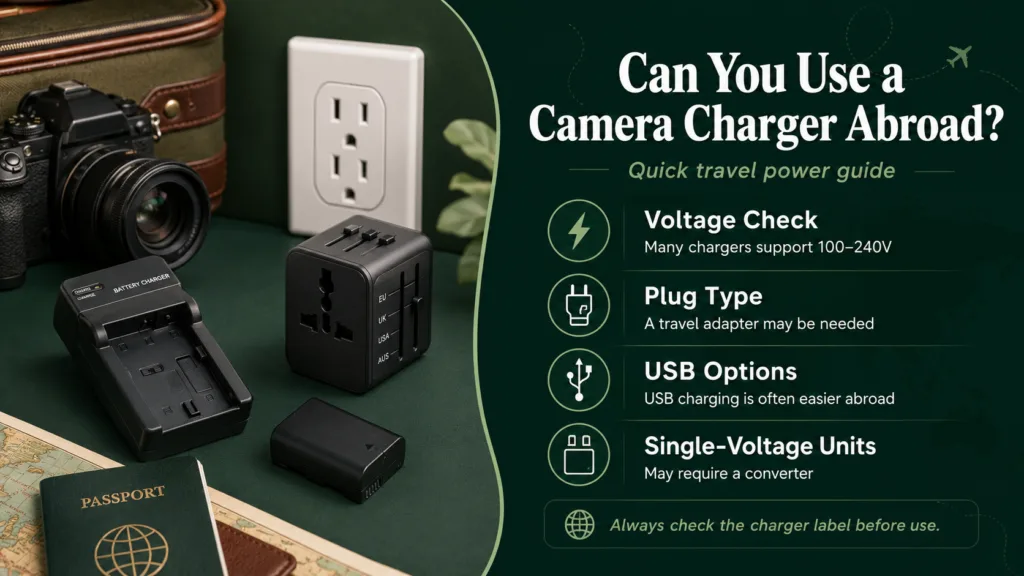
Yes, you can usually use a camera charger abroad if the charger label says Input: 100–240V and you have the right plug adapter for the country you are visiting. The main thing to check is the charger label, not the camera brand.
Camera Charger Travel Check Visual
Camera Charger Compatibility Checker
Use this quick device check before you pack your camera, battery charger, and travel adapter. The safest answer depends on the small print on the charger.
Default result: If your camera charger says Input: 100–240V, it is usually dual voltage. You will normally need only a plug adapter when the destination outlet shape is different.
A plug adapter does not convert voltage. It only helps the plug fit the wall outlet.
Quick Answer
You can usually use a camera charger abroad when the charger is marked Input: 100–240V. That range covers common household voltage systems used in many countries. You still may need a plug adapter if your home plug does not fit the destination power outlet.
| Charger label | Can you use it abroad? | Plug adapter needed? | Voltage converter needed? |
|---|---|---|---|
| Input: 100–240V, 50/60Hz | Usually yes | Yes, if the plug shape is different | Usually no |
| Input: 120V only | Only in compatible 120V countries | May be needed | May be needed in 220–240V countries |
| Input: 220–240V only | Only in compatible 220–240V countries | May be needed | May be needed in 100–120V countries |
| Label missing or unreadable | Do not guess | Check destination outlet type | Use caution until confirmed |
Can You Use a Camera Charger Abroad?
In most cases, yes. Camera battery chargers are commonly designed for travel because camera brands sell the same or similar chargers in many regions. The label often shows a wide input range such as Input: 100–240V. That means the charger can accept both lower-voltage and higher-voltage power supplies.
The charger does not care about the country name. It cares about three things: the voltage range, the frequency rating, and whether the plug physically fits the wall outlet.
For many travelers, the only missing piece is the plug shape. A charger bought in the United States may have a Type A or Type B plug. A hotel room in much of Europe may use Type C, E, or F outlets. In that case, the charger may be electrically compatible, but the plug will not fit without a travel adapter.
How to Check the Camera Charger Label
Look at the small printed text on the charger body. It may be on the back, side, or underside of the charger. You are looking for the word Input.
Input: 100–240V ~ 50/60Hz
This usually means the charger can handle common international voltage ranges. You still need the right plug adapter for the destination outlet.
If the label says only 120V, 110V, 220V, or 240V, the charger may be single voltage. A single-voltage charger should only be used with a matching power supply unless the manufacturer says otherwise.
What “Input: 100–240V” Means
Input: 100–240V means the charger is designed to accept electricity within that voltage range. Many countries use household voltage around 100–120V, while many others use around 220–240V. A charger marked 100–240V can usually work in both groups.
The label may also say 50/60Hz. Frequency is the number of cycles per second in the power supply. For most modern camera chargers with a 100–240V and 50/60Hz rating, frequency is not usually a problem. The charger converts wall power into low-voltage DC power for the camera battery.
If your charger has a narrow frequency rating or the label is unclear, check the manufacturer’s printed manual or avoid using it until you can confirm compatibility.
When a Plug Adapter Is Enough
A plug adapter is usually enough for a camera charger when two things are true:
- The charger label says Input: 100–240V.
- The destination outlet has a different shape from your home plug.
- The charger is in good condition, with no damaged cable, bent pins, or loose casing.
- You are using the charger for its normal camera battery, not for another device.
A plug adapter does not convert voltage. It only changes the physical connection between your plug and the wall socket. If your charger is already dual voltage, that is usually fine. If it is single voltage, the adapter alone does not make it safe for a different voltage system.
When a Voltage Converter May Be Needed
A voltage converter may be needed if your camera charger is single voltage and the destination uses a different voltage. For example, a charger marked only for 120V should not be treated as ready for a 230V outlet just because you have a plug adapter.
| Item | What it does | What it does not do | Camera charger use |
|---|---|---|---|
| Plug adapter | Changes the plug shape | Does not change voltage | Often enough for dual-voltage chargers |
| Voltage converter | Changes voltage level | Does not always solve plug shape | May be needed for single-voltage chargers |
| Universal travel adapter | Fits several outlet types | Usually does not convert voltage | Useful only if the charger supports destination voltage |
If your charger is old, label-free, damaged, or marked for one voltage only, do not assume it is safe. Replace it with a manufacturer-approved travel-ready charger or confirm the rating before the trip.
Camera Charger Compared With Other Travel Devices
Camera chargers are usually lower-risk than heat-producing appliances because they draw less power and many are dual voltage. The same is often true for phone chargers, laptop chargers, tablet chargers, and some electric shaver chargers.
High-power appliances are different. Hair dryers, curling irons, kettles, clothes irons, and some grooming tools can draw much more power. These devices may overheat, run poorly, or become unsafe if used with the wrong voltage.
| Device | Adapter needed? | Converter needed? | What to check |
|---|---|---|---|
| Camera charger | If plug shape is different | Usually no if 100–240V | Input label on charger |
| Phone charger | If plug shape is different | Usually no if 100–240V | Input label on USB charger |
| Laptop charger | If plug shape is different | Usually no if 100–240V | Power brick label |
| Hair dryer | Often yes | May be needed if not dual voltage | Voltage switch or label |
| Curling iron | Often yes | May be needed if not dual voltage | Voltage rating and wattage |
| CPAP machine | If plug shape is different | Depends on power supply label | Medical device power supply and travel instructions |
120V vs 230V Travel Risk for Camera Chargers
The biggest risk is using a single-voltage charger in a country with a different voltage. A 120V-only charger used in a 230V outlet may fail or become unsafe. A 230V-only charger used in a 120V outlet may not charge properly.
A dual-voltage charger marked 100–240V avoids most of that issue because it is made to accept a wide input range. That is why checking the label matters more than guessing by country.
Outlet types can also vary inside a country. Airports, hotels, older buildings, and remote areas may have different socket arrangements. When your camera matters for the trip, pack a suitable travel adapter before leaving.
What to Pack With Your Camera Charger
- Your original camera battery charger or a manufacturer-approved charger.
- A plug adapter that matches your destination country.
- A spare camera battery if you will shoot for long days.
- A short power strip only if it is rated for the destination voltage and allowed where you are staying.
- A copy or photo of the charger label, in case the printed text is hard to read later.
Do not cover the charger while it is charging. Use a stable outlet, avoid loose sockets, and unplug the charger after the battery is full. If the charger smells hot, makes noise, or becomes unusually warm, stop using it.
Common Mistakes When Charging a Camera Abroad
Using a plug adapter as if it changes voltage
This is the main mistake. A plug adapter does not convert voltage. If your charger is not dual voltage, the plug adapter alone is not enough protection.
Checking the camera instead of the charger
The camera body may list battery details, but the travel power decision comes from the charger or power supply label. Check the part that plugs into the wall.
Assuming every charger is dual voltage
Many camera chargers are dual voltage, but not all. Older chargers, third-party chargers, and region-specific chargers need extra care.
Ignoring damaged plugs or cables
International charging can involve tight adapters, unfamiliar sockets, and hotel outlets. Do not travel with a charger that already has loose pins, exposed wire, or a cracked case.
Simple Camera Charger Rule
If the label says Input: 100–240V, 50/60Hz, your camera charger can usually work abroad with the right plug adapter. If the label lists only one voltage, check the destination voltage before using it. Never rely on a plug adapter to fix a voltage mismatch.
FAQ
Do I need a voltage converter for a camera charger?
Usually no, if the charger label says Input: 100–240V. You may need a voltage converter if the charger is single voltage and the destination uses a different voltage.
Do I need a plug adapter for my camera charger?
Yes, if your charger plug does not fit the destination outlet. A plug adapter changes the plug shape only. It does not change voltage.
Where is the voltage label on a camera charger?
It is usually printed on the charger body, often near the plug pins or on the back. Look for the word Input, followed by a voltage range such as 100–240V.
Can I charge my camera battery in Europe?
Usually yes, if your charger says Input: 100–240V. Many European destinations use different plug shapes from the United States, so a plug adapter is commonly needed.
Can a wrong adapter damage my camera charger?
The bigger risk is wrong voltage, not the adapter shape. If the charger is not rated for the destination voltage, it may fail or become unsafe. Always check the charger label first.
Is a universal adapter enough for a camera charger?
It can be enough if your camera charger is dual voltage. A universal adapter may help the plug fit different outlets, but it usually does not convert voltage.