
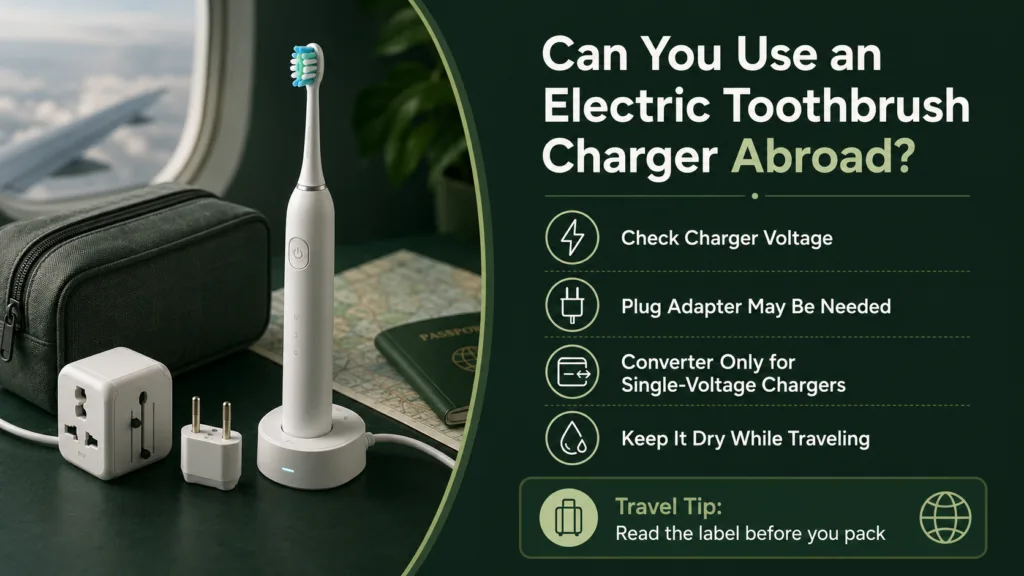
Electric Toothbrush Charger Travel Check
Yes, you can usually use an electric toothbrush charger abroad, but only after checking two things: the charger’s voltage label and the plug shape used in your destination country. Many modern toothbrush chargers support Input: 100–240V, which is travel-friendly. Some older or basic chargers may be single voltage and need extra care.
Electric Toothbrush Charger Checker
Use this simple checker before packing your toothbrush charger. It does not cover every model, but it shows the safest decision path for travel.
A plug adapter does not convert voltage. It only helps your plug fit the wall outlet. If your electric toothbrush charger is not rated for the destination voltage, a plug adapter alone is not enough.
Quick Answer
| Charger label | Can you use it abroad? | Plug adapter needed? | Voltage converter needed? |
|---|---|---|---|
| Input: 100–240V, 50/60Hz | Usually yes | Yes, if the plug shape does not fit | Usually no |
| Input: 120V only | Only in compatible voltage countries | Maybe | May be needed in 220–240V countries |
| Input: 220–240V only | Only in compatible voltage countries | Maybe | May not work correctly in 100–120V countries |
| No readable label | Do not plug in until checked | Unknown | Unknown |
Can You Use an Electric Toothbrush Charger Abroad?
In most cases, yes. Electric toothbrush chargers are low-power devices compared with hair dryers, kettles, irons, and curling irons. Many are designed to accept a wide voltage range, especially chargers sold with travel-friendly toothbrush models.
The important detail is not the toothbrush itself. It is the small charger base or charging stand. Turn it over and look for the printed electrical label. The label tells you whether the charger can handle the voltage used in your destination country.
If the label says Input: 100–240V, the charger is usually designed to work in both 100–120V and 220–240V countries. You may still need a plug adapter because outlet shapes vary by country.
If the label says only 120V, 230V, or 240V, the charger is single voltage or limited voltage. That means you need to be more careful before using it abroad.
How to Check the Charger Label
Look at the bottom of the charging base, the back of the plug, or the small power supply if your toothbrush uses a separate adapter. You are looking for the word Input.
Input: 100–240V ~ 50/60Hz
This usually means the charger can accept common household voltages used in many countries. You still need to match the plug shape to the local wall outlet.
Input: 120V ~ 60Hz
This is more limited. If you travel to a country using 220–240V, a plug adapter alone may damage the charger or make it unsafe.
Some labels are tiny, faint, or printed into plastic. Use your phone camera zoom or a flashlight if needed. If the label is unreadable, treat the charger as unknown rather than assuming it is dual voltage.
What “Input: 100–240V” Means
Input: 100–240V means the charger is usually built to accept power within that voltage range. This covers many common travel situations, including lower-voltage countries and higher-voltage countries.
The frequency part, usually written as 50/60Hz, means the charger is designed for both common power frequencies. For small chargers, this is usually less of a problem than voltage, but the label should still be checked.
If your electric toothbrush charger says 100–240V, 50/60Hz, you normally only need to solve the plug shape issue. That is where a travel plug adapter comes in.
Plug Adapter vs Voltage Converter
A plug adapter and a voltage converter solve different problems.
| Item | What it does | What it does not do |
|---|---|---|
| Plug adapter | Changes the plug shape so it can fit the wall outlet | Does not convert voltage |
| Voltage converter | Changes the voltage supplied to the device | Does not automatically solve every plug shape or device safety issue |
| Dual-voltage charger | Accepts a wider voltage range, often 100–240V | Still may need a plug adapter abroad |
For a dual-voltage toothbrush charger, a plug adapter is often enough. For a single-voltage charger, you may need a voltage converter, a compatible local charger, or a travel toothbrush option that charges by USB.
When a Plug Adapter Is Enough
A plug adapter is usually enough when all of these are true:
- The charger label says Input: 100–240V.
- The label also supports 50/60Hz.
- The only mismatch is the physical plug shape.
- The charger is in good condition, with no cracked plastic, exposed wires, or loose pins.
In that case, choose a plug adapter that matches the destination outlet type. The adapter lets the charger plug into the wall, while the charger itself handles the voltage range.
When You May Need a Voltage Converter
You may need a voltage converter if your electric toothbrush charger is single voltage and the destination uses a different voltage. For example, a charger marked only for 120V should not be treated as safe in a 230V country just because the plug fits an adapter.
Always check the device label before using single-voltage chargers abroad. A wrong voltage match can overheat the charger, damage it, or stop it from charging correctly.
For many travelers, the simpler option is to bring a dual-voltage charger, use a USB-charging toothbrush, or buy a compatible replacement charger before the trip. Avoid guessing with bathroom devices, especially in damp areas.
Electric Toothbrush Chargers Compared with Other Devices
Electric toothbrush chargers are usually lower risk than heat-producing appliances, but they still need a voltage check. Do not use the same rule for every device in your bag.
| Device | Adapter needed? | Converter needed? | What to check |
|---|---|---|---|
| Electric toothbrush charger | Usually, if plug shape differs | Usually no if label says 100–240V | Charger base input label |
| Phone charger | Often yes abroad | Usually no if 100–240V | USB charger input label |
| Laptop charger | Often yes abroad | Usually no if 100–240V | Power brick input label |
| Hair dryer | May be needed | May be needed unless dual voltage | Voltage, wattage, heat setting, travel mode |
| Curling iron | May be needed | May be needed unless dual voltage | Voltage label and heat appliance warning |
| CPAP machine | Often depends on destination plug | Check the power supply label | Medical device power supply and airline/travel rules |
Bathroom Safety Matters
Electric toothbrush chargers are commonly used near sinks, mirrors, and bathroom counters. That makes safe charging habits important when traveling.
- Keep the charger away from water and wet surfaces.
- Do not force a plug into an outlet or adapter.
- Do not use cracked chargers or loose adapters.
- Unplug the charger when it is not needed.
- Avoid stacking multiple adapters together in a bathroom outlet.
Hotel bathrooms may have special shaver sockets in some countries. These are not always meant for every charger or every power load. If the socket is marked for shavers only, treat it as limited-use.
Should You Bring the Charger or Charge Before You Leave?
Some electric toothbrushes hold charge for several days or even weeks, depending on the model and battery age. For a short trip, charging fully before departure may be enough.
For longer trips, bring the charger if the label supports the destination voltage. If the charger is single voltage and your destination uses a different voltage, consider a safer travel option before you leave.
Fully charge the toothbrush before travel. You may not need to pack the charger if battery life is enough for the full trip.
Pack the charger only after checking the input label. Bring the right plug adapter for the destination outlet.
What to Pack
- Your electric toothbrush charger, if it is compatible with the destination voltage.
- A plug adapter that matches the destination country’s outlet type.
- A small backup manual toothbrush.
- A photo of the charger label, in case the printed label is hard to read later.
- A travel case to keep the brush dry and clean.
If you travel often, a toothbrush that charges by USB may reduce the number of dedicated chargers in your bag. Still, the USB wall charger itself must be checked for Input: 100–240V.
Common Mistakes to Avoid
Assuming the plug adapter makes the charger safe
A plug adapter only changes the shape of the plug. A plug adapter does not convert voltage. The voltage rating must come from the charger label.
Checking the toothbrush handle instead of the charger
The handle may not show the full travel power information. Check the charging base, charging stand, or power supply.
Using a heat-device rule for small chargers
Hair dryers and curling irons are high-power appliances. Electric toothbrush chargers are usually low-power, but they still need the correct voltage match.
Ignoring frequency
Many travel-friendly chargers show 50/60Hz. If your charger lists only one frequency, use caution and check the full label before travel.
Practical Travel Decision
If your electric toothbrush charger says Input: 100–240V, 50/60Hz, it will usually work abroad with the right plug adapter. If it lists only one voltage, do not assume it is safe in another country. Check the destination voltage and use a proper voltage solution if needed.
The safest habit is simple: match your trip by checking the charger label, the destination outlet type, and the destination voltage before you pack.
FAQ
Can I plug my electric toothbrush charger into a travel adapter?
Yes, if the charger supports the destination voltage. A travel adapter only changes plug shape, so check the charger label first.
Do electric toothbrush chargers usually work on 220V or 240V?
Many modern chargers do if the label says Input: 100–240V. If the charger says 120V only, do not use it on 220–240V with only a plug adapter.
Do I need a voltage converter for an electric toothbrush charger?
Usually no if the charger is dual voltage. You may need one if the charger is single voltage and the destination voltage is different.
Is an electric toothbrush charger the same risk as a hair dryer abroad?
No. Toothbrush chargers are usually low-power devices. Hair dryers and curling irons use much more power and need extra caution.
What if I cannot read the charger label?
Do not guess. Use a flashlight or phone camera zoom to read the label. If it is still unreadable, use a compatible replacement charger or charge the toothbrush before the trip.
Can I use a bathroom shaver socket for my toothbrush charger?
Maybe, but only if the socket and charger are compatible. Some bathroom shaver sockets are limited-use, so read any outlet markings before plugging in.