
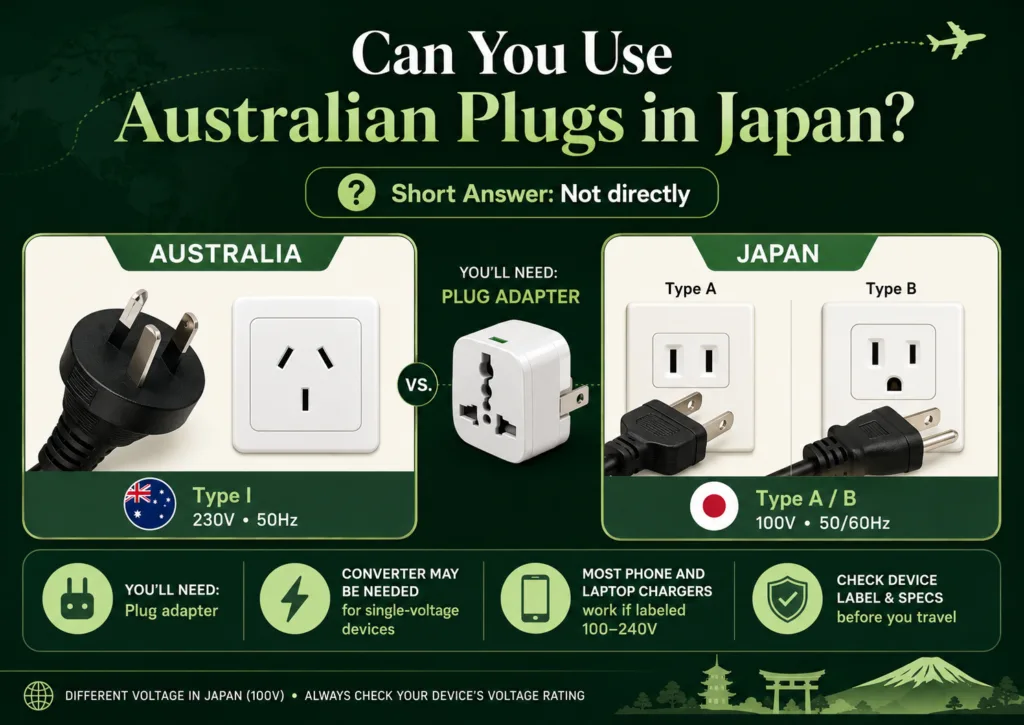
Australian plugs usually cannot be used directly in Japan. Australia uses Type I plugs, while Japan commonly uses Type A and Type B outlets, so most Australian travelers will need a plug adapter. Voltage is the second issue: Japan uses about 100V, while Australia uses about 230V, so check your device label before plugging anything in.
Trip Match Visual
Trip Match Summary
Use this quick match to understand the main travel power decision when going from Australia to Japan.
Australia
Common plug: Type I
Japan
Common outlets: Type A and Type B
Usually needed
Australian Type I plugs do not fit Japanese Type A/B outlets directly.
A plug adapter does not convert voltage. For Japan, an Australian traveler usually needs a Type I to Type A/B travel adapter. A voltage converter may be needed only for devices that are not rated for Japan’s lower 100V supply.
Australia to Japan Device Checker
Choose a device type to see what to check before using it in Japan. This checker gives practical guidance, not a guarantee for every model.
Always check the device label before using high-power appliances abroad.
Can Australian Plugs Fit Japanese Outlets?
No, not in normal use. Australian plugs are usually Type I, with two angled flat pins and often a grounding pin. Japanese outlets are commonly Type A, with two parallel flat slots, and sometimes Type B, with two flat slots plus a ground hole.
That means the plug shape does not match. For a normal Australian device, you should pack a Japan travel plug adapter that accepts Australian Type I plugs and fits Japanese Type A or Type B outlets.
Some Japanese outlets, especially older or simpler ones, may be ungrounded Type A. If your Australian device has a three-pin grounded plug, use an adapter that is suitable for the plug and the outlet situation. Do not force a plug into a socket.
Australia to Japan Power Compatibility Table
| Trip item | Australia | Japan | What it means |
|---|---|---|---|
| Common plug or outlet type | Type I | Type A / Type B | You will usually need a plug adapter. |
| Voltage | About 230V | About 100V | Check the device label before use. |
| Frequency | 50Hz | 50Hz in eastern Japan, 60Hz in western Japan | Most chargers are fine, but some motors and appliances may care. |
| Phone and laptop chargers | Often dual voltage | Usually usable with the right adapter | Look for Input: 100–240V. |
| Hair dryers and heat tools | Often voltage-specific | May run weakly or not work properly | Use extra caution and check the label carefully. |
Do You Need a Plug Adapter for Japan from Australia?
Yes, in most cases. The adapter solves the physical plug shape problem: it lets an Australian Type I plug connect to a Japanese Type A or Type B wall outlet.
For Japan, many travelers from Australia pack a compact adapter that says it supports Australia Type I to Japan Type A/B. A universal travel adapter may also work if it has a Japan/US-style output plug and accepts Australian plugs, but check its printed rating before using it.
A plug adapter does not convert voltage. It only changes the shape of the plug. Voltage compatibility depends on the device itself.
Do You Need a Voltage Converter in Japan?
Maybe, but not for every device. Australia uses about 230V, while Japan uses about 100V. This is a large difference, but many modern chargers are designed for worldwide voltage ranges.
The safest way to decide is to read the label on the charger, power brick, or device. Look for the word Input.
If the label says Input: 100–240V, the device is usually designed to handle both Australian and Japanese voltage ranges. In that case, you usually only need a plug adapter.
If the label says only 220–240V or 230V only, it may not work properly on Japan’s 100V supply. A converter or a Japan-compatible device may be needed.
For Australian travelers, the Japan voltage issue is often less dangerous than plugging a 110V-only device into a 230V country, but it still matters. A 230V-only appliance used in Japan may be weak, slow, or unable to work correctly. Heat appliances and motor-driven devices need more care than small USB chargers.
What “Input: 100–240V” Means
Input: 100–240V means the charger or device can usually accept power anywhere within that voltage range. This is common on phone chargers, laptop chargers, tablet chargers, camera battery chargers, and many USB-C power adapters.
You may also see frequency printed as 50/60Hz. That means the device is usually designed for both common power frequencies. Japan is unusual because eastern Japan commonly uses 50Hz and western Japan commonly uses 60Hz, so a 50/60Hz label is helpful.
If the device label is missing, damaged, unclear, or only lists one voltage, do not guess. Check the manufacturer’s manual or use a device made for travel.
Phone Chargers from Australia in Japan
Australian phone chargers usually work in Japan if the charger label says Input: 100–240V. You will still need the right plug adapter because the Australian plug shape does not match Japanese outlets.
USB-C chargers, multi-port chargers, and original phone chargers are commonly dual voltage, but there are exceptions. Always check the printed label on the charger body, not just the phone.
Laptop Chargers from Australia in Japan
Most laptop power bricks are designed for international use and often show Input: 100–240V, 50/60Hz. If your laptop charger says this, it will usually work in Japan with a suitable plug adapter.
Large gaming laptop chargers and high-wattage power bricks should still be checked carefully. Make sure the adapter you pack can handle the plug type and the current rating required by your charger.
Hair Dryers, Curling Irons, and Heat Appliances
Hair dryers, curling irons, hair straighteners, travel kettles, and irons need extra caution. These are high-power appliances, and many are made for a specific voltage range.
If an Australian hair dryer says only 220–240V, it may not heat properly in Japan because Japan’s supply is about 100V. A small plug adapter will not fix that. Some travel hair dryers have a voltage switch or dual-voltage rating, but the label must confirm it.
For heat tools, the safest travel choice is usually a device clearly marked for 100–240V or a device bought for use in Japan. Avoid using a small, low-quality converter with high-wattage heat appliances.
Electric Shavers, Toothbrush Chargers, and Small Grooming Devices
Electric shavers vary. Some are dual voltage and travel-friendly. Others use a charging base that may only support one voltage range.
Check the charger or base for Input: 100–240V. If it has that rating, you will usually need only a plug adapter. If it says 230V only, it may charge poorly or not work in Japan.
CPAP Machines and Medical Devices
Many CPAP power supplies are dual voltage, but you should never assume. Check the power supply label and the device manual before travel. Look for Input: 100–240V and 50/60Hz.
For CPAP travel, pack the correct plug adapter, the original power supply, and any required backup accessories. If the device is medically necessary, confirm compatibility before departure rather than testing it after arrival.
What to Pack for Japan from Australia
- A Type I to Type A/B plug adapter for Japanese outlets.
- A spare adapter if you need to charge more than one device at a time.
- Original phone and laptop chargers with visible voltage labels.
- A USB charger marked Input: 100–240V.
- A travel-friendly hair tool only if it clearly supports Japan’s voltage.
- A power bank for travel days, flights, trains, and hotel check-in gaps.
- Any device manuals for CPAP machines or medical equipment.
Common Mistakes to Avoid
Thinking the adapter changes voltage
This is the most common mistake. A plug adapter changes the shape of the plug. It does not change 230V into 100V or 100V into 230V.
Checking the device instead of the charger
For phones, laptops, cameras, and tablets, the voltage rating is usually printed on the charger or power brick. Check the part that actually plugs into the wall.
Assuming every Japanese outlet has a ground hole
Some outlets in Japan may be Type A without a ground hole. If your adapter or device needs grounding, check your accommodation setup and use suitable equipment.
Taking a 230V-only hair dryer
A 230V-only Australian hair dryer may not perform properly in Japan. Even if the plug fits through an adapter, the voltage may still be wrong for the appliance.
Simple Decision Guide
| Device | Plug adapter needed? | Voltage converter needed? | What to check |
|---|---|---|---|
| Phone charger | Usually yes | Usually no if dual voltage | Look for Input: 100–240V. |
| Laptop charger | Usually yes | Usually no if dual voltage | Check the power brick label. |
| Camera battery charger | Usually yes | Usually no if dual voltage | Check charger input rating. |
| Electric shaver | Usually yes | Depends on charger label | Check the shaver charger or base. |
| Hair dryer | Yes | May be needed, but not always practical | Use only if rated for 100V or 100–240V. |
| Curling iron or straightener | Yes | May be needed for single-voltage tools | Check for dual voltage before packing. |
| CPAP machine | Usually yes | Depends on power supply | Confirm 100–240V, 50/60Hz on the label. |
FAQ
Can I plug an Australian plug directly into a Japanese outlet?
No. Australian Type I plugs do not normally fit Japanese Type A or Type B outlets. You will usually need a plug adapter.
What adapter do I need for Japan from Australia?
You usually need an adapter that accepts an Australian Type I plug and fits Japanese Type A or Type B outlets.
Do I need a voltage converter for Japan from Australia?
It depends on the device. If the label says Input: 100–240V, you usually do not need a voltage converter. If it is 230V only, it may not work properly in Japan.
Will my Australian phone charger work in Japan?
Usually yes, if the charger says Input: 100–240V. You will still need a plug adapter because the plug shape is different.
Will my Australian laptop charger work in Japan?
Most laptop chargers are dual voltage, but check the power brick. If it says 100–240V, 50/60Hz, it will usually work with a Japan plug adapter.
Can I use an Australian hair dryer in Japan?
Only if the hair dryer is rated for Japan’s voltage or clearly marked dual voltage. A 230V-only hair dryer may not heat properly on Japan’s 100V supply, and a plug adapter will not fix the voltage difference.