
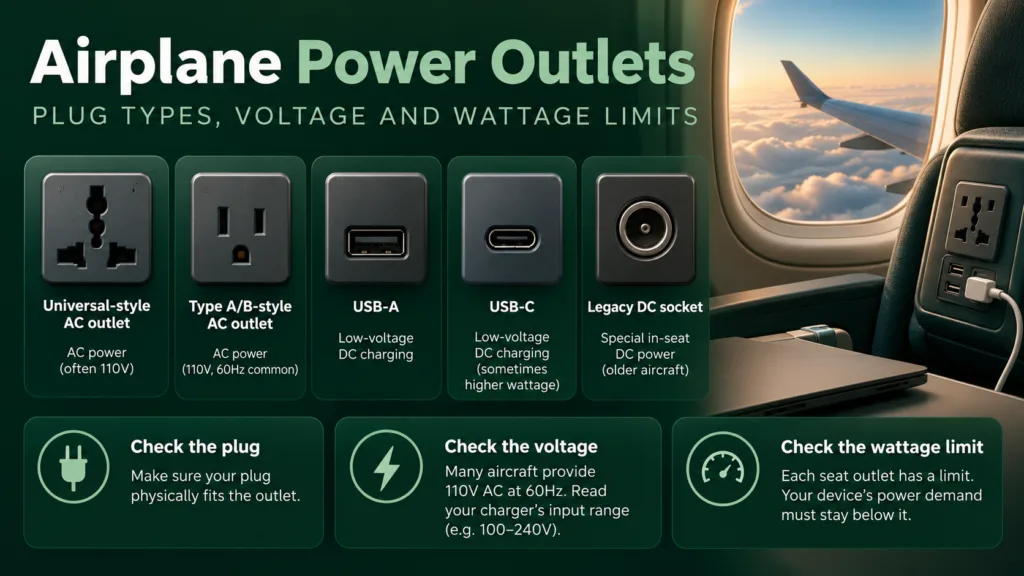
Airplane power outlets are not standardized the way household outlets are. A seat may have a universal-style AC socket, a North American-style AC socket, USB-A, USB-C, or no passenger power at all. Where AC power is provided, 110V AC at 60Hz is common, but the airline and aircraft decide the usable wattage and socket design. A charger that works from 100–240V can usually handle the voltage; the harder question is whether the outlet can supply enough watts.
For travelers, the safest decision is based on three separate checks: whether your plug physically fits, whether your charger accepts the outlet voltage, and whether its power demand stays below the seat outlet limit. Passing one check does not guarantee the other two.
What types of power outlets are found on airplanes?
| Connection | What it provides | What to expect |
|---|---|---|
| Universal-style AC outlet | AC mains power | Often designed to accept more than one plug shape. Many in-seat systems supply around 110V AC at 60Hz, but plug compatibility and watt limits vary. |
| Type A/B-style AC outlet | AC mains power | Best suited to flat-blade North American plugs. A travel adapter may be needed for other plug shapes, if the airline permits one. |
| USB-A | Low-voltage DC charging | Common on older and mixed-generation cabins. Charging speed can be much lower than a modern wall charger, and some laptops cannot charge from it. |
| USB-C | Low-voltage DC charging, sometimes with USB Power Delivery | Newer installations can charge phones, tablets and some laptops. Available wattage depends on the aircraft system and may be shared between ports. |
| Legacy dedicated DC socket | Special in-seat DC power | Older aircraft documentation may refer to 15V EmPower-type connections that require a dedicated cable or adapter. Do not plan around this format unless the airline specifically lists it for your aircraft. |
The presence of an outlet on one aircraft type does not mean every aircraft with the same model name has the same setup. Airlines retrofit cabins at different times, and seat power can differ by cabin, row or individual aircraft.
A universal airplane outlet does not guarantee that every plug will fit
A universal-style socket has several slot shapes so it can accept plugs from more than one country. That does not mean every Type C, E, F, G, I or other plug will fit every universal socket. Outlet designs differ, and some plugs are too bulky to sit securely in a recessed seat socket.
Do not force a plug into an airplane outlet. A loose connection can cause the seat system to refuse power, and some outlets use plug-detection or ground-fault protection. If the plug falls out under its own weight, use a different charging method rather than trying to hold it in place.
Check the airline before using a travel adapter. Some airlines allow ordinary plug adapters with their seat outlets, while others restrict them because of the socket’s safety design. The fact that an adapter is normal to use in a hotel does not make it automatically suitable for an aircraft seat outlet.
Airplane outlet voltage: 110V is common, but read the charger label
Many in-seat AC systems provide approximately 110V AC at 60Hz, but this is not a universal aircraft standard. Some installations use different voltage or frequency arrangements, so the marking on the outlet or the airline’s aircraft information takes priority over assumptions based on your departure country.
The useful number on your charger is its input range. It is usually printed in small text on the charger body.
The charger is designed for both common voltage ranges. If the airplane outlet is 110V/60Hz and the plug fits, a voltage converter is normally unnecessary. You still need to check the watt limit.
Do not assume it will work from a 110V seat outlet. A voltage converter would have to provide the missing voltage, and the aircraft outlet may not have enough wattage for the device anyway.
A device marked only for 110–120V should not automatically be connected to an aircraft outlet that is documented as 220–230V. Likewise, a 230V-only appliance should not be treated as compatible with a 110V seat socket just because the plug can be made to fit.
For phone, tablet, camera and laptop chargers, a 100–240V input rating is very common. Heating appliances and motor-driven devices need more care because their voltage and wattage requirements can be very different from electronic chargers.
The wattage limit is often the real restriction
An airplane outlet can have the correct voltage and still shut off when a device asks for too much power. The seat power system may have a per-outlet limit, a shared limit for a group of seats, or both.
There is no wattage number that can safely be used for every flight. Some passenger outlets are limited to about 60W, while other installations allow more. A system can also impose a shared limit across a seat pair or seat group. The limit published for the actual aircraft is the number that matters.
| Device or charger | Typical rating example | On a 60W-limited seat outlet |
|---|---|---|
| Phone charger | 20W–30W | Usually within the limit. |
| Tablet or small laptop charger | 30W–45W | Usually within the limit, assuming the charger accepts the outlet voltage. |
| 65W USB-C laptop charger | 65W | Too close to or above a 60W limit. It may stop, cycle, or fail to provide full charging under load. |
| High-power laptop charger | 90W–140W+ | Likely above a 60W limit. The outlet may shut down when the laptop draws heavily. |
| Hair dryer or hair styler | Often hundreds to well over 1,000W | Not suitable for a low-wattage seat outlet. |
The numbers in this table show what happens under a 60W limit; they are not a claim that every aircraft outlet is limited to 60W.
Why a 65W charger can fail even if the laptop is not using 65W all the time
A charger rating is its maximum output capability, not a promise that it constantly consumes that amount. A 65W USB-C charger connected to a lightly loaded laptop may draw less than 65W. Under heavier use, however, the charger can request more power. Conversion losses also mean its AC input is not exactly the same as its DC output.
If the seat system detects too much current, excessive load or another fault condition, it can disconnect the outlet. Repeatedly unplugging and reconnecting a device that is clearly over the published limit is not a useful fix.
USB-C on airplanes can be more useful than the AC outlet
USB-C changes the decision because the seat port itself may negotiate power directly with the device. That removes the need for a mains plug and avoids the question of whether a country-specific AC plug fits the socket.
The USB-C logo alone does not tell you the charging speed. Some ports supply phone-level power, while newer installations can provide laptop-level USB Power Delivery. A dual-port unit may also share one total power budget between both ports, so the usable wattage can fall when two devices charge at the same time.
- If your phone normally uses a 20W or 30W USB-C charger, a capable aircraft USB-C port may be all you need.
- If your laptop normally charges at 45W or 60W, check whether the airline lists USB-C Power Delivery or a watt rating for the seat.
- If your laptop normally uses 90W, 100W, 140W or more, a lower-power USB-C seat port may charge slowly, only maintain the battery level, or not charge while the laptop is under heavy load.
- A dual-port unit may share one total power budget between two passengers or devices, so plugging in a second device can reduce the power available to the first.
USB-A is useful for phones, but its presence says little about charging speed
USB-A seat ports are usually intended for phones and other small electronics. Older aircraft systems may provide only modest charging power. Some devices will show the charging symbol but gain battery very slowly, especially while streaming video, using Wi-Fi or running the screen at high brightness.
USB-A is also not a substitute for a laptop’s normal charger unless that laptop was specifically designed to accept power through the connected port. A USB-A-to-USB-C cable does not turn a low-power USB-A socket into a high-power laptop charger.
Do you need a voltage converter on an airplane?
For most modern phone, tablet and laptop chargers marked 100–240V, 50/60Hz, no. The charger already handles the voltage conversion internally.
A plug adapter, when permitted, only changes the physical connection. It does not turn 110V into 230V or increase the number of watts the aircraft can supply.
A separate voltage converter is rarely a good solution for high-power travel appliances in a passenger seat. A converter cannot make a 60W outlet run a 1,200W appliance. Even if the voltage could be changed, the power demand would still be far above the seat outlet limit.
Simple rule: if the device is a charger and its label says 100–240V, focus on plug fit and wattage. If the device itself is single-voltage and uses substantial power, do not assume an airplane outlet can run it.
Why the outlet may stop working during the flight
Passenger electrical outlets are not treated as an essential aircraft service. They can be switched off by the crew or aircraft system, and an electrical fault can make them unavailable. Some airlines also disable seat power during taxi, takeoff or landing.
A seat outlet may also cut out because:
- the device exceeds the outlet or seat-group power limit;
- another passenger on a shared power unit increases the combined load;
- the plug is not fully inserted;
- the outlet’s protection system detects an electrical fault;
- the power system becomes too warm;
- the airline temporarily disables passenger power.
If an outlet turns off, disconnect the device and check its charger rating before trying again. If a lower-power charger works but a high-power laptop brick does not, the seat watt limit is a likely cause.
How to check your flight before relying on seat power
- Check the airline’s aircraft or seat page. Look for AC power, USB-A, USB-C and any cabin-specific limits.
- Check your charger input label. A 100–240V, 50/60Hz rating is the easiest case for international travel.
- Find the charger’s watt rating. A laptop charger marked 20V × 3.25A is a 65W output charger. Its AC input can be a little higher because conversion is not perfectly lossless.
- Compare the rating with the airline’s published limit. If your charger exceeds the limit, do not expect the outlet to support full-power charging.
- Check the plug policy. Do not assume a normal travel adapter is permitted in the seat socket.
- Start with a charged device. Aircraft power can be unavailable even when the seat map says power is installed.
Aircraft swaps are another reason not to rely on seat power as your only charging plan. The scheduled aircraft can change before departure, and an individual outlet can be inoperative even when the rest of the cabin has power.