
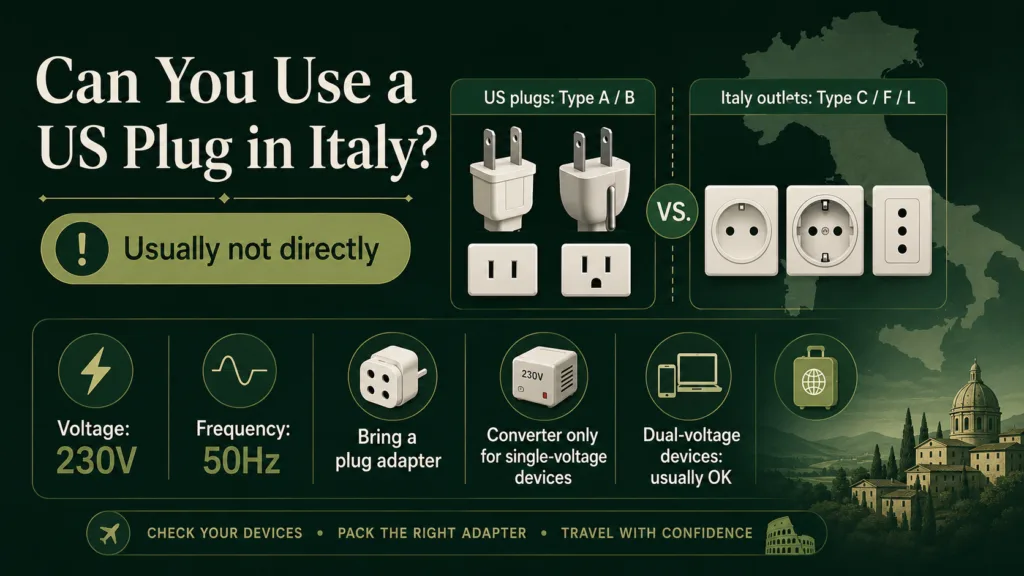
Plug Compatibility Visual
Yes, you can use many US devices in Italy, but a US plug usually will not fit Italian wall outlets directly. Most travelers from the United States will need a plug adapter for Italy, and some single-voltage 120V devices may also need a voltage converter.
Trip Match Summary
Use this quick match to understand what usually happens when you bring a US plug to Italy.
United States
Common plug types: Type A and Type B
Italy
Common outlet types: Type C, Type F, and Type L
Usually Needed
A US plug normally needs a travel plug adapter to fit Italian outlets.
Depends on Device
Check the label for Input: 100–240V.
Quick answer: For phones, laptops, cameras, tablets, and many USB chargers, a plug adapter is usually enough if the charger label says Input: 100–240V. For US hair dryers, curling irons, clothes steamers, kettles, and other high-power 120V appliances, a voltage converter may be needed, or the device may not be safe to use in Italy.
A plug adapter does not convert voltage. It only changes the plug shape so your device can fit the outlet.
Can a US Plug Fit in Italy?
A standard US plug usually does not fit Italian outlets directly. The United States commonly uses Type A and Type B plugs. Italy commonly uses Type C, Type F, and Type L outlets, depending on the building, socket, and location.
That means most US travelers should pack a US to Italy plug adapter. The adapter helps the flat US plug pins fit the round-pin outlets commonly found in Italy.
Outlet types can vary, especially in older buildings, hotels, apartments, and local guesthouses. A compact adapter that supports Italian Type C, Type F, and Type L use is usually the safest packing choice for a trip from the US to Italy.
US to Italy Adapter Check
| Trip Item | Typical Match |
|---|---|
| Home country | United States |
| Destination country | Italy |
| US plug type | Type A / Type B |
| Italy outlet type | Type C / Type F / Type L commonly appear |
| Plug adapter needed? | Usually yes |
| Voltage converter needed? | Only if your device is not compatible with Italy’s voltage |
| Best device advice | Check for Input: 100–240V on the charger or device label |
Voltage Difference Between the US and Italy
The plug shape is only one part of the decision. The United States commonly uses around 120V power, while Italy commonly uses around 230V power. Italy also uses 50Hz frequency, while the US commonly uses 60Hz.
This voltage difference matters most for devices that are designed only for US power. If a device label says something like Input: 120V only, it is not designed for Italy’s voltage without the right voltage conversion support.
If a charger label says Input: 100–240V, 50/60Hz, it is usually designed for international voltage ranges. In that case, you normally need only the correct plug adapter, not a voltage converter.
Always check the device label before using high-power appliances abroad. A US plug adapter can make the plug fit, but it cannot make a 120V-only appliance safe on 230V power.
Do You Need a Plug Adapter for Italy?
Yes, if you are traveling from the United States to Italy, you will usually need a plug adapter. Your US plug is shaped differently from the outlets commonly used in Italy.
A plug adapter is the right item when your device already supports the destination voltage but the plug does not physically fit the wall outlet.
When a Plug Adapter Is Usually Enough
- Phone chargers labeled Input: 100–240V
- Laptop chargers labeled Input: 100–240V
- Tablet chargers designed for global input
- Camera battery chargers with 100–240V input
- USB chargers that clearly support 100–240V and 50/60Hz
When a Plug Adapter Is Not Enough
- Hair dryers marked 120V only
- Curling irons or flat irons marked 120V only
- Travel kettles, clothes steamers, or irons marked 120V only
- Any heating appliance without a clear dual-voltage label
- Medical or comfort devices that require stable power, unless the power rating is confirmed
Do You Need a Voltage Converter in Italy?
You may need a voltage converter if your US device is single voltage and only supports 120V. This is most common with heat-producing appliances and some older or simpler electrical devices.
A voltage converter changes electrical voltage. A plug adapter changes plug shape. They solve different problems.
Changes the physical plug shape so your US plug can fit an Italian outlet.
It does not convert voltage.
Changes voltage for devices that are not designed for the destination power supply.
May be needed for some 120V-only high-power devices.
Phone Charger Guidance
Most modern phone chargers are designed for international travel, but you should still check the printed label. Look for Input: 100–240V. If you see that range, your phone charger can usually handle Italy’s voltage.
For a US phone charger in Italy, the usual need is a plug adapter, not a voltage converter. The adapter lets the charger fit the wall outlet. The charger itself handles the voltage if the label confirms 100–240V input.
Laptop Charger Guidance
Most laptop power bricks are also built for international voltage ranges. Check the brick, not only the laptop. The label should say something close to Input: 100–240V, 50/60Hz.
If your laptop charger has that rating, it can usually be used in Italy with the correct travel adapter. If the label is damaged, unclear, or missing, check the manufacturer’s official specifications before plugging it in.
Hair Dryer and Curling Iron Warning
US hair dryers, curling irons, flat irons, and other heat devices need more caution in Italy. Many of these appliances draw high power and may be designed for 120V only.
If the label says only 120V, do not assume a simple plug adapter is enough. Using a 120V-only heat appliance on Italy’s 230V power can damage the device and may create a safety risk.
Some travel hair tools are dual voltage and include a voltage switch or automatic voltage support. If yours has a manual switch, make sure it is set correctly before use. If you are not sure, it is safer to use a local appliance or a travel device clearly rated for 220–240V use.
What About Electric Shavers and Toothbrush Chargers?
Electric shavers, beard trimmers, and toothbrush chargers vary. Some support Input: 100–240V, while others are region-specific. Check the charging base or power adapter label carefully.
If the label supports 100–240V, you usually need only a plug adapter. If it says 120V only, do not plug it directly into an Italian outlet with only a shape adapter.
CPAP Machine and Medical Device Guidance
Many CPAP machines and medical power supplies support international input, but you should not guess. Check the power brick or device label for Input: 100–240V and 50/60Hz compatibility.
If you use a CPAP machine or another medical device, confirm the rating before travel and pack the correct plug adapter. For medical devices, it is also wise to bring any approved power accessories recommended for your specific machine.
What to Pack for Italy from the US
- A US to Italy plug adapter that supports the outlet types you may meet in Italy
- Your original phone and laptop chargers with readable power labels
- A USB charger rated for Input: 100–240V
- A power bank for travel days and airport transfers
- Dual-voltage travel hair tools, if you need them
- A voltage converter only if your device truly requires one
Common Mistakes to Avoid
Buying Only by Country Name
Italy can have more than one outlet type in real use. A country label on the adapter is helpful, but the better question is whether the adapter supports the actual outlet types you may find.
Assuming a Plug Adapter Converts Voltage
This is the biggest travel power mistake. A plug adapter does not convert voltage. It only helps the plug fit the socket.
Ignoring the Device Label
The device label is the most important clue. If it says Input: 100–240V, the device is usually designed for international power. If it says 120V only, treat it as a higher-risk item in Italy.
Packing High-Power US Appliances
Hair dryers, curling irons, kettles, steamers, and irons are not the same as phone chargers. These devices use much more power and need stricter voltage checks.
Simple Decision Rule
If your US device label says Input: 100–240V, pack a plug adapter for Italy. If it says 120V only, do not rely on a plug adapter alone. You may need a voltage converter, a dual-voltage travel version, or a local device.
FAQ
Can I plug a US charger into an Italian outlet?
Not directly in most cases. A US plug usually needs a plug adapter to fit Italian outlets. You should also check that the charger label says Input: 100–240V.
Do I need a converter for my iPhone charger in Italy?
Usually no, if your iPhone charger is rated for Input: 100–240V. You will normally need only a plug adapter for the Italian outlet.
Will my US laptop work in Italy?
Most US laptop chargers work in Italy if the power brick says Input: 100–240V, 50/60Hz. You will still need a plug adapter so the plug can fit the outlet.
Can I use a US hair dryer in Italy?
Be careful. Many US hair dryers are 120V only, while Italy commonly uses 230V. A plug adapter alone is not enough for a 120V-only hair dryer.
What plug adapter do I need for Italy from the US?
You usually need a US to Italy travel plug adapter that works with Italian outlet types commonly found in the country, including Type C, Type F, and Type L situations.
Does a universal adapter work in Italy?
It may work if it supports the Italian outlet type you encounter. However, a universal adapter still does not convert voltage, so you must check the device label.