
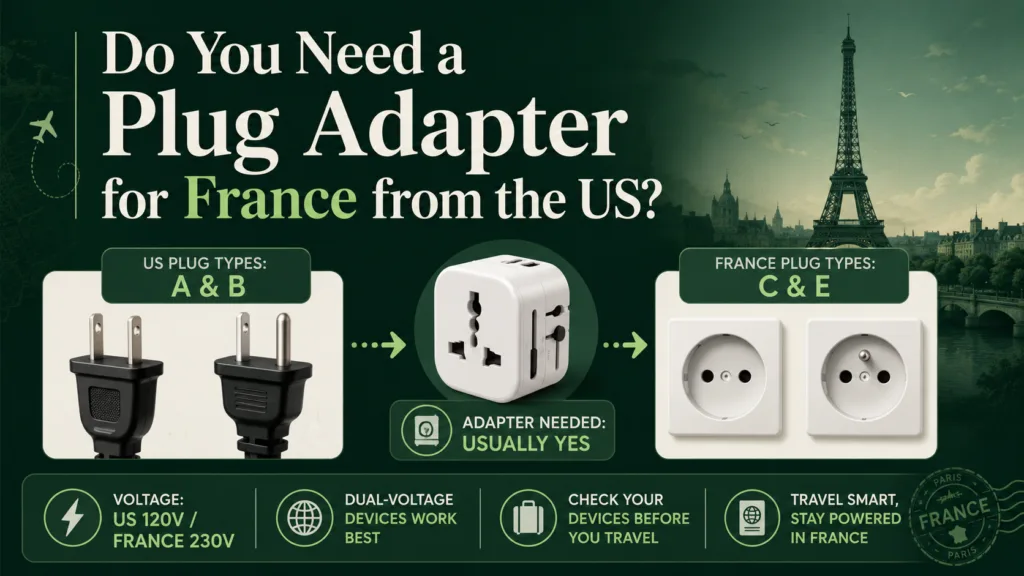
Plug Compatibility Visual
Traveling from the US to France? You will usually need a plug adapter for France because US Type A and Type B plugs do not fit most French power outlets. A voltage converter is only needed for devices that are not compatible with France’s 230V electricity supply.
Trip Match Summary
Use this quick match to understand what changes when you bring US devices to France. The main issue is plug shape first, then voltage compatibility.
United States
Common plug types: Type A and Type B
France
Common outlet types: Type C and Type E
Usually needed
US flat-pin plugs do not normally fit French round-pin sockets.
Depends on the device label
Check for Input: 100–240V.
A plug adapter does not convert voltage. For phones, tablets, cameras, and many laptops, a France plug adapter is often enough if the charger label says Input: 100–240V, 50/60Hz. For 120V-only hair dryers, curling irons, irons, kettles, and other high-power appliances, you may need a proper voltage converter or a dual-voltage travel version.
US to France Device Check
Choose a common travel device to see the usual adapter and converter advice for France.
Always check the device label before using high-power appliances abroad. France uses a higher voltage than the United States, so a 120V-only appliance can be damaged or become unsafe if plugged in without the right equipment.
Plug Compatibility from the US to France
US travelers normally use Type A or Type B plugs. Type A has two flat parallel pins. Type B has two flat parallel pins plus a round grounding pin. France commonly uses Type C and Type E sockets, which are designed around round-pin plugs.
Because the physical plug shapes are different, a US plug will usually not fit directly into a French wall outlet. That is why most travelers from the United States should pack a US to France plug adapter. The adapter changes the plug shape so your US charger can connect to the French socket.
The adapter does not make your device electrically compatible. That second question depends on voltage, frequency, and the device label.
| Trip Detail | United States | France | What It Means |
|---|---|---|---|
| Common plug type | Type A / Type B | Type C / Type E | You will usually need a plug adapter. |
| Voltage | 120V | 230V | Single-voltage US devices may need a converter. |
| Frequency | 60Hz | 50Hz | Most chargers are fine if labeled 50/60Hz. |
| Best device advice | Check the label for Input: 100–240V before plugging in any device. | ||
Do You Need a Plug Adapter in France?
Yes, in most cases, US travelers need a plug adapter in France. The adapter should accept US Type A or Type B plugs and fit French Type C or Type E outlets.
For simple charging, many travelers only need the plug adapter. This is common for phone chargers, laptop chargers, camera chargers, USB-C chargers, power banks, tablets, and similar electronics. The important step is to read the charger label before use.
If your charger says Input: 100–240V, it is usually designed to work across both US and French voltage ranges. You still need the physical plug adapter, but you usually do not need a voltage converter for that charger.
Do You Need a Voltage Converter for France?
You may need a voltage converter if your device is made only for US 120V power. France uses 230V electricity, which is much higher than the standard US household voltage.
Look for the input label on the device, charger, or power brick. It may be printed in small text near the plug, on the underside of the charger, or on the device rating plate.
- Phone charger labeled 100–240V
- Laptop charger labeled 100–240V
- Tablet charger labeled 100–240V
- Camera battery charger labeled 100–240V
- USB-C charging brick labeled 100–240V
- Hair dryer
- Curling iron
- Hair straightener
- Clothes iron
- Electric kettle
- Heating pad
High-power appliances are the devices most likely to cause problems. Even when a voltage converter is available, it must be rated for the appliance’s wattage. Many small travel converters are not suitable for powerful heat-producing devices. For France, a dual-voltage travel hair tool or a local appliance is often safer and simpler than bringing a US-only 120V appliance.
What “Input: 100–240V” Means
The label Input: 100–240V means the charger is usually designed to accept voltage from about 100 volts up to about 240 volts. Since France uses 230V, that device is normally within range.
You may also see 50/60Hz on the label. The United States uses 60Hz, while France uses 50Hz. Most modern chargers that list 50/60Hz are designed for both. This is why phone and laptop chargers are usually easier to travel with than heat-producing appliances.
If the label only says 120V or Input: 120V 60Hz, do not assume a plug adapter is enough. That device may need a voltage converter, or it may not be practical to use in France.
Phone Charger Guidance for France
Most modern phone chargers sold in the US are dual voltage. If your charger label says Input: 100–240V, you will usually only need a US-to-France plug adapter.
USB charging is usually straightforward, but do not skip the label check. Some older chargers, specialty chargers, or cheap replacement adapters may have narrower input ranges.
Laptop Charger Guidance for France
Most laptop power bricks are also dual voltage. Check the brick itself, not just the laptop. If the brick says Input: 100–240V, 50/60Hz, it is usually suitable for France with the correct plug adapter.
If your laptop has a three-prong grounded US plug, choose an adapter that accepts Type B plugs and is designed for grounded use where available. A loose or low-quality adapter can be frustrating in hotels, airports, and older buildings.
Hair Dryer and Curling Iron Warning
Hair dryers, curling irons, straighteners, and similar devices need more care because they draw much more power than phone chargers. A US 120V-only hair dryer should not be plugged into a French 230V outlet with only a plug adapter.
Some travel hair tools have a voltage switch or dual-voltage label. If your device has a switch, make sure it is set correctly before use. If you are not sure, it is safer to use a hotel-provided dryer, buy a dual-voltage travel appliance, or use a local 230V appliance in France.
What to Pack for France from the US
- A US to France plug adapter for Type C / Type E outlets
- Chargers labeled Input: 100–240V for phones, tablets, laptops, and cameras
- A USB-C or USB charger you trust and have tested before travel
- A power bank for long travel days
- Dual-voltage hair tools if you plan to bring your own
- A voltage converter only if your specific device requires one and the converter is properly rated
AdapterMatch tip: Match your trip in two steps: first check whether your plug fits the destination outlet, then check whether your device supports the destination voltage. For US to France travel, the plug adapter is usually needed; the voltage converter depends on the device.
Common Mistakes to Avoid
Assuming an Adapter Changes Voltage
A plug adapter only changes the shape of the plug. A plug adapter does not convert voltage. This is the most important rule for US travelers visiting France.
Checking the Device but Not the Charger
For phones and laptops, the voltage information is usually printed on the charger or power brick. Check the part that actually plugs into the wall.
Bringing a 120V Hair Tool Without Checking
High-power 120V-only appliances are risky in France. If the appliance is not dual voltage, a simple adapter is not enough.
Forgetting About Frequency
France uses 50Hz, while the US uses 60Hz. Most modern chargers handle both when labeled 50/60Hz. Some clocks, motors, and older appliances may not work normally if they are designed only for 60Hz.
FAQ
Do US plugs work in France?
No, US Type A and Type B plugs usually do not fit French Type C or Type E outlets. You will usually need a plug adapter.
Do I need a voltage converter for my phone in France?
Usually no, if your phone charger says Input: 100–240V. You will still need a plug adapter so the charger can fit the French outlet.
Can I use my US laptop charger in France?
Usually yes, if the laptop power brick is labeled Input: 100–240V, 50/60Hz. Check the charger label before plugging it in.
Can I use a US hair dryer in France?
Only if it is dual voltage or used with a properly rated voltage converter. A 120V-only hair dryer should not be used in France with just a plug adapter.
What plug adapter should I bring for France?
Bring a US-to-Europe style adapter that works with French Type C and Type E outlets. If your US plug has a grounding pin, choose an adapter that can accept a Type B plug.
Is France 50Hz or 60Hz?
France uses 50Hz. The US uses 60Hz. Most modern chargers are fine if they list 50/60Hz on the label.