
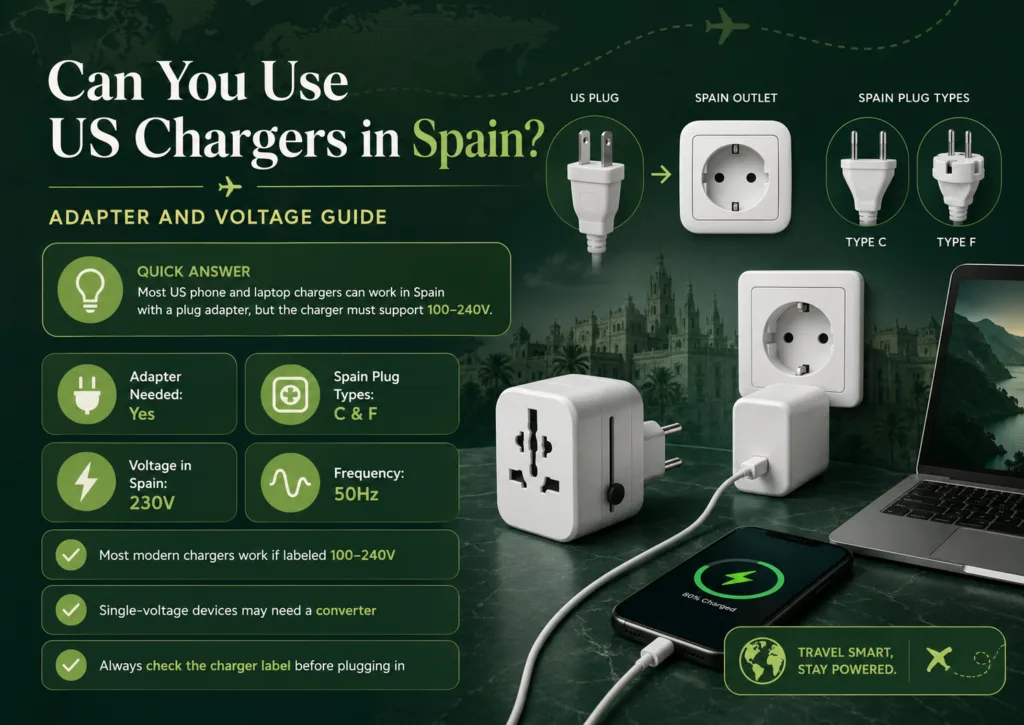
Plug Compatibility Visual
Yes, you can usually use US phone, laptop, camera, and USB chargers in Spain, but you will normally need a US to Spain plug adapter. Spain uses 230V power, so the main safety check is the charger label: if it says Input: 100–240V, you usually do not need a voltage converter.
US → Spain Charger Check
Use this quick decision box before packing chargers for Spain. It separates plug shape from voltage, because they are not the same issue.
United States
Common plug types: Type A and Type B
Spain
Common outlet types: Type C and Type F
Usually needed
US flat-pin plugs do not normally fit Spanish round-pin outlets.
Check the label
Spain uses 230V / 50Hz. US power is commonly 120V / 60Hz.
A plug adapter does not convert voltage. It only changes the plug shape so your US charger can fit a Spanish wall outlet.
Always check the device label before using high-power appliances abroad. A 120V-only device should not be plugged into a 230V outlet without the correct voltage equipment.
Quick Answer
For most US travelers, the right setup for Spain is simple: pack a Type C or Type F compatible travel adapter for your US plug, then check each charger’s voltage label.
| Item | US | Spain | What It Means |
|---|---|---|---|
| Plug shape | Type A / Type B | Type C / Type F | You will usually need a plug adapter. |
| Voltage | 120V | 230V | A converter may be needed for 120V-only devices. |
| Frequency | 60Hz | 50Hz | Most modern chargers handle this, but check the label. |
| Phone and laptop chargers | Often dual voltage | 230V outlet | Usually fine if labeled Input: 100–240V. |
| Hair tools | Often high-power | 230V outlet | Use extra caution; many 120V-only tools are not safe in Spain. |
Can US Chargers Fit Spanish Outlets?
No, not directly in most cases. US chargers usually have flat Type A or Type B plugs. Spain commonly uses round-pin Type C and Type F outlets. The plug shape is different, so a US charger usually needs a travel adapter for Spain.
The adapter you pack should accept your US plug and fit Spanish outlets. Many Europe travel adapters are made for Type C or Type F sockets, but check the adapter description before relying on it.
Other outlet types may appear in some places, especially in older buildings or special installations, but Type C and Type F are the main practical match for travelers going from the United States to Spain.
Do US Chargers Need a Voltage Converter in Spain?
Sometimes, but not usually for modern phone and laptop chargers. The key is the small printed label on the charger body or power brick.
If the label says Input: 100–240V, 50/60Hz, the charger is usually designed for international voltage ranges. In that case, you normally need only a plug adapter, not a voltage converter.
If the label says only Input: 120V, 120V AC, or a narrow range that does not include 230V, do not plug it into a Spanish outlet with only a plug adapter. A plug adapter will make it fit, but it will not reduce Spain’s 230V power.
A plug adapter does not convert voltage. This is the most important rule for US travelers in Spain. The adapter changes the shape of the plug. It does not make a 120V-only device safe on 230V power.
What “Input: 100–240V” Means
Input: 100–240V means the charger can usually accept power within that voltage range. Since Spain’s normal household voltage is 230V, a charger with this label is usually suitable for Spain when used with the correct plug adapter.
You may also see 50/60Hz on the charger. Spain commonly uses 50Hz, while the United States commonly uses 60Hz. If your charger label includes 50/60Hz, it is usually designed to handle both frequencies.
This label is common on many modern USB phone chargers, laptop power bricks, tablet chargers, camera battery chargers, and some medical-device power supplies. Still, do not guess. Check the label on the exact charger you plan to pack.
Phone Chargers in Spain
Most modern US phone chargers can be used in Spain with a plug adapter, as long as the charger label says Input: 100–240V. This includes many USB-A, USB-C, and multi-port wall chargers.
The phone itself is not usually the voltage concern. The charger is. If the charger accepts 100–240V, it can normally handle Spain’s 230V outlet power and deliver the correct low-voltage output to your phone.
Laptop Chargers in Spain
US laptop chargers are also commonly dual voltage. Look at the power brick, not just the laptop. If it says Input: 100–240V and 50/60Hz, you will usually need only a Spain plug adapter.
Some laptop power cords have a removable wall cable. If you already have a compatible European cable for the same power brick, that may work instead of a plug adapter. The power brick label still matters.
Camera, Tablet, Watch, and USB Chargers
Small electronics chargers are often low-risk for travel because many are designed for international voltage. That said, the safe habit is the same: check for Input: 100–240V before plugging in.
For USB-powered devices, a quality charger that supports Spain’s voltage range is usually enough. You still need the right plug shape for the wall outlet.
Hair Dryers, Curling Irons, and Other Heat Devices
Hair dryers, curling irons, flat irons, clothes steamers, kettles, and other heat-producing devices need much more caution. These are high-power appliances, and many US models are made only for 120V.
If a hair dryer or curling iron says only 120V, do not use it in Spain with a basic plug adapter. It may overheat, fail, trip protection, or become unsafe. Even when a voltage converter is available, high-wattage heat devices can be difficult to match correctly.
A dual-voltage travel hair tool may be a better option, but only if the label clearly includes Spain’s voltage range and the device is set correctly before use.
CPAP Machines and Medical Chargers
Many CPAP power supplies are dual voltage, but you should check the power brick carefully before travel. Look for Input: 100–240V and 50/60Hz. If the label includes that range, you will usually need a plug adapter for Spain.
For medical devices, do not rely on general travel advice alone. Check the manufacturer’s power supply label, bring the original power adapter when possible, and consider packing a backup plug adapter.
Adapter vs Converter for Spain
A plug adapter helps your US plug fit a Spanish outlet. A voltage converter changes voltage. They solve different problems.
| Item | What It Does | When You May Need It |
|---|---|---|
| Plug adapter | Changes plug shape only | Usually needed for US plugs in Spain |
| Voltage converter | Changes voltage | May be needed for 120V-only devices |
| Dual-voltage charger | Accepts a wide voltage range | Usually needs only a plug adapter |
What to Pack for Spain
- A US to Spain plug adapter that fits Type C or Type F outlets.
- Your original phone charger with a readable voltage label.
- Your laptop charger or power brick, checked for Input: 100–240V.
- A spare adapter if you need to charge several devices.
- A USB charger or power bank for travel days.
- No 120V-only hair dryer or curling iron unless you have a safe, correctly rated setup.
Common Mistakes to Avoid
Buying Only by Country Name
“Spain adapter” is useful, but check the actual plug compatibility. You need an adapter that accepts US Type A or Type B plugs and fits common Spanish Type C or Type F outlets.
Assuming Every Charger Is Dual Voltage
Many modern chargers are dual voltage, but not all devices are. The label is the safest answer. Look for Input: 100–240V, not just a brand name or device type.
Using a Plug Adapter as a Converter
This is the risky one. A plug adapter does not convert voltage. If your device is 120V-only, a basic adapter does not protect it from Spain’s 230V supply.
FAQ
Can I charge my US iPhone in Spain?
Usually yes. Check the wall charger label. If it says Input: 100–240V, you normally need only a US to Spain plug adapter.
Can I use my US laptop charger in Spain?
Usually yes, if the laptop power brick supports 100–240V and 50/60Hz. Most modern laptop chargers do, but you should verify the label.
Do I need a Type C or Type F adapter for Spain?
Spain commonly uses Type C and Type F outlets. A travel adapter made for European Type C/F outlets is usually the right choice for US plugs.
Will a US power strip work in Spain?
Be careful. Even if a plug adapter lets the strip fit, the devices connected to it must support Spain’s 230V power. Many US power strips are not meant for international voltage use.
Can I use a US hair dryer in Spain?
Only if it is clearly rated for Spain’s voltage or is a properly set dual-voltage travel model. Many US hair dryers are 120V-only and should not be used with just a plug adapter.
Does Spain use the same voltage as the US?
No. The US commonly uses 120V / 60Hz, while Spain commonly uses 230V / 50Hz. That is why checking the device label matters.