
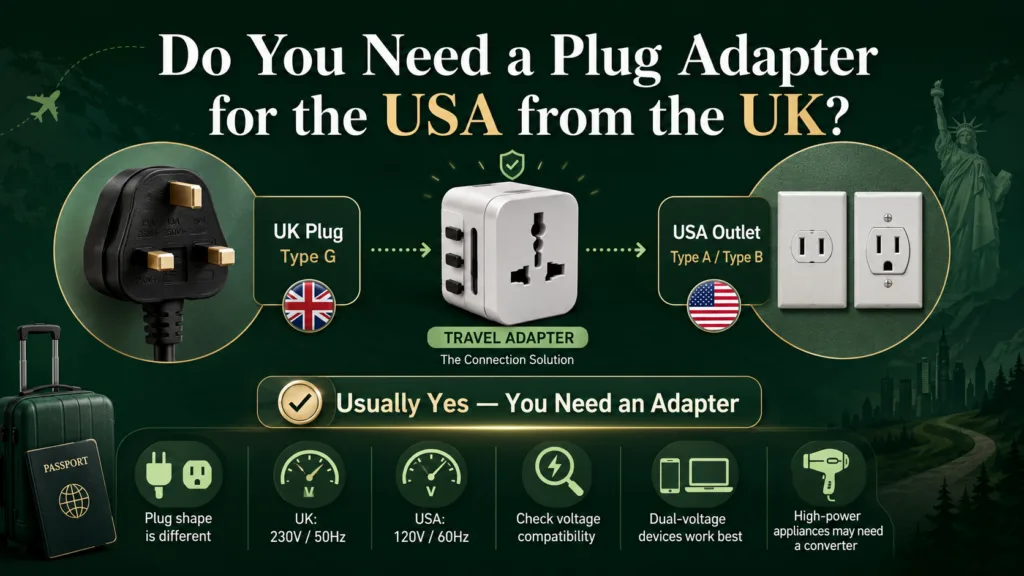
Yes. If you are traveling from the UK to the USA, you will usually need a UK to USA plug adapter. UK Type G plugs do not fit standard US Type A or Type B outlets. For phones and laptops, the adapter is often enough, but you must still check the charger label for Input: 100–240V.
Plug Compatibility Visual
Trip Match Summary
Use this quick UK to USA match to decide what to pack before your trip.
United Kingdom
Common plug: Type G
United States
Common outlets: Type A and Type B
Adapter usually needed
A UK Type G plug will not fit a US outlet directly.
UK: 230V / 50Hz
USA: 120V / 60Hz
Best match for most travelers: pack a UK-to-USA plug adapter for Type A/B outlets. For phone chargers, laptop chargers, camera chargers, and many USB chargers, check that the label says Input: 100–240V, 50/60Hz.
A plug adapter does not convert voltage. It only changes the plug shape so your UK plug can physically fit a US wall outlet.
UK to USA Device Checker
Choose a device type to see the usual adapter and converter advice for a UK traveler visiting the United States.
Always check the device label before plugging in high-power appliances abroad.
Quick Answer
For a trip from the UK to the USA, the simple answer is: yes, you usually need a plug adapter. UK plugs are Type G, while the USA commonly uses Type A and Type B outlets. The shape is different, so a UK plug will not go directly into a standard US wall socket.
The voltage is also different. The UK uses about 230V at 50Hz. The USA uses about 120V at 60Hz. That does not automatically mean every device needs a voltage converter. Many modern chargers are designed for international voltage ranges. The label matters more than the device category.
| Trip detail | What it means |
|---|---|
| Home country | United Kingdom |
| Destination country | United States |
| UK plug type | Type G |
| USA outlet type | Type A and Type B |
| Plug adapter needed? | Yes, usually. A UK Type G plug does not fit US outlets. |
| Voltage converter needed? | Only if your device is not compatible with 120V. Check the device label. |
| Best device advice | Phones and laptops are often fine with an adapter only. Heat devices need extra caution. |
Plug Compatibility from the UK to the USA
UK plugs and US outlets are not physically compatible. A UK plug has three rectangular pins in a triangular layout. A US outlet usually has two flat vertical slots, with a round grounding hole on grounded Type B outlets.
That means you should pack a UK to USA travel adapter. This is sometimes described as a Type G to Type A/B adapter. It lets the UK plug shape connect to a US socket shape.
Some hotel rooms, airports, cruise cabins, and newer buildings may have USB charging ports or international sockets, but you should not rely on that. A small plug adapter is still the safer item to pack.
AdapterMatch rule: match the trip first, then match the device. For this trip, the plug shape does not match, and the voltage is lower in the USA than in the UK.
Voltage Difference Between the UK and the USA
The UK supply is commonly 230V / 50Hz. The USA supply is commonly 120V / 60Hz. This matters because a plug adapter does not change 120V into 230V or 230V into 120V.
If a UK device is marked only for 220–240V, it may not work correctly on a standard US 120V outlet. Some devices may run weakly, heat poorly, charge slowly, or not turn on at all. A UK-only 230V hair dryer, kettle, or iron is usually not a good travel choice for the USA.
If the label says Input: 100–240V, the device is usually designed for both UK and US voltage ranges. Many phone chargers, laptop power bricks, tablet chargers, camera chargers, and USB-C chargers fall into this group. Still, check your exact label instead of guessing.
Do You Need a Plug Adapter?
Yes, in most cases. The adapter solves the physical plug problem. Your UK Type G plug needs to connect to a US Type A or Type B wall outlet.
For grounded UK plugs, choose an adapter that can accept a UK Type G plug and connect to a grounded US Type B outlet when grounding matters. For simple two-pin chargers or small USB adapters, a basic travel adapter may be enough, as long as the charger label supports the voltage.
- Pack a UK-to-USA plug adapter before you travel.
- Check whether your accommodation has Type A or Type B outlets.
- Do not assume USB ports will be available everywhere.
- Do not use a plug adapter as a voltage converter.
Do You Need a Voltage Converter?
You may need a voltage converter only if your device is not designed for US 120V power. The easiest way to check is to read the small print on the charger, plug, power brick, or appliance label.
If the Label Says Input: 100–240V
If the label says Input: 100–240V, 50/60Hz, your device is usually dual voltage or multi-voltage. For a UK to USA trip, you will usually need only the plug adapter.
This is common for:
- Phone chargers
- Laptop chargers
- Tablet chargers
- Camera battery chargers
- Many USB-C chargers
- Some CPAP power supplies
If the Label Says 220–240V Only
If the label says 220–240V only, the device is not made for standard US 120V power. A simple plug adapter will not fix that. You may need a suitable step-up voltage converter, but for high-power appliances this can be bulky, expensive, and easy to mismatch.
For heat appliances, it is often better to travel with a dual-voltage model or use a device designed for the USA.
High-power appliances such as hair dryers, curling irons, straighteners, kettles, travel irons, and some steamers need extra caution. Check both voltage and wattage before using them in the USA.
Phone Charger Guidance
Most modern UK phone chargers are designed for travel, but you should still check the label. Look for Input: 100–240V and 50/60Hz. If you see that range, your phone charger should usually work in the USA with a UK-to-USA plug adapter.
If you use a USB-C charger, check the writing on the charger itself, not just the cable. The cable does not decide voltage compatibility. The power adapter or charging brick does.
Laptop Charger Guidance
Most laptop chargers are also multi-voltage. The power brick often says something like Input: 100–240V, 50–60Hz. If it does, you usually only need a plug adapter for the US outlet.
Some laptop chargers use a detachable mains cable. In that case, you may be able to use a compatible US mains lead for the power brick, but a normal travel adapter is often simpler for short trips.
Hair Dryer and Curling Iron Warning
UK hair dryers, curling irons, straighteners, kettles, and travel irons are the devices that cause the most confusion on UK to USA trips. Many are made for 220–240V only. Since the USA commonly uses 120V, these devices may not heat properly or may not work as expected.
A voltage converter may sound like the answer, but heat devices draw a lot of power. The converter must be rated for the appliance wattage, and even then, performance can vary. For this route, a dual-voltage travel hair tool or a locally rated device is usually the safer and lighter option.
Electric Shavers, Toothbrushes, and Small Bathroom Devices
Electric shavers and toothbrush chargers vary. Some are dual voltage; some are not. Check the charger base or power supply label. If it says Input: 100–240V, a plug adapter is usually enough.
Be careful with bathroom shaver sockets and hotel sockets. They may have lower power limits and may not be suitable for all devices.
CPAP Machine Guidance for UK Travelers Visiting the USA
Many CPAP machines use external power supplies that support 100–240V, but you should check the power supply label before traveling. If it supports 100–240V and 50/60Hz, you will usually need only a UK-to-USA plug adapter.
Because a CPAP machine is a health-related device, bring the correct adapter, check your power brick before departure, and consider a backup plan for long flights, road trips, or remote stays. Do not wait until the first night in the USA to test your setup.
What 50Hz / 60Hz Means
The UK uses 50Hz power frequency, while the USA uses 60Hz. For many chargers and power supplies marked 50/60Hz, this is not a problem. For some motor-based devices, clocks, pumps, or older appliances, frequency can affect performance.
If your device label includes 50/60Hz, it is usually designed to handle both frequencies. If it lists only 50Hz, be more careful, especially with motor-based or timing-based equipment.
Device Advice Table
| Device | Plug adapter needed? | Voltage converter needed? | What to check |
|---|---|---|---|
| Phone charger | Usually yes | Usually no if dual voltage | Look for Input: 100–240V |
| Laptop charger | Usually yes | Usually no if the power brick supports 100–240V | Check the power brick label |
| Camera charger | Usually yes | Usually no if dual voltage | Check the charger label, not the battery |
| Hair dryer | Yes | May be needed if 220–240V only | Check voltage and wattage; high-power devices need caution |
| Curling iron or straightener | Yes | May be needed if 220–240V only | Use only if the label supports 120V or dual voltage |
| Electric shaver | Usually yes | Depends on the charger | Check for 100–240V and 50/60Hz |
| CPAP machine | Usually yes | Often no if the power supply supports 100–240V | Check the power supply label and bring a backup plan |
What to Pack for the USA from the UK
- UK to USA plug adapter for Type A/B outlets.
- Your original phone and laptop chargers.
- A USB charger that clearly says Input: 100–240V.
- A dual-voltage hair tool if you need one.
- A separate plan for high-power appliances instead of assuming a small adapter is enough.
- CPAP power supply, adapter, and backup charging plan if needed.
Common Mistakes to Avoid
Buying Only a Plug Adapter for a 230V-Only Appliance
This is the main UK to USA travel power mistake. The adapter changes the plug shape, but the US outlet still supplies about 120V. If the appliance needs 230V only, it may not work properly.
Checking the Cable Instead of the Charger
The useful voltage information is usually on the charger, power brick, or appliance body. A USB cable does not tell you whether the charger can handle US voltage.
Assuming Every Hotel Has International Outlets
Some hotels provide USB ports or mixed sockets, but many standard US rooms still use Type A/B outlets. Pack your own adapter.
Using High-Power Heat Devices Without Reading the Label
Hair dryers, straighteners, curling irons, kettles, and irons can draw a lot of power. For these, check voltage, frequency, and wattage before use.
FAQ
Can I use a UK plug in the USA?
No, not directly. UK Type G plugs do not fit standard US Type A or Type B outlets. You will usually need a UK-to-USA plug adapter.
Do I need a voltage converter for the USA from the UK?
It depends on the device. If the label says Input: 100–240V, you usually do not need a voltage converter. If it says 220–240V only, it may not work correctly on US 120V power.
Will my UK phone charger work in the USA?
Usually yes, if the charger label says Input: 100–240V, 50/60Hz. You will still need a plug adapter so the UK plug fits a US outlet.
Will my UK laptop charger work in the USA?
Most laptop chargers are multi-voltage, but check the power brick. If it supports 100–240V, a plug adapter is usually enough.
Can I use a UK hair dryer in the USA?
Be careful. Many UK hair dryers are 220–240V only, while the USA commonly uses 120V. A plug adapter alone will not convert voltage, and high-power heat devices need extra caution.
Are US outlets Type A or Type B?
Both are common. Type A has two flat slots, while Type B has two flat slots plus a round grounding hole. A UK Type G plug needs an adapter for either outlet type.