
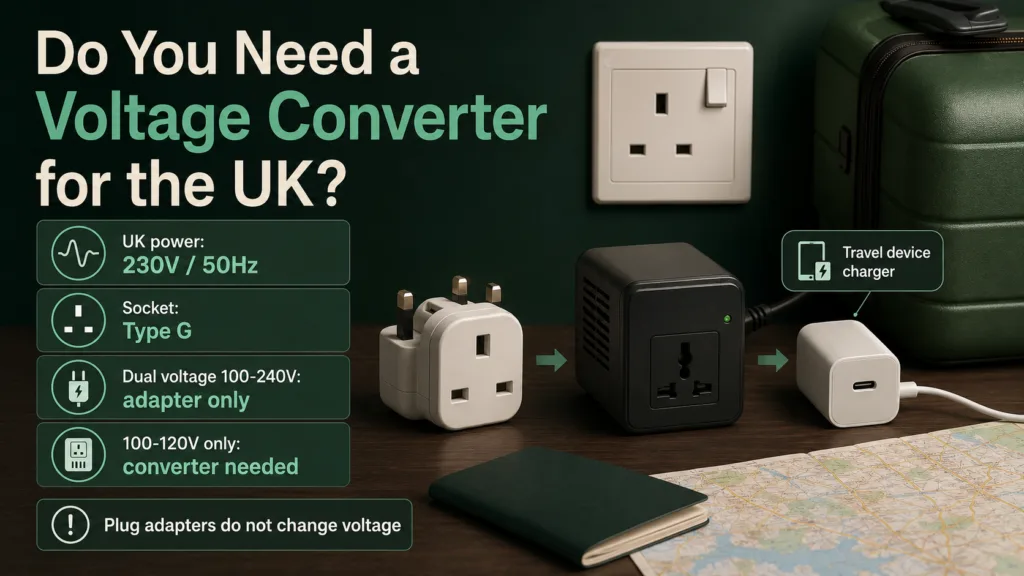
For the UK, you usually need a plug adapter if your device plug is not Type G. You only need a voltage converter if your device is not rated for the UK’s 230V supply. Phones, laptops, camera chargers, and many USB chargers usually work if the label says Input: 100–240V.
Adapter vs Converter Visual
Voltage Converter Checker for the UK
Use this quick check to sort the adapter question from the converter question. A plug adapter does not convert voltage.
United Kingdom
Common outlet: Type G
230V, 50Hz
Real outlet appearance can vary by building.
If your device says Input: 100–240V, a voltage converter is usually not needed.
Always check the device label before using high-power appliances abroad. Heat devices can draw more power than small chargers, and some are not suitable for converter use.
Quick Answer
| Question | Usual answer for the UK |
|---|---|
| Do UK outlets use the same plug as the US? | No. The UK normally uses Type G outlets, so US Type A/B plugs usually need a plug adapter. |
| Do you need a voltage converter? | Only if your device is not rated for 230V. Check the label before plugging it in. |
| Are phones usually okay? | Usually yes, if the charger says Input: 100–240V. |
| Are laptops usually okay? | Usually yes, if the power brick says Input: 100–240V. |
| Are hair dryers and curling irons okay? | Only if they are dual voltage or made for 230V. Single-voltage 120V heat devices should not be plugged directly into UK power. |
| Does frequency matter? | The UK uses 50Hz. Most chargers handle this, but motor-based or timing-based devices may need extra care. |
What a Voltage Converter Does
A voltage converter changes electrical voltage so a device can run on a supply it was not designed for. For the UK, the common travel issue is a device from a 110V or 120V country being used on UK 230V power.
If a device is marked only for 110V, 120V, or 125V, it is usually not safe to plug directly into a UK outlet. A plug adapter may let the plug fit, but it will not make the electricity suitable for the device.
Some converters are meant for short use with travel appliances. Others are transformers for lower-power electronics. Converter suitability depends on wattage, device type, and use time. Heat devices such as hair dryers and irons can be difficult because they draw a lot of power.
What a Plug Adapter Does
A plug adapter changes the shape of your plug so it can fit the wall outlet. For the UK, that usually means adapting your device plug to a Type G socket.
A plug adapter does not convert voltage. This is the most common travel power mistake. If your device is not compatible with 230V power, the right plug shape alone is not enough.
Adapter result: If your plug is not Type G, you will usually need a UK plug adapter.
Converter result: If your device label does not include 230V or 100–240V, a voltage converter may be needed.
How to Read the Device Label
Before packing a converter, look for the input rating printed on the charger, power brick, device body, or plug. The wording is usually near “Input.”
If the Label Says Input: 100–240V
If the label says Input: 100–240V, the device is usually designed for international voltage ranges. In the UK, you would normally need a Type G plug adapter, not a voltage converter.
This is common on phone chargers, laptop chargers, tablet chargers, camera chargers, and many USB power adapters.
If the Label Says 110V or 120V Only
If the label lists only 110V, 115V, 120V, or 125V, treat it as a single-voltage device. Do not plug it directly into UK power. You may need a voltage converter, or it may be better to use a UK-compatible replacement device.
If the Label Says 220V, 230V, or 240V
If the device is rated for 220V, 230V, or 240V, it is usually compatible with UK voltage. You may still need a plug adapter if the plug shape is not Type G.
If You Cannot Find the Label
If the label is missing or unreadable, do not guess with high-power devices. For small chargers, check the original power adapter or manufacturer documentation. For heat appliances, the safer travel choice is often a dual-voltage model or a UK-rated device.
Phones, Tablets, and USB Chargers in the UK
Most modern phone and tablet chargers are dual voltage. If your charger says Input: 100–240V, 50/60Hz, it can usually accept UK power. You still need the right plug shape for the wall outlet.
For most travelers, the simple answer is: bring a UK Type G plug adapter, check the charger label, and use the original charger or a well-rated USB charger. Do not rely on plug shape alone.
Laptops in the UK
Laptop chargers commonly support 100–240V. The label is usually on the power brick. If it says Input: 100–240V, the laptop charger normally works in the UK with a plug adapter.
If the laptop uses a detachable power cable, another option is to use a UK-compatible cable for the charger brick. The power brick still needs to support UK voltage.
Hair Dryers, Curling Irons, Kettles, and Irons
Heat appliances need more caution. A hair dryer, curling iron, hair straightener, travel kettle, or clothes iron can draw much more power than a phone charger. If it is a single-voltage 120V appliance, do not plug it directly into a UK outlet.
Some travel hair tools have a voltage switch or dual-voltage label. If the label says 110–240V or 100–240V, check whether the device must be manually switched to the correct voltage before use. If it only says 120V, it is not ready for UK power without a suitable converter.
High-power appliances are the devices most likely to cause problems when travelers confuse adapters with converters.
CPAP Machines and Medical Travel Devices
Many CPAP machines use external power supplies that support 100–240V, but you should verify the label on your own machine and power brick. If it says Input: 100–240V, a UK plug adapter is usually the main item needed.
For medical devices, also check battery needs, airline rules, and the device manual before travel. If the machine is single voltage or the label is unclear, confirm compatibility before relying on it abroad.
What 50Hz / 60Hz Means for UK Travel
The UK uses 50Hz frequency. Many chargers are marked 50/60Hz, which means they are normally designed for both common frequency ranges.
Frequency is usually not a problem for phone and laptop chargers. It can matter more for some clocks, motors, pumps, and older appliances. If a device depends on motor speed or timing, check the label and manual before use.
When a Plug Adapter Is Enough
A plug adapter is usually enough for the UK when all three points are true:
- Your device label says Input: 100–240V or includes 230V.
- The device supports 50Hz or 50/60Hz.
- You have a plug adapter that fits UK Type G outlets.
This is the common result for phones, laptops, tablets, USB chargers, camera chargers, and many electric shavers.
When a Voltage Converter May Be Needed
A voltage converter may be needed if the device is single voltage and rated only for a lower-voltage country, such as 110V or 120V. This is common with some older appliances, grooming tools, and heat devices.
Even then, a converter is not always the best travel answer. High-wattage appliances may exceed the converter’s rating or may not work well for long use. For UK travel, many visitors choose to pack dual-voltage devices or use a local appliance instead.
Common UK Travel Power Mistakes
- Buying only a plug adapter and assuming it changes voltage.
- Plugging a 120V-only hair dryer into a 230V UK outlet.
- Checking the device brand but not the actual input label.
- Forgetting that the charger and the device can have different ratings.
- Using a converter with a device that draws more watts than the converter can handle.
- Ignoring 50Hz / 60Hz information on motor-based devices.
What to Pack for the UK
- A UK Type G plug adapter for your chargers and small electronics.
- Phone and laptop chargers labeled Input: 100–240V.
- A dual-voltage travel hair tool if you need one.
- A printed or saved note of your CPAP or medical device power rating, if relevant.
- A short charging plan for airports, hotels, and long travel days.
For most modern chargers, the UK decision is simple: match the plug shape with a Type G adapter, then confirm the label says Input: 100–240V. For heat devices, slow down and check the voltage rating carefully.
FAQ
Do I need a voltage converter for the UK from the US?
Only if your device is rated for 110V or 120V only. If your charger says Input: 100–240V, you usually need a UK plug adapter, not a voltage converter.
Can I charge my phone in the UK without a voltage converter?
Usually yes. Most phone chargers support 100–240V. Check the charger label, then use a Type G plug adapter for the UK outlet.
Can I use my laptop charger in the UK?
Usually yes, if the power brick says Input: 100–240V. You will still need a plug adapter or UK-compatible power cable.
Can I use a US hair dryer in the UK?
Only if it is dual voltage or rated for 230V. A 120V-only hair dryer should not be plugged directly into a UK outlet. A plug adapter alone is not enough.
Is a universal adapter enough for the UK?
A universal adapter may solve the plug shape problem if it supports UK Type G outlets. It does not convert voltage, so you still need to check the device label.
Does the UK use 50Hz or 60Hz?
The UK uses 50Hz. Most modern chargers support 50/60Hz, but some motor-based or timing-based devices may need closer checking.